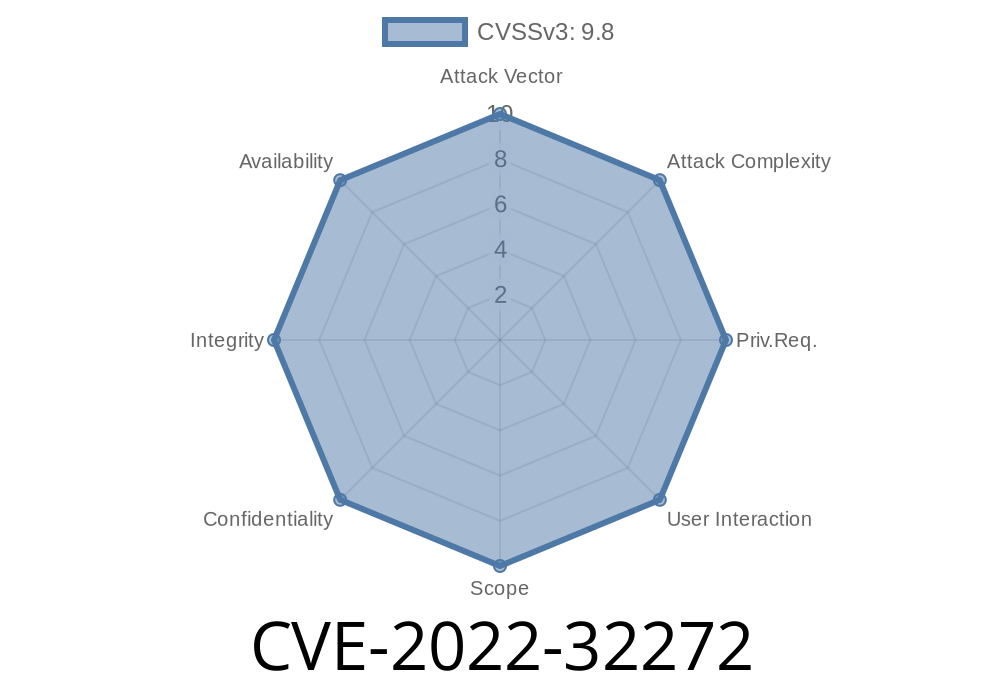
Security software is supposed to keep intruders out, but what if a flaw turns defenders into unintentional enablers? That’s exactly what happened with the vulnerability identified as CVE-2022-32272. This issue affected several widely deployed OPSWAT products—MetaDefender Core, MetaDefender ICAP, and MetaDefender Email Gateway Security—allowing attackers to escalate their privileges, potentially gaining unauthorized control over critical environments.
In this post, we break down what went wrong, how it could be exploited, and what you should do if you use these tools.
What is CVE-2022-32272?
CVE-2022-32272 is a security vulnerability caused by incorrect access control in specific OPSWAT products:
MetaDefender Email Gateway Security (before version 5.6.1)
Due to improper controls in the backend authentication and authorization logic, users could potentially escalate their privileges, performing tasks reserved for admins.
Why Is This Serious?
Privilege escalation means a user who is supposed to have limited access can perform critical actions—like changing configurations, disabling security engines, or, worse, executing restricted commands. This could lead to:
Planting backdoors in your system
In short, a low-privilege user could pwn your defenses from the inside.
The Core Mistake: Insecure Access Control
In these products, user roles are supposed to limit their capabilities. For example, only admin users should POST or DELETE critical resources.
However, researchers discovered that role checking was either missing or insufficient on several API endpoints. Even regular authenticated users, or sometimes unauthenticated network actors, could call sensitive administrative endpoints.
The most dangerous pattern looked like this (in pseudo-code)
def api_update_config(request):
    # BAD: No role checking!
    config_id = request.GET['id']
    new_value = request.POST['value']
    database.update_config(config_id, new_value)
    return Response(code=200, message="Config updated.")
A proper implementation should have
def api_update_config(request):
    if not request.user.role == 'admin':
        return Response(code=403, message="Access denied.")

    config_id = request.GET['id']
    new_value = request.POST['value']
    database.update_config(config_id, new_value)
    return Response(code=200, message="Config updated.")
Without this check, anyone authenticated (and possibly even unauthenticated, if their endpoint had a bug) could tamper with critical configuration.
Crafting an Exploit: How Attackers Could Abuse This
Imagine a scenario where a normal user logs into MetaDefender Core. Normally, they could only scan files or check logs. But due to this flaw, they could craft a malicious HTTP request:
curl -X POST \
     -H "Authorization: Bearer USER_TOKEN" \
     -d "value=new_admin_email@example.com" \
     "https://YOUR_CORE_SERVER/api/admin/settings/update?id=admin_email";
Or, in some known cases, even escalate to admin with a specially crafted request
POST /api/users/1/role
Authorization: Bearer NORMAL_USER_TOKEN
Content-Type: application/json

{
  "role": "admin"
}
If the backend doesn't check the role before allowing this, bam! the user is now an admin.
How Was It Fixed?
After receiving the report, OPSWAT issued updates that added or strengthened access control checks for all sensitive API endpoints. Now only properly authorized users can perform dangerous actions.
OPSWAT Advisory & Patch Info:
- OPSWAT Security Advisories
- MetaDefender Core Release Notes
- MetaDefender ICAP Release Notes
- MetaDefender Email Gateway Security Release Notes
Recommendations
- Update immediately: If you use any of these products in production, patch to a secure version as soon as possible.
Audit logs: Check for unexpected config changes or privilege escalations in recent logs.
- Limit network access: Whenever possible, restrict who can access these management interfaces or APIs by IP and firewall rules.
References & Further Reading
- NIST NVD - CVE-2022-32272
- OPSWAT official announcement for MetaDefender Core 5.1.2
- HackerOne write-up on similar access control flaws
Conclusion
CVE-2022-32272 is a classic example of how missing access control is a simple yet devastating vulnerability. Security software developers must never trust the client’s role—always enforce strict checks on sensitive actions, and test APIs for privilege boundaries.
If you’re an OPSWAT user: update now, check access logs, and stay secure.
Timeline
Published on: 06/09/2022 15:15:00 UTC
Last modified on: 06/21/2022 14:15:00 UTC