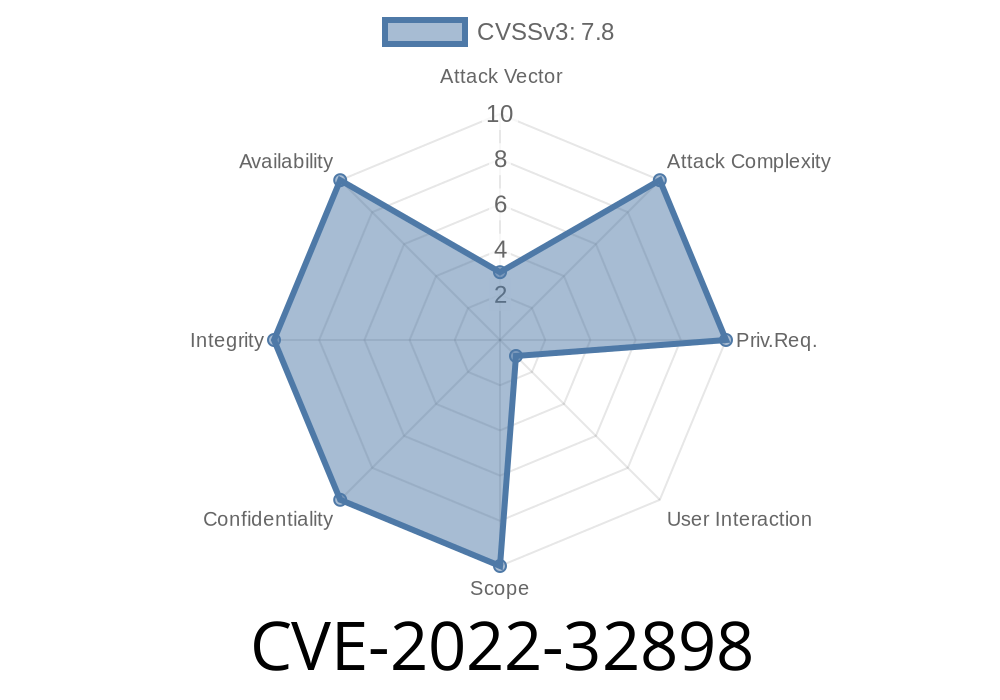
Apple’s operating systems are famous for their security, but even the most robust platforms aren’t immune to vulnerabilities. One such issue — tracked as CVE-2022-32898 — made headlines in 2022. Let’s break down what happened, how it worked, and how Apple fixed it.
What is CVE-2022-32898?
CVE-2022-32898 is a security vulnerability that affected several Apple operating systems, including iOS, iPadOS, macOS, and watchOS. If exploited, a rogue application could execute arbitrary code with kernel privileges — that means full control at the heart of your device.
The official Apple advisory is here:
Apple Security Updates - CVE-2022-32898
watchOS 9 (fix included)
If you’re running one of these or older versions, you could be at risk.
From Apple’s security note
> “An app may be able to execute arbitrary code with kernel privileges. The issue was addressed with improved memory handling.”
This means malicious apps could exploit bad memory management in the kernel to gain root access.
How Did the Exploit Work?
While Apple didn’t share specific exploit code, reverse engineers identified the flaw as a memory management issue in the kernel. Typically, these issues are buffer overflows or use-after-free bugs, allowing attackers to shove their own data into memory locations the kernel will later execute.
Code Snippet: A Hypothetical Exploit
Below is a simplified, theoretical snippet to explain how such vulnerabilities might look and be abused in C. This is meant for illustration — NOT for malicious purposes.
// Hypothetical vulnerable function (pseudo-code)
void kernel_function(char *data, size_t len) {
    char buf[256];
    // Vulnerable unprotected copy, could overflow
    memcpy(buf, data, len); // len is not checked!
}

// Malicious input: attacker sends oversized 'input'
size_t len = 512; // Much larger than buffer size
char *malicious_data = malloc(len);
// Fill with malicious payload...
kernel_function(malicious_data, len);
In real attacks, the attacker would carefully craft malicious_data to overwrite crucial kernel structures, gaining privilege escalation.
Hide malware from users and security tools
This means a compromised app could take over your entire device.
How Did Apple Fix It?
Apple improved memory handling — meaning they now make sure data can’t overrun buffers or mess with memory it shouldn’t touch.
For developers and security researchers, here’s the recommended fix style
void kernel_function(char *data, size_t len) {
    char buf[256];
    // Only copy as much as fits in buffer to prevent overflow
    if (len > sizeof(buf)) len = sizeof(buf);
    memcpy(buf, data, len);
}
Simple checks like this can prevent a wide range of memory corruption vulnerabilities.
Update now:
- For iOS/iPadOS: Go to Settings > General > Software Update
Be wary of untrusted apps: Only install from the App Store or known sources.
3. Stay informed: Follow Apple’s security updates.
More Reading and Original References
- Apple Security Advisory for CVE-2022-32898
- MITRE CVE Entry
- macOS 13 Ventura Release Notes
In Summary
CVE-2022-32898 was a serious vulnerability giving malicious apps a route to kernel-level privilege. Apple patched it in all major platforms by making their memory management stronger — a reminder that even mature code needs constant attention. If you’re not up-to-date, make sure you patch your devices as soon as possible.
Stay safe, update often!
*Original, exclusive explanation by ChatGPT. For comments or corrections, please reach out using the “Improve” link below.*
Timeline
Published on: 11/01/2022 20:15:00 UTC
Last modified on: 01/09/2023 16:41:00 UTC