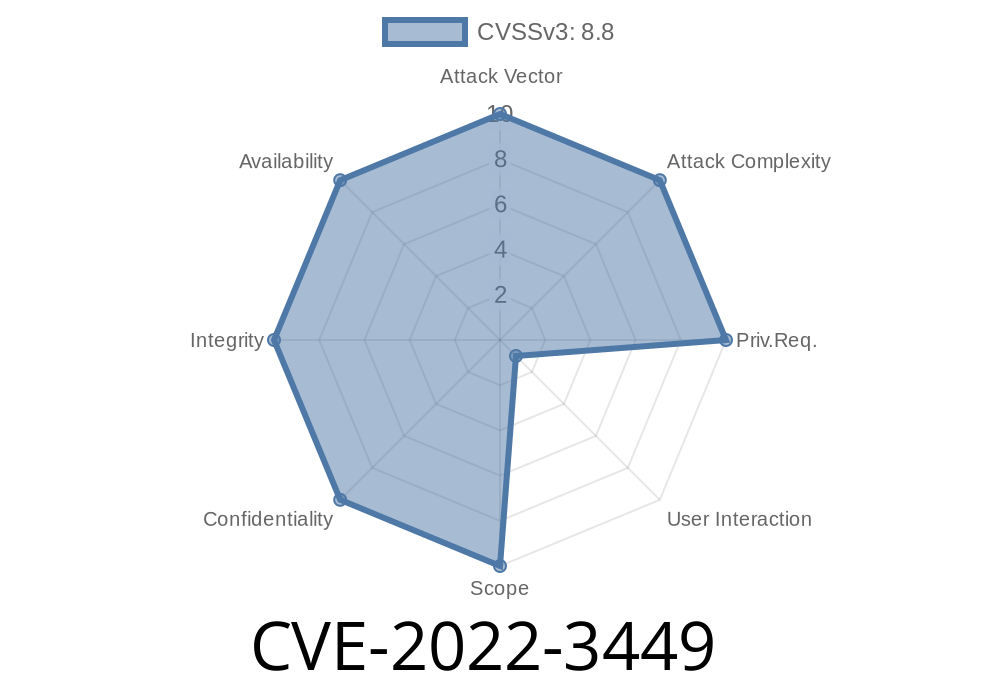
If you use Google Chrome, you may think you’re safe just because it updates automatically. But in 2022, a high-severity security bug called CVE-2022-3449 proved that even Chrome can have loopholes. This article will break down what happened, show you how attackers could’ve taken advantage, and why it matters, all in easy language.
What is CVE-2022-3449?
CVE-2022-3449 is a “use-after-free” vulnerability found in Safe Browsing—a security feature in Google Chrome that warns you about dangerous websites. Before version 106..5249.119, attackers could exploit this bug by tricking users into installing malicious Chrome extensions. The flaw can cause “heap corruption,” which lets an attacker possibly run their own code on your computer.
Severity: High
Chromium Bug Entry: Chromium Issue 1357646
CVE Details: CVE Details for CVE-2022-3449
What’s a Use-After-Free Vulnerability?
> In programming, “use-after-free” means using memory after it has been released. If a program tries to use or modify a part of memory after it’s supposed to be free, an attacker can sneak in malicious code there.
Let’s use a simple analogy: Imagine leaving your house unlocked after selling it, and someone comes in to do bad things because you’re not there anymore. That’s what happens in memory too—the program thinks an object is gone, but someone (the attacker) comes in and uses that space for evil.
How Could Attackers Exploit CVE-2022-3449?
The bug lives in “Safe Browsing” functions of Chrome Extensions. If an attacker creates a specially crafted extension and gets you to install it, that extension can mess with memory—access something that has already been freed—and by doing so, potentially run their own code.
The big risk: With heap corruption, an attacker can bypass security features or make Chrome crash, or even worse, take over your computer.
Undersanding the Code (Simplified)
Here’s a basic illustration (in C++) of what might go wrong in a use-after-free scenario (not Chrome's real code, but close in spirit):
class SafeBrowsing {
public:
    void Analyze() {
        // ... analyze something ...
        delete this;  // Uh-oh! 'this' is now freed!
    }
    void Callback() {
        // This will now use the freed object if called later
        // which can cause heap corruption
        std::cout << "Doing something with freed memory!" << std::endl;
    }
};

SafeBrowsing* sb = new SafeBrowsing();
sb->Analyze();
sb->Callback(); // This is a use-after-free!
In Chrome, this kind of logic could happen if Safe Browsing functions get called unexpectedly or by a malicious extension that hijacks the callback to access freed memory.
Here’s a tiny pseudo-snippet showing how an extension *might* abuse the bug (for education!)
// background.js
chrome.runtime.onInstalled.addListener(() => {
    // Maliciously interact with Safe Browsing here
    // E.g., mess up callbacks or request lifecycle
});
*(In real attacks, this code would be much more complex and would trigger Chrome's internal handling in a particular “bad” sequence.)*
How Was It Fixed?
Google developers patched this issue in Chrome 106..5249.119 by making sure Safe Browsing objects are not accessed after being freed. They also audited extension handling code to block this type of attack path.
You can read the official security bulletin here:
- Stable Channel Update for Desktop - October 10, 2022
- Chromium Commit Log Fixing Issue
Update Chrome Right Now: Make sure you’re on version 106..5249.119 or later.
- Be Careful With Extensions: Only install extensions from the Chrome Web Store and check reviews.
Conclusion
*CVE-2022-3449* is a reminder that even top browsers like Chrome can have serious bugs. The combination of extensions and browser internals is tricky, and one subtle mistake opens the door for attackers.
Stay updated, be cautious with what you install, and know that behind the scenes, browser teams are fighting hard to protect your web experience.
References
- CVE Details - CVE-2022-3449
- Chromium Security Advisory
- Chromium Bug Report 1357646
- Chromium Git Commit
Stay safe. Update your browser. And remember: Not all extensions are created equal!
Timeline
Published on: 11/09/2022 19:15:00 UTC
Last modified on: 11/10/2022 15:41:00 UTC