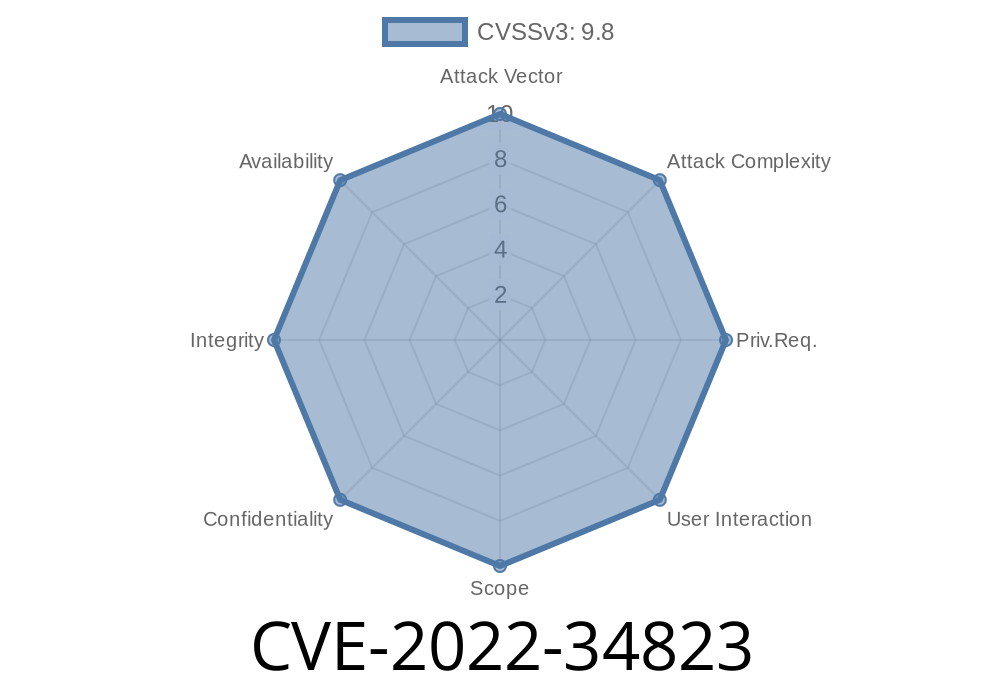
In June 2022, a critical vulnerability—CVE-2022-34823—was discovered in CLUSTERPRO X 5. and EXPRESSCLUSTER X 5. series for Windows by NEC. This buffer overflow flaw can allow a remote, unauthenticated attacker to overwrite files on the server’s file system, potentially leading to arbitrary code execution. These products are widely used for server clustering and high-availability purposes. Let’s examine what this vulnerability is, how it works, and what could happen if it’s exploited.
EXPRESSCLUSTER X 5. SingleServerSafe (for Windows and earlier)
- Impact: Allows remote unauthenticated attackers to overwrite files and possibly execute arbitrary code.
Original Advisory:
- NEC Advisory (Japanese)
- JPCERT/CC JVN#76784624
Background on the Products
CLUSTERPRO X and EXPRESSCLUSTER X are middleware used to build reliable servers that keep services running through clustering. These are essential in financial institutions, hospitals, and other environments that cannot afford downtime.
The Vulnerable Component
The vulnerability lies in how these products handle certain network requests. An unauthenticated attacker can send a specially crafted packet that overflows a buffer in the server process running with high privileges (often SYSTEM), causing it to overwrite critical files.
Technical Details
The root cause is improper input validation or lack of boundary checking when copying user-provided data into a fixed-size buffer. Here’s a simplified example of what such vulnerable code might look like (not the vendor’s actual code):
// Hypothetical vulnerable function in the clustering software
void handle_request(char *user_input) {
    char buffer[256];
    // Vulnerable: no bounds checking!
    strcpy(buffer, user_input);
    // process the buffer...
}
Here, if user_input is longer than 256 characters, the extra data will overwrite adjacent memory. In the context of the server, this could overwrite function pointers, return addresses, or variables such as file paths used for writing.
Real-World Exploit Scenario
1. Attacker sends a malicious request to the server, targeting the vulnerable service/port.
The attacker overwrites an important file (e.g., system executable or configuration).
4. On the next restart, or by tricking the system or an administrator to do so, the attacker’s payload runs as SYSTEM.
Proof-of-Concept (PoC) Attack Steps
While no public PoC is provided by the vendor, based on the vulnerability type, a PoC might follow logic like this (demonstration in pseudo-Python):
import socket

target_ip = "192.168.1.100"
target_port = 12345  # Example port where service is listening

# Construct a payload to overflow the buffer and overwrite a file pointer
payload = b"A" * 300  # Overflow by sending 300 bytes
# Possible to include shellcode/payload after the overflow

s = socket.socket(socket.AF_INET, socket.SOCK_STREAM)
s.connect((target_ip, target_port))
s.send(payload)
s.close()
*Note: The real values, protocol details, and offsets should be reverse-engineered from the binary, which is illegal to attempt on production servers or without consent.*
Remote Code Execution: Attacker can run arbitrary code as SYSTEM, the highest privilege level.
- File Overwrite: Critical OS or application files can be corrupted or replaced, causing system instability or enabling further compromise.
Mitigation
Patch: NEC released a patch for this issue. If you run any affected version, IMMEDIATELY upgrade to the fixed version:
- Download and Support Information (Japanese)
Check for the patch specific to your edition.
Workaround:
If you cannot apply the patch right away
- Restrict network access to the affected service using firewalls (block at the port/service level).
References
- NEC Security Vulnerability Information (Japanese)
- Japan Vulnerability Notes (JVN)
- ExpressCluster Official Support
Conclusion
CVE-2022-34823 is a serious buffer overflow vulnerability in several NEC clustering products for Windows. If exploited, it can give attackers remote code execution without even needing a password. If you use these products in your organization—especially in high-availability or production environments—apply available patches today and restrict network access until you do. This threat is a reminder: always keep your critical infrastructure up to date and safe from public exposure.
*For responsible exploit research, always get written permission before testing systems. Stay secure!*
Timeline
Published on: 11/08/2022 22:15:00 UTC
Last modified on: 11/09/2022 16:30:00 UTC