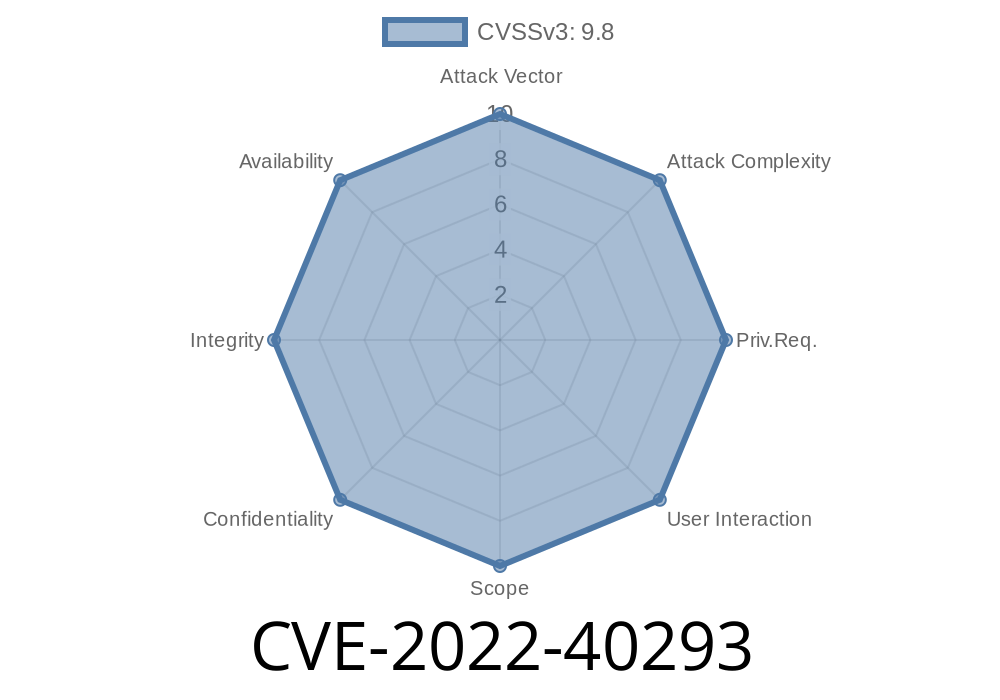
In today’s digital world, the security of our web applications is more important than ever. Sometimes, however, a small mistake can open the door to serious threats like account hijacking. One such threat was discovered as CVE-2022-40293: a session fixation vulnerability that put the security of users at risk. Let’s break down what happened, how the exploit works with some easy-to-understand code snippets, and what anyone can do to prevent such issues.
What is Session Fixation?
Before getting into the details, let’s simplify the jargon.
A session is a way for a web application to remember who you are as you click from page to page. It uses a *session ID,* often stored in a cookie, to keep track of your activity. When you log in, the session ID gets tied to your account.
Session fixation is a vulnerability where an attacker tricks a user into using a session ID that the attacker knows. If the application isn’t careful, the attacker can later use that same session ID to access the victim’s account.
How Did CVE-2022-40293 Happen?
In the affected application (the exact platform wasn’t officially disclosed in most references), the server didn’t change (or "regenerate") the session ID after a user logged in. That looks innocent, but it means an attacker could give a user a pre-set session ID, wait for them to log in, then use that same session ID to hijack the user’s account.
A Simple Analogy
Imagine you get a ticket with a number at a deli counter. You go away, and someone steals your ticket. If the deli worker only cares about the number and not who’s holding the ticket, someone else can claim your spot and get your lunch!
The attacker sends a link to the victim:
http://victimsite.com?sessionID=ABC123
Below is a simplified code example
# Pseudocode representing the flawed authentication flow

# Attacker gets a session ID from the target site
attacker_session_id = "ABC123"

# Attacker sends this session ID to the victim
# (e.g., through a phishing email with a special link or by setting it via XSS)

# Victim clicks the link, and their browser uses SESSIONID=ABC123

# Victim logs into the application
if user_enters_credentials:
    # BAD: Application does NOT change session ID here (vulnerable!)
    session_id = get_cookie("SESSIONID")  # Still "ABC123"
    user_is_now_authenticated(session_id)

# Attacker now uses SESSIONID=ABC123 to log in as the victim
Original References
- NIST NVD - CVE-2022-40293
- OWASP: Session Fixation
- Common fixations patterns
Making destructive changes that the victim can’t undo
This threat is real and easy to exploit, especially if a user can be lured to a malicious site or link.
How Should Applications Defend Against This?
The fix is straightforward: regenerate the session ID after login. That way, any old session ID used before authentication becomes useless—just like giving fresh, unique tickets after you order at the deli.
Here’s what the safe login flow might look like
# After credentials are verified
if user_enters_credentials and credentials_correct:
    # GOOD: Regenerate the session ID
    session_id = generate_new_session_id()
    set_cookie("SESSIONID", session_id)
    user_is_now_authenticated(session_id)
Frameworks like Django and Rails do this by default, but custom applications and legacy sites might not.
Conclusion
CVE-2022-40293 is a classic lesson about the dangers of session fixation. It shows how a simple oversight—in this case, not regenerating session IDs after login—can let attackers hijack accounts with little effort.
Web developers should double-check their session management logic. Users should be alert for suspicious activity and links. Together, we can close the doors that might let attackers in.
For further reading
- OWASP Top 10: Broken Authentication
- NIST Guide to Session Management
Timeline
Published on: 10/31/2022 21:15:00 UTC
Last modified on: 11/04/2022 02:15:00 UTC