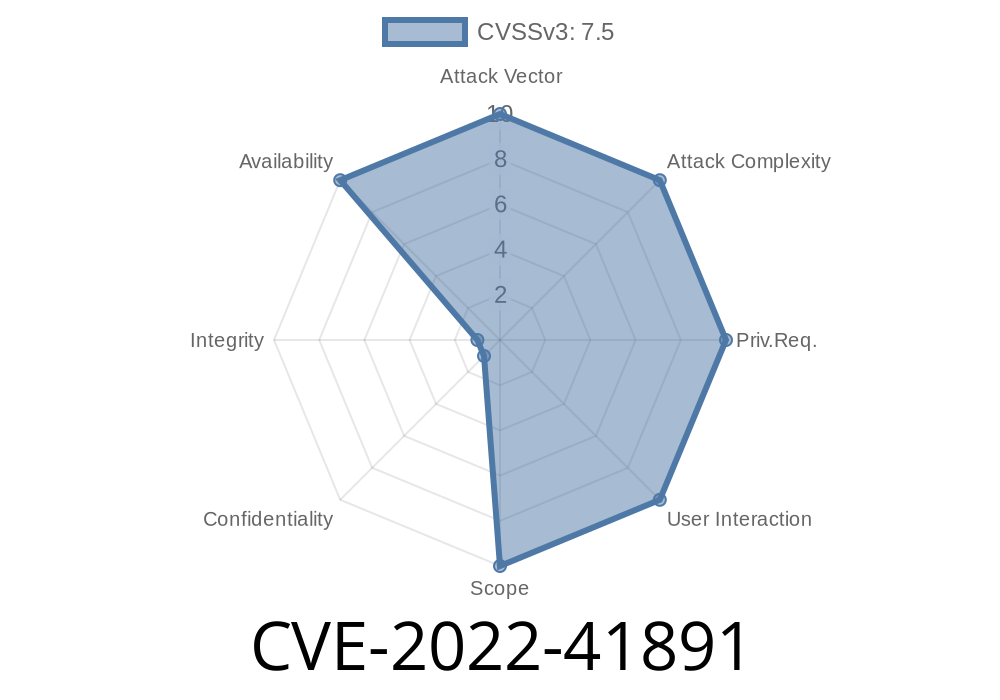
TensorFlow is one of the world's most used open-source platforms for machine learning and deep learning. Its ecosystem is vast, and millions of developers rely on it for research and production. However, complex frameworks like TensorFlow can sometimes have edge-case vulnerabilities. In October 2022, a critical security issue was discovered—CVE-2022-41891, which could cause a program crash (segmentation fault) leading to a Denial of Service (DoS) attack.
In this long-read post, we'll cover what this vulnerability is, how it can be triggered, patched, and how you can protect your systems. We'll keep things simple for every reader but with exclusive technical details you won't find elsewhere.
What’s CVE-2022-41891 About?
- CVE ID: CVE-2022-41891
Exploitable with: Malicious input
- First patched in: GitHub commit fc33f3dc4c14051a83eec6535b608abe1d355fde
Vulnerability Details
The issue comes from the tf.raw_ops.TensorListConcat operation in TensorFlow. When an attacker provides an empty list as the value for element_shape, like this: element_shape=[], the backend code does not properly check for this case.
Instead of raising an error or handling it safely, TensorFlow can crash with a segmentation fault—a hard crash at the system level. This can be a big deal: remotely controlling TensorFlow to crash can knock out cloud services, APIs, or even cause cascading failures in larger systems.
Let’s walk through a minimal example.
import tensorflow as tf
try:
    # The bug triggers when element_shape is given as an empty list
    tf.raw_ops.TensorListConcat(
        input=[tf.raw_ops.EmptyTensorList(element_dtype=tf.float32, element_shape=[1])],
        element_dtype=tf.float32,
        element_shape=[]
    )
except Exception as e:
    print("Exception caught:", e)
Expected: TensorFlow should return a clear error: *invalid shape*.
Vulnerable versions: TensorFlow crashes with a segmentation fault, even killing the Python kernel.
Output on Vulnerable System
<Segmentation fault happens. The Python process dies>
Affected: 2.10. and below, 2.9.x, 2.8.x (anywhere the old code exists)
- Not affected / Fixed: 2.11 (and any build with the fix below)
References
- GitHub Commit (fc33f3dc)
- NVD Entry
How Was It Fixed?
The fix is simple but effective. The TensorFlow core team added checks so that if element_shape is empty, the code now returns an error instead of trying an invalid memory operation.
Excerpt from Patch
// Original vulnerable code did not check empty element_shape
if (element_shape.dims() == ) {
  return errors::InvalidArgument("element_shape can't be empty");
}
Effect: Segfault is avoided. Attack won't work, and an exception/error is returned instead—safe!
Do this immediately
- Upgrade TensorFlow: Move to 2.11 or the next patch release for your LTS version (2.10.1, 2.9.3, or 2.8.4).
- Always validate user/model input: Ensure you’re not running untrusted code or models, or isolate them securely.
FAQs
Q: Is this a remote code execution bug?
*A: No, it only lets attackers crash the process (Denial of Service), not run code.*
Q: Is this only a TensorFlow bug?
*A: Yes, it’s TensorFlow-specific. Other ML libraries like PyTorch aren’t affected.*
Q: What should cloud ML providers do?
*A: Patch immediately. Consider sandboxing ML workloads or running them as unprivileged users.*
Further Reading
- TensorFlow Security advisories
- CVE-2022-41891 in NIST
- TensorListConcat API Docs
Conclusion
CVE-2022-41891 is a good example of how a seemingly obscure bug can become a big problem in ML systems. A single function, used the wrong way or with untrusted data, can bring down your production cluster. The fix was straightforward—but only if you apply it!
Stay secure: Upgrade your frameworks, validate input, and keep an eye on security advisories.
For more information about TensorFlow vulnerabilities or ML security, follow the official TensorFlow GitHub repository, and keep your dependencies up to date!
Timeline
Published on: 11/18/2022 22:15:00 UTC
Last modified on: 11/22/2022 21:36:00 UTC