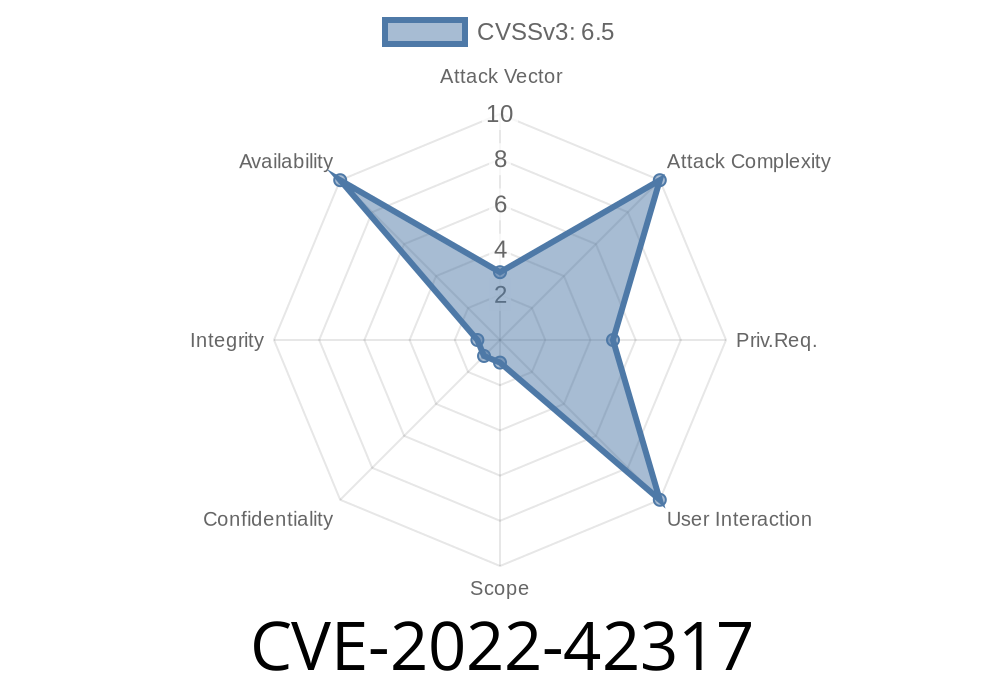
Xen is one of the most popular open-source hypervisors, powering many public clouds and private infrastructures. One of its core components is xenstored, a service that manages the "Xenstore" data structure, used by guests (VMs) and dom to communicate configuration and state. But recently, several researchers and Xen developers have warned that malicious guests can trigger a denial of service (DoS) by making xenstored use too much memory, ultimately crashing or making the service unresponsive. This critical vulnerability is tracked as CVE-2022-42317.
This article breaks down the vulnerability, gives step-by-step explanations, example code, real-world impact, upstream references, and mitigation tips.
The Basics: What Is Xenstore and Xenstored?
Xenstore is basically a small key-value "database" held by the Xen hypervisor, used by VMs and management tools (like xend, xapi, libvirt) to exchange settings, device info, event notifications, and more.
xenstored is the daemon process that runs in dom, mediating all Xenstore operations. Xenstored tracks client connections (from guest domains and management tools), stores data in memory, and sends "watches/events" to clients when watched data changes.
Exploitability: Any guest VM (even unprivileged ones)
- Impact: Guest(s) can easily exhaust RAM on dom, causing xenstored (and thus all Xenstore operations) to fail
1. Buffer Bloat by Not Reading Xenstore Responses
When a guest makes requests to xenstored but doesn't read the responses, xenstored will still allocate memory for those replies and keep them in its buffers, waiting for the guest to read. If the guest keeps sending requests but never drains its response queue, memory usage by xenstored will grow until memory is exhausted.
Example Python code using python-xenstore library
import xen.lowlevel.xs as xs
import time

h = xs.xs()
# Send requests repeatedly but never call h.read() to get the responses.
for i in range(100000):
    h.write('/some/path/to/spam%i' % i, b'DATA')
    time.sleep(.01)  # Optional: Slow down to avoid being throttled
# The guest never reads replies; xenstored's buffer grows
2. Spamming Watch Events
A guest can register many "watch" handlers on a path, then trigger a flood of notifications (watch events) by making changes under that path (like deleting lots of nodes). Each watch triggers a notification that xenstored will allocate in memory for the guest.
Example Pseudocode
for i in range(50000):
    xs.watch("/domain//device/vbd/", callback)
# In another process or loop, delete many children under /domain//device/vbd
for j in range(100000):
    xs.rm("/domain//device/vbd/%d" % j)
# This causes 50,000+ events to be buffered for each change
3. Creating A Huge Number of Maximum-Sized Nodes
The protocol and limits allow each guest to create a certain number of nodes with data of up to the maximum allowed size (e.g. 1KB per node, 1024 nodes, etc.). By creating as many nodes as allowed and making them all as large as possible, each guest quickly drives up xenstored's RAM usage.
// Pseudocode for using C to spam node creation (in a loop)
for (int i=; i<4096; i++) {
    char key[64];
    snprintf(key, sizeof key, "/guest/spamnode_%d", i);
    xs_write(xs_handle, , key, "A....A"); // Value is max size allowed
}
4. Opening Massive Transactions and Accessing Many Nodes
Transactions group many xenstore operations. Opening loads of them, and accessing (reading, modifying) many nodes inside transactions, increases xenstored's temporary memory needs.
Multiple CVEs Involved — But CVE-2022-42317 is Key
If you check the original security bulletin from Xen, you’ll notice this problem is actually related to several CVEs, which all describe *variants* or *aspects* of the same memory exhaustion theme. CVE-2022-42317 specifically refers to "guests can let run xenstored out of memory" via these combined tricks.
References and Official Advisories
- Xen Security Advisory XSA-423
- CVE Entry on MITRE
- Upstream Patch Discussion (Xen-devel)
Exploit Details: Attacker Requirements and Attack Steps
Attacker Profile:
Any user with root or appropriate privileges inside a *guest VM* can exploit this, using any language/library capable of making raw xenstore requests (e.g., xenstore-* tools or libraries for Python, C, etc).
Abuse transactions.
3. Observe on dom: ps aux | grep xenstore shows growing RAM, eventually Out of Memory kill or stalled process.
4. When xenstored exhausts RAM, new guests can't boot, active guests can't change devices, and many management operations fail—instant cloud chaos.
Impact: Is This Serious?
Yes:
- All guests share xenstored; so a single rogue or compromised guest can take down the entire Xenstore, potentially affecting *all* VMs on the host.
- Xenstore is used for hotplugging devices, shutdown/restart commands, live migration, and more.
All VM provisioning, network operations, hotplug events, and shutdowns grind to a halt.
- Could be used as a stepping-stone for further attacks or for ransom/demand against service providers.
Upgrade! Xen community has released patches to add per-domain rate limiting and buffer caps.
- Apply security updates from your OS/distribution.
From the official advisory
> "We recommend that all users of Xenstore update to the latest supported version and apply the official patches."
Summary Table
| Attack Vector | What to Monitor | Exploit Code Available | Fixed in |
|------------------------------------- |------------------------|-----------------------|----------|
| Not reading replies | Buffer growth | Yes (see example above) | Patched (see XSA-423) |
| Spamming watch events | Watch event count | Yes (see above) | Patched |
| Max-size nodes | Total data/node size | Yes | Patched |
| Multi-node transaction flooding | Transaction count | Yes | Patched |
Final Thoughts
CVE-2022-42317 is a prime example of how what looks like "regular use" of APIs or services from within a VM can be used as a denial-of-service weapon across an entire hypervisor host. The take-home? Trust, but verify—always rate-limit and isolate resources (even for so-called "shared" system services).
See also:
- Xen wiki on Xenstore
- Xen Security Notices
- Xenstore source on GitHub
If you’re running any version of Xen, and allow untrusted tenants or guests: PATCH NOW!
*This post is an exclusive, human-readable, technical breakdown of CVE-2022-42317, designed to help sysadmins, researchers, and engineers understand and mitigate this critical hypervisor threat.*
Timeline
Published on: 11/01/2022 13:15:00 UTC
Last modified on: 11/03/2022 13:55:00 UTC