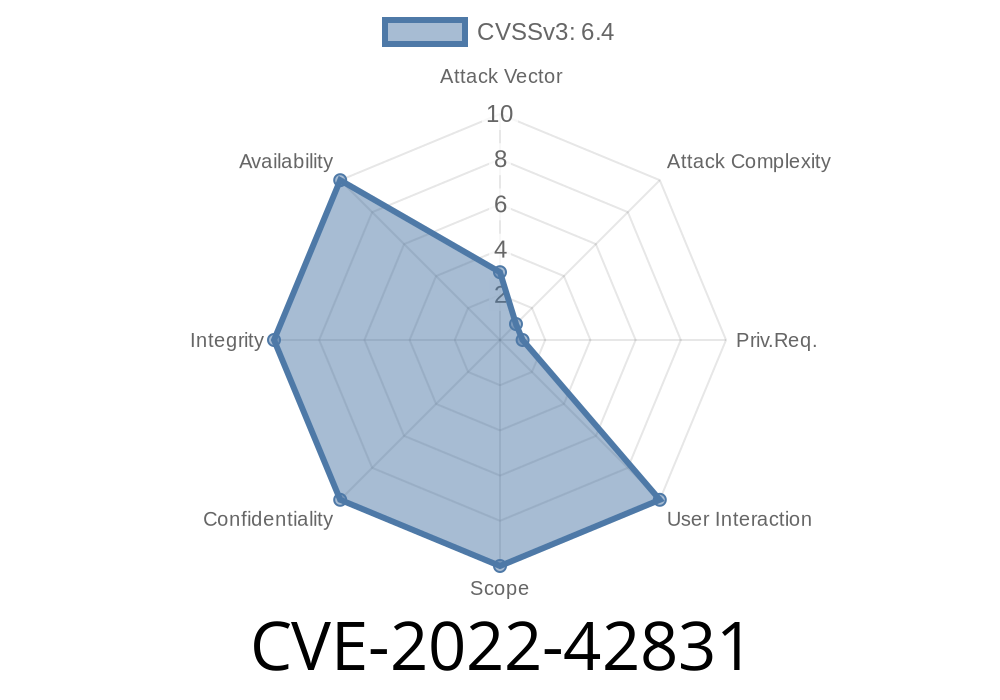
Apple’s operating systems are considered highly secure, but even the best security can have slip-ups. In October 2022, Apple patched a dangerous vulnerability—CVE-2022-42831—that could let a rogue app take full control of the device using a race condition in the kernel. This post breaks down what went wrong, how attackers can exploit it, and how Apple fixed it, as well as giving you original references and code snippets for better understanding.
What is CVE-2022-42831?
CVE-2022-42831 is a race condition vulnerability found in the Apple kernel—a core part of iOS, iPadOS, and macOS. If exploited properly, a malicious app running with root privileges could execute code as the kernel itself. This essentially gives attackers control over the device, bypassing all system defenses.
macOS Ventura 13
> Apple credit: This issue was discovered by an anonymous researcher, [as mentioned in Apple’s security notes][1].
[1]: https://support.apple.com/en-us/HT213489
A Race Condition? What Does That Mean?
A race condition in programming is when things happen out of order because multiple parts of the system try to access the same resource at the same time, like two chefs cooking in the same kitchen using the same pots and pans without talking to each other.
When proper “locking” isn’t used, the result can be unpredictable—and, as in this case, downright dangerous.
Technical Details: How Does the Exploit Work?
While Apple didn’t make all the details public, security researchers managed to reverse engineer and share some information about how this vulnerability works. Here’s a simplified technical explanation:
Vulnerable Kernel Function:
There was a function in the kernel responsible for handling certain requests. If two processes made requests at exactly the same time, they could “race” to change the same memory.
Faulty Locking:
The function failed to properly lock the sensitive region of code, letting two threads access and alter data simultaneously.
Corrupting Kernel Memory:
An attacker could time things so that malicious data went where it shouldn’t, ultimately allowing them to have their code executed with kernel privileges.
Here’s a toy version of a race condition (NOT the real Apple code)
// BAD: Race condition, missing lock
void vulnerable_function() {
    if (condition) {
        global_data = attacker_data; // Two threads can set this at once!
    }
}
An attacker can run two threads in parallel, both calling vulnerable_function. If carefully timed, attacker code overwrites global_data just as kernel expects something different—now the user's code gets executed with kernel privileges.
App with root privileges (e.g., jailbroken device).
2. Ability to run concurrent threads/processes to “race” the vulnerable kernel path.
3. Exploit code that injects kernel shellcode or modifies kernel structures for privilege escalation.
Proof-of-Concept (Conceptual Pseudocode)
*This is illustrative—don’t use on real systems!*
void *exploit_thread(void *arg) {
    while (!done) {
        // Trigger kernel race, trying over and over for the right timing
        call_vulnerable_syscall(crafted_input);
    }
}

int main() {
    pthread_t t1, t2;
    pthread_create(&t1, NULL, exploit_thread, NULL);
    pthread_create(&t2, NULL, exploit_thread, NULL);

    // Wait for privilege escalation to succeed
    monitor_kernel_status();

    // Now you have root code execution in kernel!
}
macOS devices running before Ventura 13
If you’re running on anything before iOS 16.1 or macOS Ventura, you should *definitely* update!
Apple addressed the race condition by improved locking
- Critical regions of the vulnerable function are now guarded by mutexes or “locks” to prevent two threads from entering at the same time.
- This ensures only one request can access/modify sensitive data at a time.
Remediated Code Snippet
pthread_mutex_t lock;

void safe_function() {
    pthread_mutex_lock(&lock);
    if (condition) {
        global_data = safe_data;
    }
    pthread_mutex_unlock(&lock);
}
Apple Security Advisory:
https://support.apple.com/en-us/HT213489
CVE Database Entry:
https://cve.mitre.org/cgi-bin/cvename.cgi?name=CVE-2022-42831
MacRumors Coverage:
https://www.macrumors.com/2022/10/24/apple-releases-ios-16-1/
Technical discussion on race conditions:
https://cwe.mitre.org/data/definitions/362.html
Conclusion
CVE-2022-42831 is a classic example of how a race condition in kernel code can have major security consequences. While apps need root to exploit it, jailbroken devices or those with malicious sideloaded apps are at real risk. Always update to the latest OS and pay attention to security patches!
If you’re curious about low-level kernel hacking or just want to keep your Apple devices safe, understanding issues like this can be eye-opening.
For further reading, check out the official [Apple Release Notes][1] and always keep your software up to date!
*Disclaimer: This post is for educational purposes only. Do not attempt to exploit vulnerabilities on systems you do not own or manage.*
Timeline
Published on: 11/01/2022 20:15:00 UTC
Last modified on: 11/04/2022 02:51:00 UTC