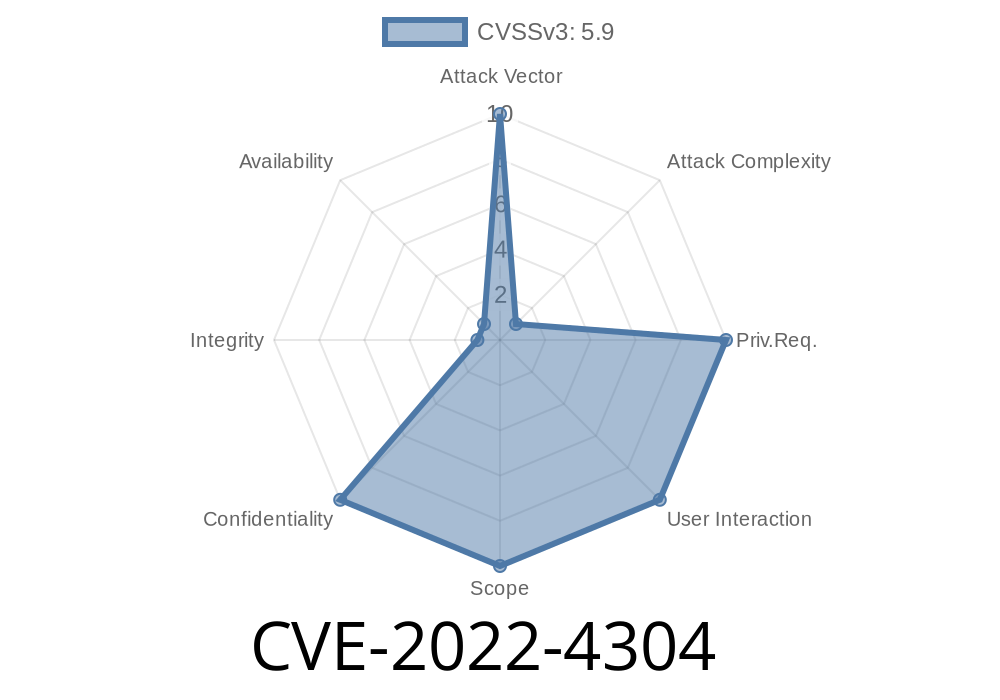
OpenSSL is one of the world’s most widely used cryptography libraries, powering secure connections everywhere—from websites to email services to VPNs. In late 2022, a new vulnerability in OpenSSL's RSA decryption process was discovered and tracked as CVE-2022-4304. This flaw could allow determined attackers to recover secret data like TLS session keys by watching how long it takes a server to decrypt specially crafted messages. This post breaks down how this works, what makes it dangerous, and shows code snippets to help you understand the risk.
What is CVE-2022-4304?
CVE-2022-4304 is a timing side-channel vulnerability. That means the attacker doesn't break the encryption directly; instead, they learn secrets by cleverly measuring how long certain operations take. Even small differences in processing time—sometimes just a few nanoseconds—can give away critical clues.
With CVE-2022-4304, the leaking operation is RSA decryption in OpenSSL. The flaw specifically means that, under certain conditions, the amount of time taken to process different RSA-encrypted messages can reveal enough information for an attacker to ultimately recover the original plaintext. This is similar to the famous Bleichenbacher attack from 1998.
The issue affects all RSA padding modes: PKCS#1 v1.5, RSA-OAEP, and RSASVE.
- Any protocol or application using RSA decryption, including TLS handshakes, is potentially a target.
How Does the Attack Work?
Let’s say you, as an attacker, observe a real encrypted session between a client and a server. In protocols like Transport Layer Security (TLS), the client often encrypts a secret (the pre-master secret) with the server’s public RSA key.
An attacker records this encrypted message and then does the following
1. Sends many “trial” ciphertexts to the server, each varying slightly from the original captured message.
Measures exactly how long the server takes to process each one.
3. Analyzes those timings for tiny variations that might indicate, for example, whether the padding checks succeeded or failed at a certain point.
4. Repeats this process, sending *many thousands or millions* of guesses, to eventually extract the _original_ pre-master secret.
With this knowledge, the attacker could decrypt what was supposed to be a secure connection between client and server.
Sample Exploit Logic (Pseudo-Code)
Here’s a simplified version of what attacker-side code for exploiting CVE-2022-4304 might look like. This is meant for educational purposes to illustrate the danger; do not use this for malicious activities.
import time
import socket

SERVER = 'victim.example.com'
PORT = 443

original_ciphertext = ...  # Recorded RSA-encrypted pre-master secret

def send_trial(ciphertext):
    with socket.create_connection((SERVER, PORT)) as sock:
        start = time.perf_counter_ns()
        sock.sendall(ciphertext)
        # Wait for server's response (could be error or normal TLS alert)
        try:
            response = sock.recv(1024)
        except:
            response = None
        duration = time.perf_counter_ns() - start
        return duration, response

# For each modified guess of the ciphertext:
for trial_ciphertext in generate_trial_ciphertexts(original_ciphertext):
    time_taken, result = send_trial(trial_ciphertext)
    log_trial(trial_ciphertext, time_taken, result)
    # Careful analysis of timings can reveal patterns
    # Attack continues until enough information is gathered to deduce the secret
Key point: The attack is practical only if you can send _many_ trial ciphertexts and precisely measure response times. In the real world, this often means an internet-facing server is most at risk.
References and Further Reading
- Official OpenSSL Security Advisory
- CVE-2022-4304 NIST Entry
- Bleichenbacher's Original Attack Paper (PDF)
- OpenSSL GitHub Patch
Defense: What Should You Do?
1. Update OpenSSL: The OpenSSL team has fixed this bug in newer releases. Upgrade as soon as possible.
2. Disable RSA key transport in TLS: Modern TLS (1.3) doesn’t use RSA for handshakes but uses (EC)DHE instead—prefer these modes.
3. Reduce exposure: If you’re running public-facing servers, ensure strict rate limits, monitor for suspicious connections, and minimize use of outdated protocols.
Summary
CVE-2022-4304 is a reminder that timing leaks are not just theoretical—they can be used by skilled attackers to steal secrets, even when cryptography is implemented correctly at the algorithm level. If you have systems using OpenSSL’s RSA decryption, act today: upgrade and move away from RSA key transport where possible.
*Written for educational use. If you find a similar issue in the wild, disclose responsibly and help make the internet safer for everyone.*
Timeline
Published on: 02/08/2023 20:15:00 UTC
Last modified on: 02/24/2023 17:13:00 UTC