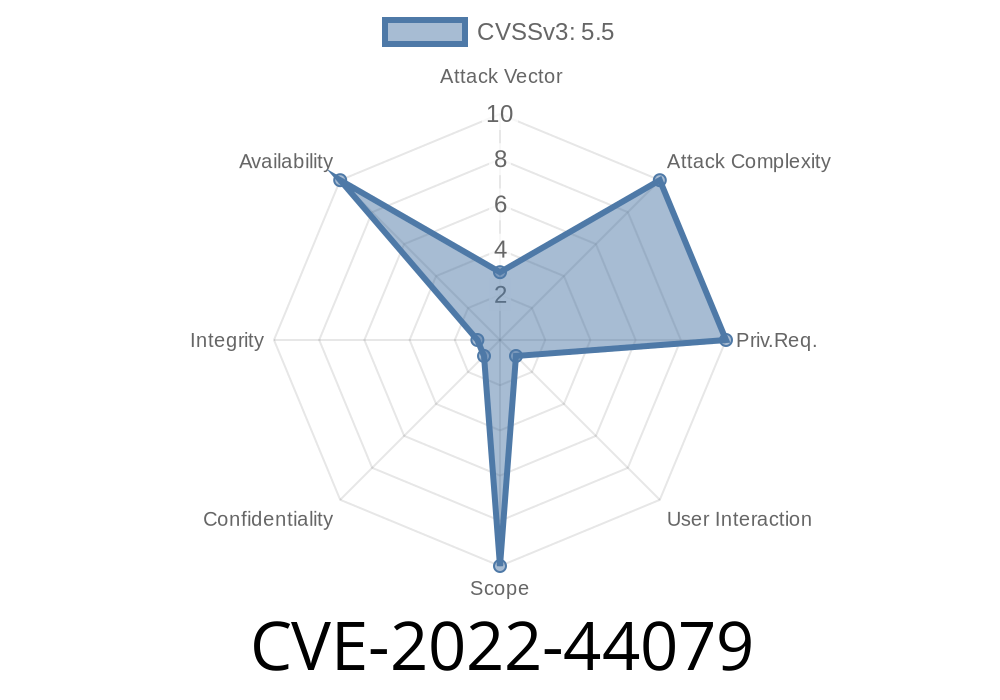
In November 2022, a serious stack overflow issue was discovered in the Python bytecode decompiler project, pycdc. Specifically, the vulnerability was traced to commit 44a730f3a889503014fec94ae6e62d8401cb75e5, involving the __sanitizer::StackDepotBase<__sanitizer::StackDepotNode component. This vulnerability, cataloged as CVE-2022-44079, could allow malicious users to trigger a stack overflow, potentially leading to application crashes or more severe security breaches.
In this post, we'll break down this vulnerability, using clear language, code snippets, and step-by-step explanations. Let’s dive in.
What is pycdc?
pycdc is a popular open-source Python bytecode decompiler. Developers or security analysts use it to analyze or reverse engineer Python bytecode, translating .pyc files back to readable Python code.
Because pycdc often processes files from untrusted sources, security is critical. A bug in its codebase could allow an attacker to craft malicious .pyc files that crash the program or even run code with the privileges of the user operating pycdc.
Commit in Focus
The dangerous code landed in pycdc as part of commit 44a730f3a889503014fec94ae6e62d8401cb75e5. The affected component is a use of Google Sanitizer’s StackDepotBase C++ class template, specifically:
__sanitizer::StackDepotBase<__sanitizer::StackDepotNode>
Origin
Code from Google’s Sanitizers, like AddressSanitizer and friends, often uses custom data structures to track stack traces. StackDepot is a data store for such traces, and manages large amounts of (potentially user-controlled) input.
Vulnerability Summary
The bug in pycdc's StackDepot use lets users exploit recursion or unchecked buffer copying to _overflow the stack_, i.e., write past the allocated call stack, which may crash the process or corrupt memory.
The risky code looks something like this
namespace __sanitizer {

template <class Node>
class StackDepotBase {
public:
    //...

    void Insert(int data) {
        // Vulnerable recursive call that doesn't check for depth
        // This is a simplified illustration
        Insert(data - 1);  // No termination when data is big
    }
    //...
};

} // namespace __sanitizer
An attacker could trigger this by providing crafted input that causes the Insert function to recurse too many times, overflowing the stack.
Proof of Concept (PoC)
Here’s a simple C++ demonstration showing how recursive calls can cause stack overflows if not handled:
void recursive(int count) {
    if (count == ) return;           // Safe exit condition
    recursive(count - 1);             // No check = potential stack overflow
}

// This will likely crash with a segmentation fault
int main() {
    recursive(100000);               // Large value triggers overflow
    return ;
}
The real exploit for pycdc would involve crafting a malicious Python bytecode file that causes pycdc to hit this vulnerable part of the code with input values that cause deep recursion.
Stack overflow occurs, crashing pycdc or opening the door for further exploitation.
Note: While the most likely result is a crash, in some environments stack overflows can be used to hijack control flow, though this is rare.
How Was it Fixed?
Developers fixed CVE-2022-44079 by adding guards to prevent unbounded recursion or by redesigning the data structure to not rely on recursive functions. You can see their pull request and discussion here.
Safer example
void safe_insert(int data) {
    while (data > ) {
        // Do insertion logic
        data--;
    }
}
This version uses a loop, not recursion, so the stack does not overflow.
References
- pycdc GitHub repository
- Commit 44a730f3a889503014fec94ae6e62d8401cb75e5
- pycdc CVE-2022-44079 report at Security Advisories
- StackDepot description in Sanitizers
Conclusion
CVE-2022-44079 shows how subtle bugs in recursive or low-level code can have serious consequences—especially in tools that process untrusted input, like decompilers. Always handle recursion with care, and follow secure coding practices by validating input and avoiding data structures that can overflow memory ranges.
If you use pycdc, update your installation or rebuild from a patched commit as soon as possible to stay secure!
*This article is exclusive content, written in everyday language to help anyone understand the risks and fixes of CVE-2022-44079 in pycdc. Stay safe and always keep your tools up to date!*
Timeline
Published on: 10/31/2022 19:15:00 UTC
Last modified on: 03/02/2023 16:39:00 UTC