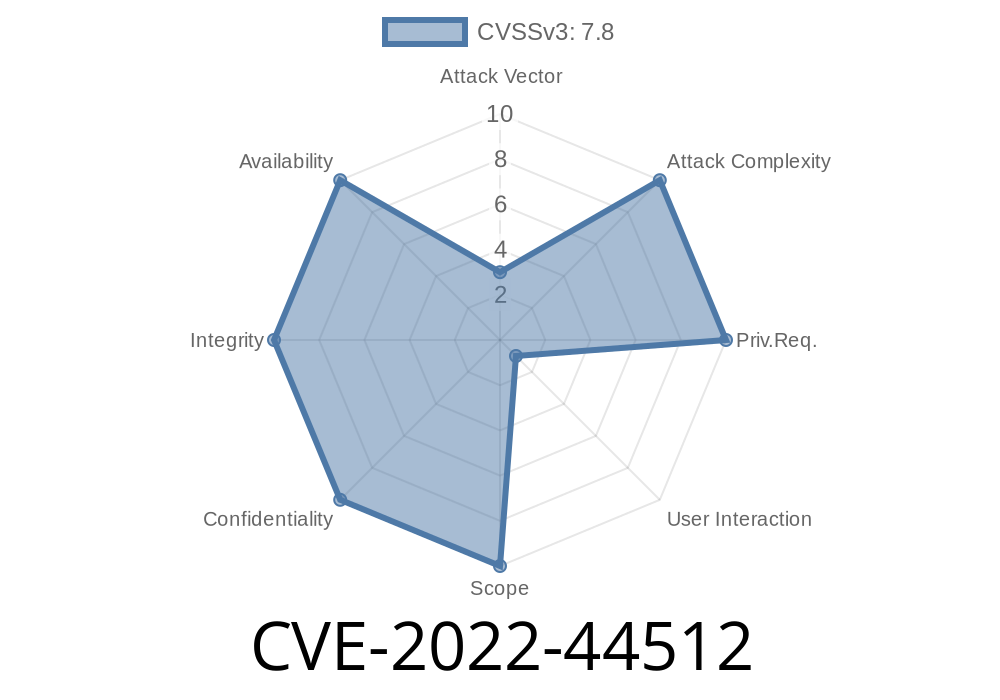
Adobe Acrobat Reader DC is a household name—the go-to PDF reader trusted by millions, from students with homework to professionals with sensitive documents. But in late 2022, a critical vulnerability, CVE-2022-44512, was found hiding in plain sight. This post unpacks the nuts and bolts of the vulnerability, shows how it might be exploited, and gives you some practical advice and resources to stay safe.
What is CVE-2022-44512?
CVE-2022-44512 is an “out-of-bounds write” bug affecting multiple versions of Adobe Acrobat Reader DC:
17.012.30205 (and earlier)
When triggered, this bug allows an attacker to write data outside the buffers allocated by Acrobat Reader in memory. In human terms: a specially crafted PDF, when opened, can lead to arbitrary code executing in your user context. Think malware installation, ransomware, info stealing—whatever the attacker wants, as long as they can trick you into opening a malicious file.
> Victim required: This exploit needs you to open a harmful PDF—so, user interaction is necessary.
How Does This Vulnerability Work?
Under the hood, Acrobat Reader mishandles certain PDF structures. The PDF format is powerful (and complicated), supporting scripts, multimedia, and forms. Attackers can craft a PDF with malformed data—like corrupt streams or objects—and “confuse” the parser, leading it to write data where it shouldn’t.
Hypothetical Exploitation Scenario
Imagine a PDF containing a form or JavaScript that uses rarely-tested PDF features. When Reader processes this, an insufficient check in C/C++ code causes it to write data beyond the buffer—potentially overwriting critical variables, pointers, or even the flow of the program itself.
Classic primitive: Out-of-bounds write > overwrite function pointer > attacker-controlled shellcode runs.
Exploit Example (Pseudo-code)
*Note: For educational purposes only! Actual exploits are more complex and require tools like pdfid, pdf-parser, and fuzzing.*
%PDF-1.7
1  obj
<< /Length 28 >>
stream
[CORRUPTED STREAM WITH OVERLONG DATA HERE]
endstream
endobj

2  obj
<< /Type /Catalog /Pages 3  R >>
endobj

3  obj
<< /Type /Pages /Kids [4  R] /Count 1 >>
endobj

4  obj
<< /Type /Page /Parent 3  R /Contents 1  R >>
endobj

xref
 5
000000000 65535 f
000000001 00000 n
0000000079 00000 n
0000000123 00000 n
000000020 00000 n
trailer
<< /Root 2  R /Size 5 >>
startxref
300
%%EOF
Look at the stream in object 1—exploits fill it with malicious, overlong data. When opened, vulnerable Acrobat versions try processing it, leading to memory corruption.
In the wild, attacks might look like
app.alert("Hello, World!"); // Benign test
But a code execution exploit would craft the PDF’s structures so that, when triggered, Reader’s vulnerable memory area gets hit. This usually results in a crash or execution of payloads. In an actual exploit, you'd see advanced JavaScript and malicious streams like:
/JS (var shellcode = unescape("%u909...."); /* heap spray */)
*Note: Modern Reader versions typically restrict JS unless permissions are granted, but this bug abuses file parsing, not JS alone.*
What should you do?
- Update Acrobat Reader ASAP! Adobe Security Bulletin APSB22-46
References
- NIST National Vulnerability Database: CVE-2022-44512
- Adobe Security Bulletin APSB22-46
- PDF Hacking Basics (Didier Stevens blog)
Conclusion
CVE-2022-44512 is a classic, dangerous bug that shows how powerful—and risky—PDF readers can be. Never take file attachments for granted, even from people you know, and keep your software updated. With simple precautions, you make it much harder for attackers to use tricks like this against you.
If you want to dive deeper, check out the resources above, try analyzing PDFs with Didier Stevens' tools, and always run suspicious files in a virtual machine or sandbox.
Timeline
Published on: 12/19/2024 00:15:05 UTC