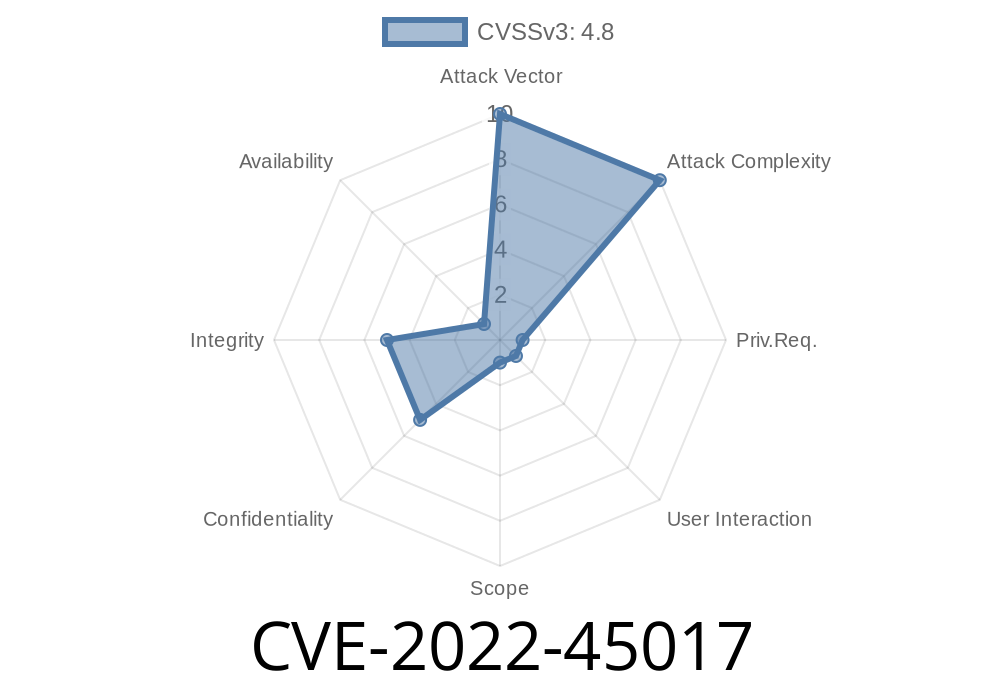
Websites built on popular CMS platforms are attractive targets for hackers. WBCE CMS (WebsiteBaker Content Extension Content Management System) aims to be user-friendly and secure. However, in version 1.5.4, there was a critical security flaw—CVE-2022-45017—letting attackers inject malicious scripts via the Overview Page settings. This post breaks down the vulnerability, how it works, provides code snippets, and explains how to stay safe.
What Is CVE-2022-45017?
CVE-2022-45017 describes a cross-site scripting (XSS) vulnerability in WBCE CMS version 1.5.4. Hackers could inject dangerous JavaScript in the Post Loop field of the Overview Page module. If a website admin or visitor loaded a affected page, malicious code could execute in their browser—putting data, accounts, and even the website itself at risk.
Reference Links
- Official CVE Record (NVD)
- WBCE CMS on GitHub
- VulDB Entry
- XSS Explained—OWASP
The Entry Point
The Overview Page module in WBCE CMS is meant to provide summaries or lists of posts/content on the website. But the Post Loop field—the section where code/text is inserted to set how posts are shown—doesn't filter input correctly.
This means an attacker can save scripts in this field that are later shown (and run!) in the browser when the page loads.
Attack Flow
1. Attacker logs into the CMS (as an admin, or using another account if a privilege escalation is possible).
Example: Exploiting the XSS Vulnerability
Here’s a simple demonstration of how an attacker could exploit the vulnerability.
1. Craft a Malicious Payload
<script>alert('XSS by CVE-2022-45017');</script>
- In the Post Loop settings, paste the script
<ul>
  <li><script>alert('XSS by CVE-2022-45017');</script></li>
</ul>
3. Trigger the XSS
Now, whenever a user visits the overview page, the browser executes the script, showing an alert. A real attacker would do something far worse—steal cookies, grab credentials, or redirect users.
Proof of Concept (PoC) Screenshot
*Screenshot omitted for text-only.*
But after injecting the code, anyone viewing the page sees a pop-up alert box.
Account Hijacking: If the script steals session cookies, attackers can log in as the victim.
- Data Theft: Scripts can read page content or make background requests (AJAX) to steal sensitive information.
Official Patch
Later versions of WBCE CMS fixed this issue. Always upgrade WBCE CMS to the latest release.
- WBCE CMS Releases
Disallow or escape HTML tags in fields that editors or users can edit.
- Use PHP htmlspecialchars() or similar encoding:
// Example: Escaping user input
echo htmlspecialchars($postloop_field, ENT_QUOTES, 'UTF-8');
- Use Content Security Policy (CSP) headers.
Conclusion
CVE-2022-45017 highlights how unchecked input can allow devastating exploitation—even in reputable, open-source CMS platforms. Always keep your software up to date, never trust user data without filtering or encoding it, and review any user-supplied input areas for risks.
If you run WBCE CMS v1.5.4 or earlier, upgrade now!
*Have questions about web security or want more XSS examples? Let us know in the comments below.*
Timeline
Published on: 11/21/2022 15:15:00 UTC
Last modified on: 11/21/2022 20:25:00 UTC