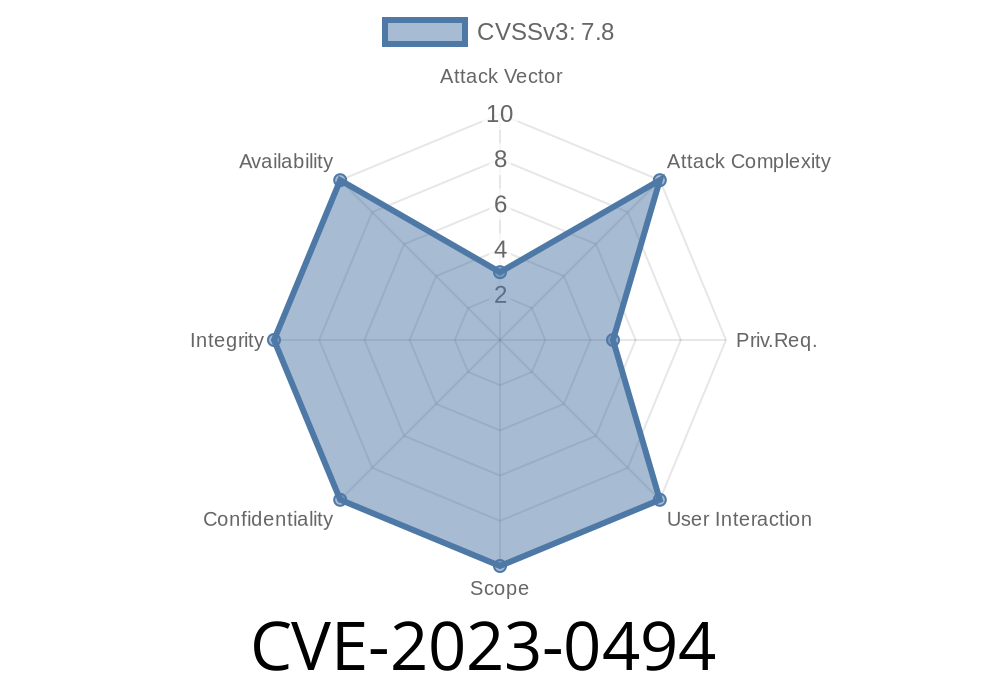
CVE-2023-0494 is a critical security vulnerability found in the X.Org server. The bug lets attackers read and write into memory that has already been freed (called a *dangling pointer*). This can result in local privilege escalation (LPE) or remote code execution (RCE), especially when X.Org is running with elevated privileges or via SSH X forwarding.
This is a big deal since X.Org Server is the most common display server used on Linux and UNIX systems.
Vulnerability Details
The issue comes from the function DeepCopyPointerClasses inside the X.Org server codebase. Two other functions — ProcXkbSetDeviceInfo() and ProcXkbGetDeviceInfo() — can interact with this bit of code. If an attacker can trigger the code paths in the right way, they could make the server keep a pointer to memory that's already been freed.
If the attacker then manages to get the server to use that pointer, they can read from or write to arbitrary memory locations — in other words, classic Use-After-Free.
Let’s look at a simplified version of the bug in C so you can see how it happens
// Pseudocode for X.Org's DeepCopyPointerClasses use-after-free
void DeepCopyPointerClasses(DeviceIntPtr src, DeviceIntPtr dst) {
    // Allocates new pointer class struct
    dst->button = malloc(sizeof(ButtonClassRec));
    // Fills struct with src data
    memcpy(dst->button, src->button, sizeof(ButtonClassRec));
}

void proc_xkb_get_or_set(DeviceIntPtr dev) {
    DeepCopyPointerClasses(dev, new_device);
    free(dev->button); // <-- Here: dev->button is freed, but pointers may remain
    // ...now the pointer is dangling!
}
If the system tries to use dev->button again elsewhere (say, with attacker-influenced data), it will access freed, now attacker-controlled memory.
Why Does This Matter?
If your X.Org server is running as root (often the case), and an attacker on your machine can connect to the X server (like a local user via SSH X forwarding), they can use this exploit to:
Escalate privileges to root (Local Privilege Escalation).
- Run arbitrary code remotely if you're forwarding X via SSH, which could mean a remote attacker running code as your user (or worse, root) on your system.
Setup: The attacker connects to a vulnerable X.Org server.
2. Trigger Dangling Pointer: The attacker uses X11 protocol messages to call ProcXkbSetDeviceInfo() or ProcXkbGetDeviceInfo(), carefully constructing their input to cause a pointer to freed memory.
3. Hijack Memory: By sending more messages, the attacker can control what is placed at the freed memory (a "heap spray"), so when the server re-uses the dangling pointer, it does what the attacker wants—like running arbitrary machine code.
In the context of SSH X11 forwarding, a compromised remote X11 client can send the malicious requests to exploit the bug and compromise the server-side.
Proof of Concept Example
Below is a skeleton Python example that imitates an attack via SSH X forwarding. This isn't a weaponized exploit — real exploits would need to speak the raw X11 protocol, heap spray, and more — but it shows how an attacker would use a client to trigger the bug.
import socket

def send_malicious_xkb_request(x_server_ip, x_server_port):
    # Connect to X.Org X server
    sock = socket.socket(socket.AF_INET, socket.SOCK_STREAM)
    sock.connect((x_server_ip, x_server_port))

    # Construct XKB request with malicious payload
    xkb_payload = b'\x64\x00...'  # not real protocol, for illustration only

    print("Sending crafted XKB message to trigger use-after-free...")
    sock.sendall(xkb_payload)

    # Additional protocol messages would go here for real attack
    sock.close()

if __name__ == '__main__':
    send_malicious_xkb_request('127...1', 600)  # X server typically runs on port 600
> Note: This is for educational purposes only! Real-world exploits will look different and are more complex.
How to Protect Yourself
- Upgrade your X.Org Server: Make sure you’re running at least version 21.1.7 or later (released Feb 2023), which includes the fix.
Limit X11 forwarding: Only allow trusted users for SSH X forwarding.
- Security Monitoring: Watch for suspicious X11 client connections, especially from untrusted users or over SSH.
Original References
- X.Org official security advisory
- CVE details for CVE-2023-0494
- Debian Security Tracker - CVE-2023-0494
- Red Hat Security - CVE-2023-0494
- Fixed in X.Org Server 21.1.7
Final Thoughts
CVE-2023-0494 is a nasty bug in one of the most basic building blocks of Linux desktops. If you’re an admin or user running X11, check your server version today. Patch now, and always follow best practices for running critical system services — never trust network-accessible clients unless you have to.
Timeline
Published on: 03/27/2023 21:15:00 UTC
Last modified on: 03/31/2023 14:27:00 UTC