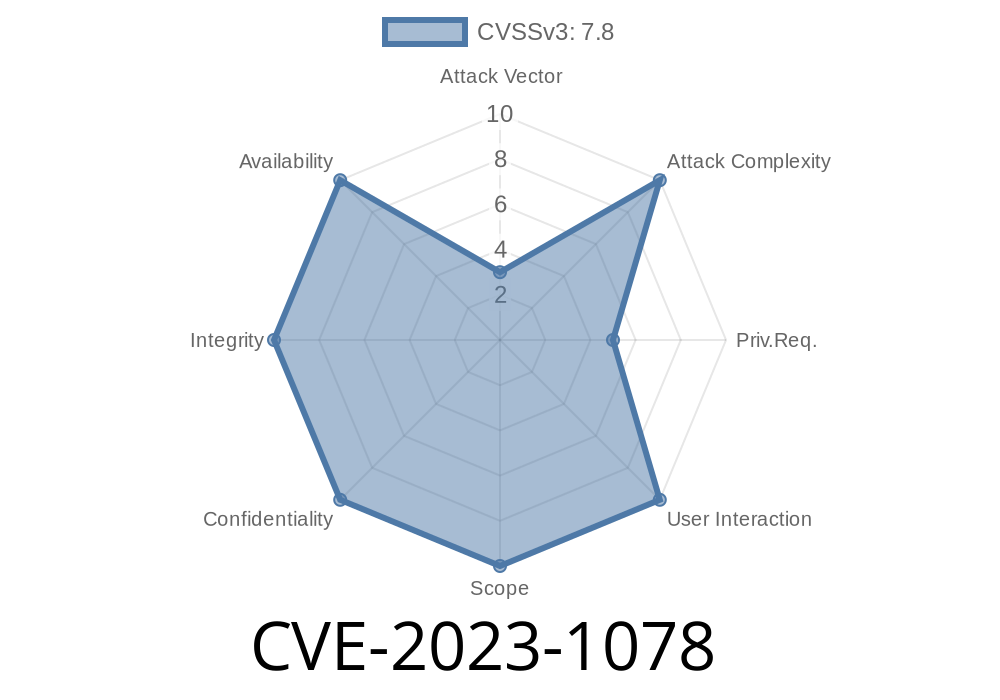
In early 2023, a critical security flaw was discovered in the Linux Kernel, specifically targeting the RDS (Reliable Datagram Sockets) protocol. Tracked as CVE-2023-1078, this vulnerability revolves around a type confusion bug in how the kernel manages zero-copy buffers within the networking stack. This post will break down what happened, show real code examples, explain how attackers can exploit this problem, and provide resources for further reading.
What is RDS?
Reliable Datagram Sockets (RDS) is a protocol used for fast, reliable message passing, especially in clustered environments or distributed database systems. Linux includes RDS support in its kernel networking stack.
References:
- Kernel.org write-up / patch
- Red Hat CVE page
- Exploit write-up reference
Inside the Linux kernel, the dangerous path looks like this
// rds/rdma.c

static void rds_rm_zerocopy_callback(struct rds_sock *rs)
{
    struct rds_msg_zcopy_info *info;
    // "head" is a list_head of pending messages
    if (!list_empty(&rs->zero_copy_queue)) {
        // BUG: blindly assumes the list always contains rds_msg_zcopy_info objects
        info = list_entry(rs->zero_copy_queue.next, struct rds_msg_zcopy_info, entry);
        // ... use "info" ...
    }
}
What's the type confusion?
list_entry() is supposed to retrieve a node of type struct rds_msg_zcopy_info from a linked list of such objects. But if a malicious user manages to submit objects of the wrong type (or corrupt the list), this method will treat arbitrary memory as the right struct. This is the classic type confusion bug.
The function does not check the type of the list element.
2. If a user manages to insert a different kind of object (or forged memory) into the list, when dereferenced with list_entry(), info will point to something entirely controlled by the user.
3. This can result in out-of-bounds memory access and ultimately kernel lock corruption if the forged struct has invalid pointers or values.
Creates an RDS socket and performs operations that add custom entries to rs->zero_copy_queue.
2. Calls rds_message_put() from user space, forcing the kernel to process and eventually empty the zero-copy queue.
3. If the list's first element can be manipulated to point to user-controlled data, rds_rm_zerocopy_callback() will operate on the wrong data type—a type confusion!
The following code is a simplified illustration for educational purposes only.
// Userland: Setup a local RDS socket
int s = socket(AF_RDS, SOCK_SEQPACKET, );
// prepare msg, trigger events that affect zero_copy_queue...

// Now invoke code path that ends up in rds_message_put()
close(s); // triggers resource cleanup in kernel
Kernel-side: (Vulnerable code path)
struct rds_msg_zcopy_info *info;
info = list_entry(rs->zero_copy_queue.next, struct rds_msg_zcopy_info, entry);
// 'info' could point to malformed/fake data, allowing malicious access
If an attacker can control rs->zero_copy_queue.next, they can arrange for the kernel to process arbitrary (user-supplied) memory.
The ability to control what the kernel thinks is a struct rds_msg_zcopy_info provides
- Arbitrary read/write in kernel context (through crafted struct members)
Out-of-bounds access can lead to info leak or denial of service
- Corruption of spinlock or other kernel synchronization primitives, leading to system crash or privilege escalation
This is particularly dangerous on systems with unprivileged user namespaces enabled, or where other mitigations are missing.
Patch your kernel!
The bug is fixed in Linux versions containing commit c66e3dd39db39982cfa1c15a6f0591cd4cc8d67f.
Further Reading
- Kernel patch commit log
- Red Hat CVE Database
- oss-security mailing list advisory
- Basic guide to type confusion bugs (Google Project Zero)
Conclusion
CVE-2023-1078 showcases how even a small oversight in type safety can lead to big kernel security holes. If you manage Linux servers or develop kernel-level code, always validate data structures, carefully manage linked lists, and keep systems up to date. Type confusion, especially in the Linux kernel, is a powerful bug class that frequently leads to security bugs.
Remember: Patch early and restrict local access whenever possible!
*This post is original content and aims to provide a clear, accessible view of CVE-2023-1078 for system administrators, developers, and security researchers.*
Timeline
Published on: 03/27/2023 21:15:00 UTC
Last modified on: 05/05/2023 20:15:00 UTC