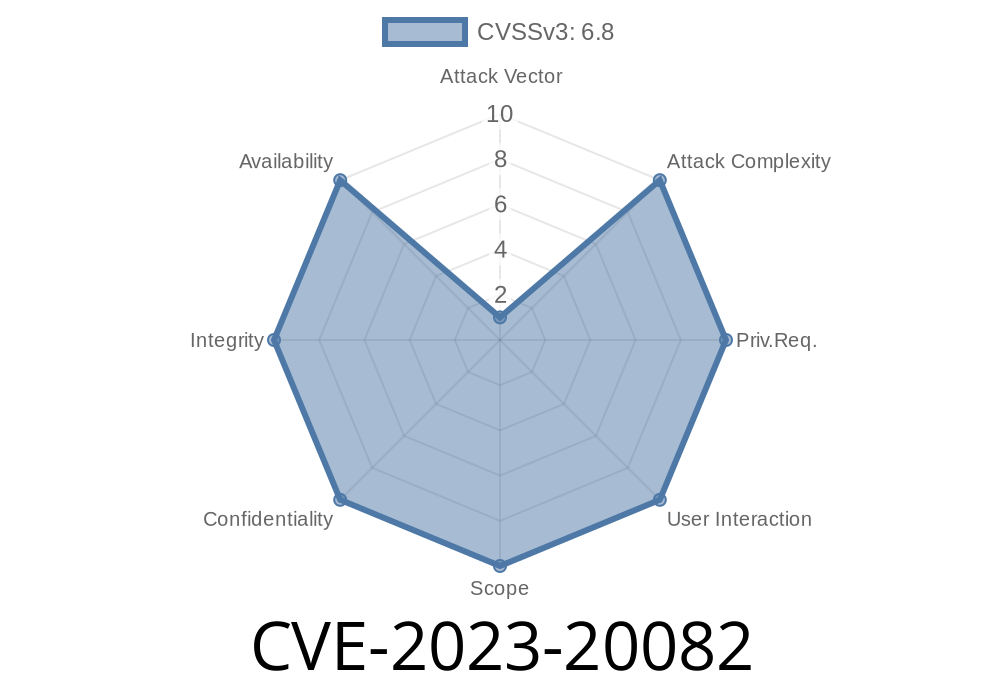
If you manage or work near Cisco Catalyst 930 switches, CVE-2023-20082 is something you need to understand. This vulnerability is a big deal, especially if attackers get local access or have “level-15” (highest) privileges. Here’s a plain-language breakdown so your team can stay ahead.
What Is CVE-2023-20082?
CVE-2023-20082 is a severe vulnerability in Cisco IOS XE Software running on Cisco Catalyst 930 Series switches. If abused, an attacker could install persistent, unauthorized code that survives reboots and undermines the switch’s security from boot-up.
How Does This Vulnerability Work?
The root problem is in how the switch checks the authenticity of its software images using a “public release key.” The vulnerability makes it possible to change variables in the switch’s SPI (Serial Peripheral Interface) flash storage. With those changes, attackers can trick the device into running malicious firmware—or code—during boot.
Two Paths to Exploitation
- Remote: If an attacker has “level-15” (full admin) access, even from a remote session, they can use this flaw.
- Physical: If someone can physically get to the device, they can exploit it without any credentials.
Signature Verification Bypassed: The altered variables mess with the image verification process.
4. Persistent Code Launched: On next boot, the device happily loads the attacker’s code—permanently.
This means a malicious person could install a backdoor or rootkit that survives reboots, firmware upgrades, and more.
Real-World Exploit Details
*While Cisco hasn't released a full exploit, here's a simplified example of how code changes might work:*
# Example pseudocode: Modifying SPI Flash for a Cisco Catalyst 930 switch

# WARNING: Don't run this in production - for illustration only!

import spi_flash_lib

# SPI flash connection (device-specific)
spi = spi_flash_lib.connect("/dev/spidev.")

# Locate and read current signing key variable
spi.seek(SIGNING_KEY_OFFSET)
current_key = spi.read(KEY_LENGTH)

print("Current key:", current_key)

# Write attacker's 'fake' key to override verification
fake_key = b'MY_FAKE_PUBLIC_KEY_BYTES'
spi.seek(SIGNING_KEY_OFFSET)
spi.write(fake_key)

print("Signing key overridden! Reboot for attacker code to run.")
*Again: you’d need real hardware access and/or full admin, and offsets/keys shown here are for educational purposes only.*
Why is This Harder on New Versions?
Starting with Cisco IOS XE 16.11.1, Cisco improved some of the security checks. Exploitation now requires more detailed tech skill. But an attacker with “level-15” access could simply downgrade the switch to an older, weaker version—making this problem easier to exploit.
Control Physical Access. Keep switches in locked, monitored areas.
3. Update Regularly. Always run the latest IOS XE software (*see Cisco’s official advisory*).
References & Further Reading
- Cisco Official Advisory for CVE-2023-20082
- NIST NVD CVE-2023-20082
- Cisco Catalyst 930 Series Switches Data Sheet
Final Thoughts
CVE-2023-20082 shows why device access controls and patching routines matter. If an attacker gets admin or physical access, your network’s core switches could be completely compromised. Update your switches, check your access lists, and keep an eye on any signs of tampering.
*Stay secure—one switch at a time!*
*Written exclusively for your cyber defense toolbox.*
Timeline
Published on: 03/23/2023 17:15:00 UTC
Last modified on: 03/30/2023 20:35:00 UTC