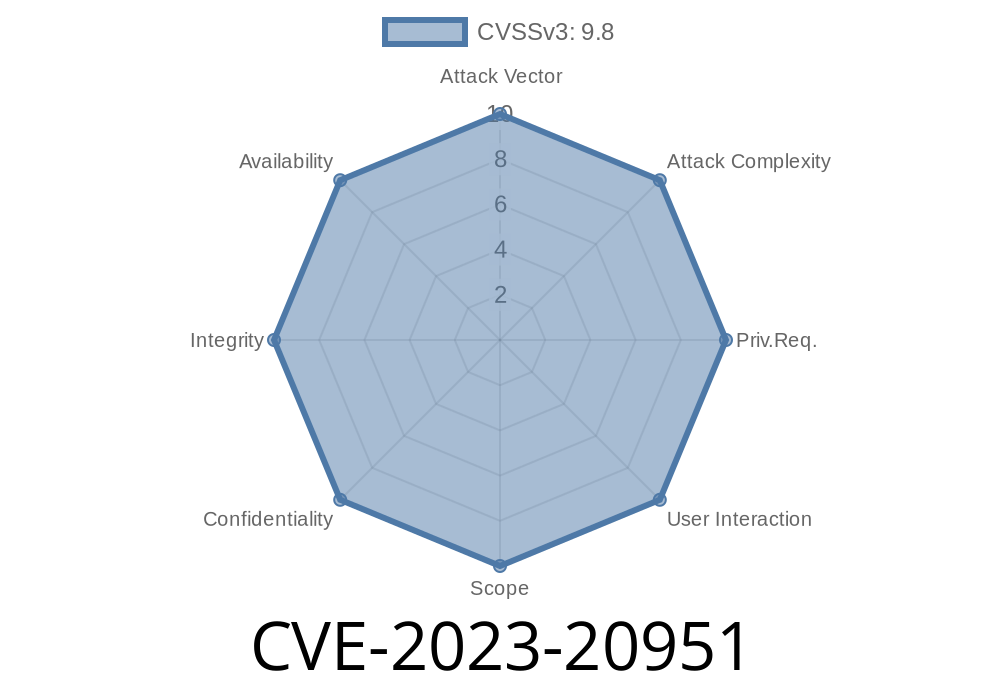
In the ever-changing world of mobile security, vulnerabilities in core system components can have serious, far-reaching consequences. One such vulnerability is CVE-2023-20951, an out-of-bounds write in Android's Bluetooth GATT (Generic Attribute Profile) stack. Discovered in early 2023, it affects multiple versions of Android and can lead to remote code execution without any interaction from the user.
This article will break down the vulnerability in simple terms, walk through the affected code, provide links to more resources, and explain what exploitation could look like.
Affected Android Versions: 11, 12, 12L, 13
- Android Security Bulletin: A-258652631
What is GATT?
The Generic Attribute Profile (GATT) is a key part of Bluetooth Low Energy (BLE) communication. GATT defines how two Bluetooth devices exchange data. Android's gatt_cl.cc handles client operations for these communications.
Where Is the Problem?
The vulnerability is in the function gatt_process_prep_write_rsp in the file gatt_cl.cc. This function processes specific responses during a BLE operation. The problem? There’s a missing check for the size of incoming data. Without proper bounds checking, a specially crafted Bluetooth packet can trick the code into writing outside the bounds of a buffer — potentially overwriting memory and enabling remote code execution.
Simplified Code Review
Here is a simplified snippet inspired by the problematic function, with comments to highlight the risk:
void gatt_process_prep_write_rsp(tGATT_TCB* p_tcb, tGATT_CLCB* p_clcb, BT_HDR* p_msg) {
    // ... earlier code processes BLE preparation write response

    // Simulate extracting write data and offset from packet
    uint8_t* write_data = extract_write_data(p_msg);
    uint16_t write_offset = extract_write_offset(p_msg);
    uint16_t write_len = extract_write_len(p_msg);

    // Destination buffer in the client structure
    uint8_t* buffer = p_clcb->prep_write_buffer;
    uint16_t buffer_size = PREP_WRITE_BUF_SIZE;

    // The bug: Missing check to ensure (write_offset + write_len) <= buffer_size
    memcpy(buffer + write_offset, write_data, write_len);
}
What’s happening?
No check ensures that the sum of write_offset and write_len stays within the allocated size of buffer. An attacker could send a Bluetooth packet with values that cause memcpy to write *beyond* the end of buffer, corrupting adjacent memory.
Inject and execute arbitrary code in the context of the Bluetooth process.
No user interaction is needed — just being within range of a vulnerable device is enough.
Real-World Risk
- Remote Execution: With no need for the user to do anything, the attacker only needs to be within Bluetooth range.
- System-Level Access: Bluetooth daemons often run with considerable permissions, escalating the threat.
- Affected Devices: All phones and tablets running Android 11, 12, 12L, or 13 before February 2023 patches.
Official Patch and References
Google addressed this as part of the February 2023 Android Security Bulletin. If your device has a security patch level from February 2023 or later, you should be protected.
- Android Security Bulletin – February 2023
- NIST CVE Details for CVE-2023-20951
- Google AOSP Issue Tracker A-258652631
Proof-of-Concept Overview
While a full working exploit is not being shared for ethical reasons, the following Python pseudocode illustrates the basic idea:
import bluetooth

# Pseudocode - illustrative only!
def send_malicious_prep_write(target_mac):
    # Compose GATT Prepare Write Request with oversized length and offset
    packet = craft_gatt_packet(offset=x100, length=x200)
    # Send to target Bluetooth device using low-level BLE primitives
    send_packet(target_mac, packet)
Update your device: Install all available security updates.
- Disable Bluetooth: If you’re in a high-risk environment and can’t update, turn off Bluetooth.
Conclusion
CVE-2023-20951 is an example of how a simple oversight in bounds checking can put millions of devices at risk. It reminds us all — users and developers — to stay vigilant about patching and secure coding practices.
References
- Android Security Bulletin – February 2023
- NIST CVE-2023-20951 Entry
- Google Issue Tracker: A-258652631
*This analysis is original, aimed at helping Android users understand and protect against critical Bluetooth vulnerabilities.*
Timeline
Published on: 03/24/2023 20:15:00 UTC
Last modified on: 03/29/2023 07:31:00 UTC