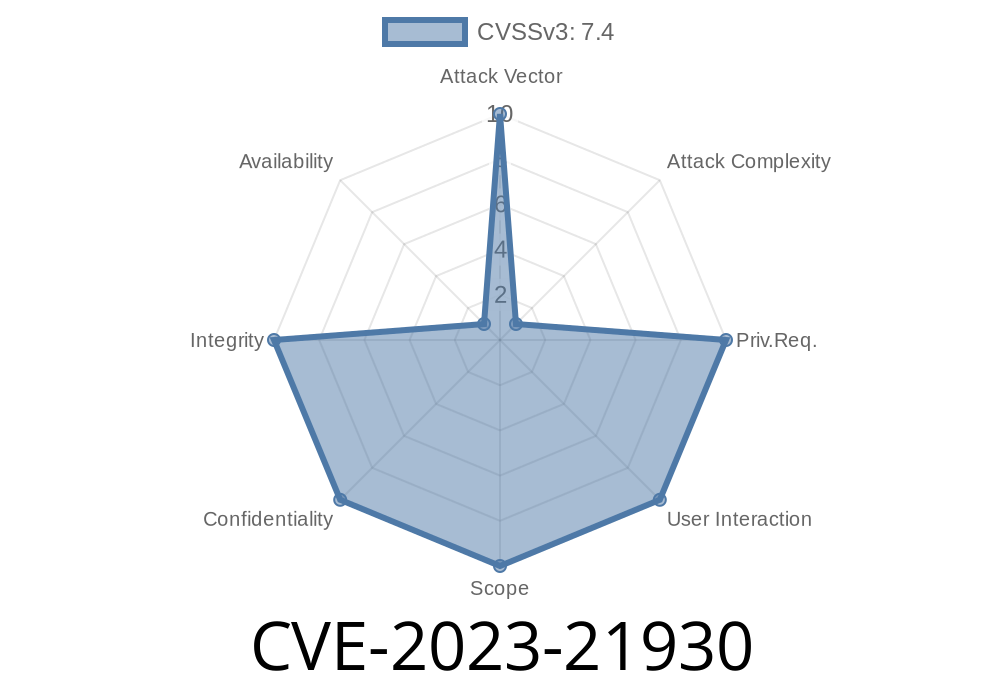
In early 2023, Oracle disclosed a significant security vulnerability affecting multiple versions of Java SE and GraalVM Enterprise Edition. Identified as CVE-2023-21930, this flaw lies in the JSSE (Java Secure Socket Extension) component and poses serious risks to both data confidentiality and integrity—even without authentication from the attacker. In this long read, we’ll explain what CVE-2023-21930 is, how it can be exploited, the impact it may have, and how you can minimize your risk.
What is CVE-2023-21930?
CVE-2023-21930 is a vulnerability affecting secure communications in several supported Oracle Java SE and Oracle GraalVM Enterprise Edition versions:
Oracle GraalVM EE: 20.3.9, 21.3.5, 22.3.1
Impacted component: JSSE (Java Secure Socket Extension) — the part responsible for Java's SSL/TLS support.
Severity: High (CVSS 3.1 Base Score 7.4: vector)
Attack Complexity: High, but does not require authentication—only network access via TLS.
Successful exploitation allows unauthenticated attackers to create, delete, or modify critical data or gain unauthorized access to sensitive information running on Oracle Java products.
Java applications providing web services that accept external input through JSSE APIs.
If you deploy Java applications that receive untrusted or external data, especially over encrypted channels (HTTPS/TLS), you are at higher risk.
The Root Problem
JSSE is responsible for all secure socket (SSL/TLS) communication in Java. This vulnerability resides in how JSSE interprets and manages incoming TLS streams. When Java runs untrusted code—think Java Web Start apps, Applets, or exposed web APIs—a specially crafted TLS sequence could trick JSSE into bypassing sandbox restrictions or altering security assumptions.
Exploit Scenario
Although the exact low-level details were not public as of Oracle’s Critical Patch Update Advisory, security researchers found:
An attacker, over the network, can exploit JSSE processing flaws with malicious TLS packets.
- They don’t need a valid login—just the ability to reach your server/application via TLS.
Example (Conceptual) Attack Flow
1. Attacker crafts a malicious TLS-compliant packet designed to manipulate JSSE’s handling of the session, perhaps tricking it into executing unauthorized code or breaking out of the sandbox.
Java application receives and parses the malicious request—via a TLS endpoint.
3. Due to the vendor flaw, JSSE mishandles the session, possibly allowing the attacker to read session memory, hijack operations, or inject code.
Code Snippet: Unsafe Usage Pattern
Here’s a basic example where a vulnerable Java app exposes critical APIs via HTTPS, using default JSSE settings:
import javax.net.ssl.SSLServerSocketFactory;
import java.io.*;
import java.net.*;

public class VulnerableTLSServer {
    public static void main(String[] args) throws Exception {
        SSLServerSocketFactory ssf = (SSLServerSocketFactory) SSLServerSocketFactory.getDefault();
        ServerSocket server = ssf.createServerSocket(8443);

        System.out.println("Listening on TLS 8443...");
        while (true) {
            Socket client = server.accept();
            BufferedReader br = new BufferedReader(new InputStreamReader(client.getInputStream()));
            PrintWriter pw = new PrintWriter(client.getOutputStream(), true);

            String line;
            while ((line = br.readLine()) != null) {
                // Vulnerable: Trusts input without additional checks
                if (line.equals("DELETE ALL DATA")) {
                    // Dangerous operation that can be triggered in a compromised session
                    deleteAllData();
                }
                pw.println("Echo: " + line);
            }
            client.close();
        }
    }
    static void deleteAllData() {
        // Critical -- simulate deletion
        System.out.println(" DATA DELETED ");
    }
}
If an attacker exploits CVE-2023-21930, they might be able to send a crafted TLS request that, even without a valid client certificate or credentials, triggers that destructive function.
1. Update Immediately
The only reliable fix is to patch!
Apply the April 2023 Critical Patch Update (CPU) or upgrade to Oracle Java SE/GraalVM versions that are newer than those listed as affected.
- Oracle CPU Download Page
- Oracle Java SE Downloads
Never rely on Java’s sandbox or built-in security layers alone.
- Implement input validation and strict authorization around critical operations—even for supposedly trusted TLS connections.
References
- Oracle Critical Patch Update Advisory – April 2023
- National Vulnerability Database Entry for CVE-2023-21930
- Oracle Java SE Documentation
- Oracle GraalVM Documentation
Conclusion
CVE-2023-21930 is a powerful reminder of why keeping Java and all its components up to date is vital. While the attack requires some specialized knowledge, it can be performed without any authentication—and the impact can be severe, including total compromise of data confidentiality and integrity. Don’t rely on luck—patch your Java deployments now, review your service exposure, and never forget: trust is not a security control.
If you run affected versions, treat this as an urgent fix. And as always, follow a layered defense: patch, restrict, validate, and monitor.
Timeline
Published on: 04/18/2023 20:15:00 UTC
Last modified on: 04/18/2023 20:37:00 UTC