Published: June 2024
Tags: Oracle Solaris, Vulnerability, CVE, Exploit, Data Integrity
Introduction
Oracle Solaris, a powerful UNIX operating system used in enterprise environments, plays a critical role in countless businesses around the globe. On April 2023, Oracle disclosed a new vulnerability—CVE-2023-22003—affecting its _Utility_ component. This bug threatens the data managed by Oracle Solaris on versions 10 and 11. While not a "high-severity" risk compared to total system takeovers, it grants unauthorized ability to update, insert, or delete some data and only requires limited attacker access, making it a sneaky and real threat.
Learn what makes CVE-2023-22003 dangerous, how it can be exploited, and what Solaris admins should do today to stay safe.
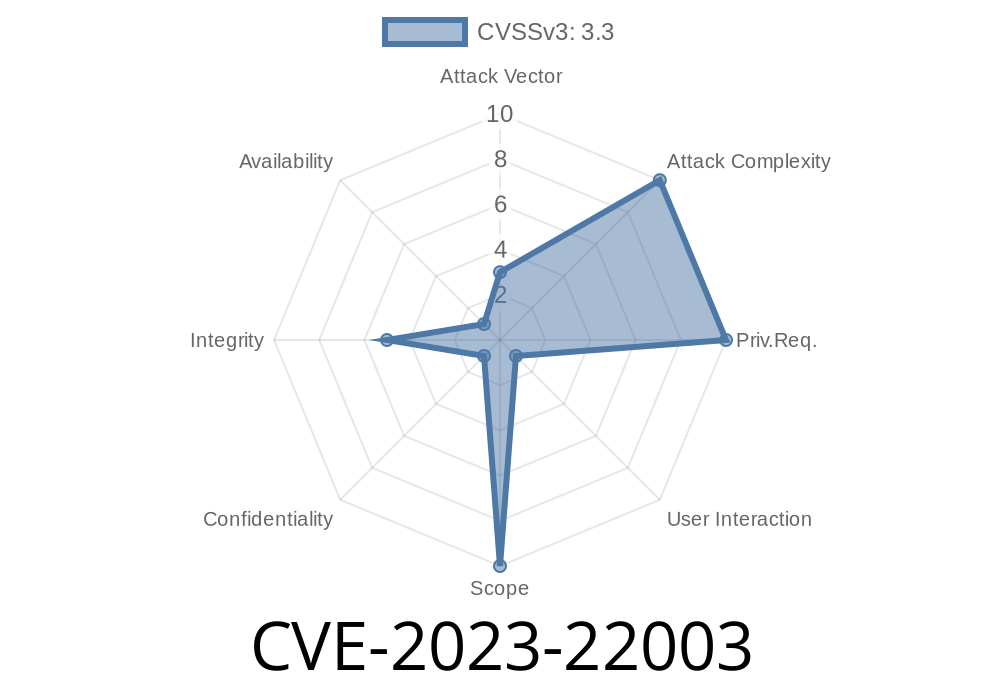
User Interaction: Yes (requires help from another user)
- Impact: Integrity (unauthorized update/insert/delete of accessible data)
Vector:
CVSS:3.1/AV:L/AC:L/PR:N/UI:R/S:U/C:N/I:L/A:N
What's the Real-World Impact?
This bug does not give the attacker full system access or leak confidential files. But it allows data tampering—think log file edits, misconfigured settings, or unexpected data changes that can be hard to detect. Because it requires another person's interaction (for example, tricking an admin to use a manipulated script or utility), it's not fully "auto-exploitable" but can be triggered by clever attackers with local infrastructure access.
How the Vulnerability Works
The vulnerability sits in a _utility_ used by Solaris (Oracle has not named the exact utility). Poor permission handling allows a local attacker, who doesn't have to be logged in as any special user, to alter data in a way that is normally not allowed—if they can get a legitimate user to run a manipulated script, binary, or command for them.
Attacker gains local system access (physically, via SSH, or as an unprivileged user).
2. Attacker creates a tainted file or binary in a directory accessible to another, higher-privileged user (like /tmp/, user's home dirs, etc).
3. Attacker tricks another user (system admin, or cron job) into running their tampered utility or script—by social engineering, phishing, or abuse of scheduled tasks.
4. When executed, the attacker's payload tampers with data that they shouldn't be able to touch—logs, configuration, or other system files—exploiting the permissions bug in the Solaris Utility component.
Example Exploit Code
Below is a generalized demonstration of how such an exploit might look (for educational purposes only):
# attacker.sh - crafted file to exploit improper input handling

#!/bin/bash
# Place this in a world-writable directory, e.g., /tmp/
# Suppose victim runs /usr/lib/solaris-utility mytmpfile
# which is symlinked to /etc/importantcfg

ln -s /etc/importantcfg /tmp/mytmpfile

# Now, if 'solaris-utility' (run by the victim) does not check ownership,
# it might end up writing to /etc/importantcfg, letting attacker insert data

echo "hacked_setting=enabled" > /tmp/mytmpfile
> Note: This example demonstrates a classic symlink attack pattern, commonly seen in local privilege escalation flaws where input or file ownership isn't checked.
How Can Attackers Trigger This? (More Detail)
- The attacker typically cannot exploit this alone—they need someone else (like a cron job or unsuspecting admin) to interact with the manipulated utility or file.
Waiting for legitimate users to access or process them using vulnerable utilities
- No credentials or special privilege are needed: The system itself may provide all the needed access
- If successful, the attacker changes data; however, they cannot read secret files or cause a full system crash or denial of service through this bug.
Reference Links (Original Advisories)
- Oracle April 2023 Critical Patch Update for Solaris
- National Vulnerability Database: CVE-2023-22003
- Oracle Security Alert Documentation (Oracle Customer login required)
Patch Immediately: Oracle has released patches. If you run Solaris 10 or 11, update NOW.
- Restrict Local User Access: Limit who can log onto infrastructure where Solaris runs, especially those who could be tricked into running unknown files/scripts.
- Audit File Permissions: Check for directories and utilities that may be world-writable or misconfigured.
- Educate Staff: Warn admins and regular users not to run scripts/executables from untrusted sources, and be wary of files in shared directories like /tmp/ or /var/tmp/.
Conclusion
CVE-2023-22003 shows that even a _low-rated_ flaw can have real consequences—especially when attackers use their access and some creative thinking to bring a vulnerability to life.
Oracle Solaris users: don't ignore this bug. Patch soon, monitor data integrity, and maintain good local security hygiene to keep your systems safe!
Share this post if you run Solaris or know someone who does. Questions? Leave a comment or contact us.
Timeline
Published on: 04/18/2023 20:15:00 UTC
Last modified on: 04/19/2023 19:53:00 UTC