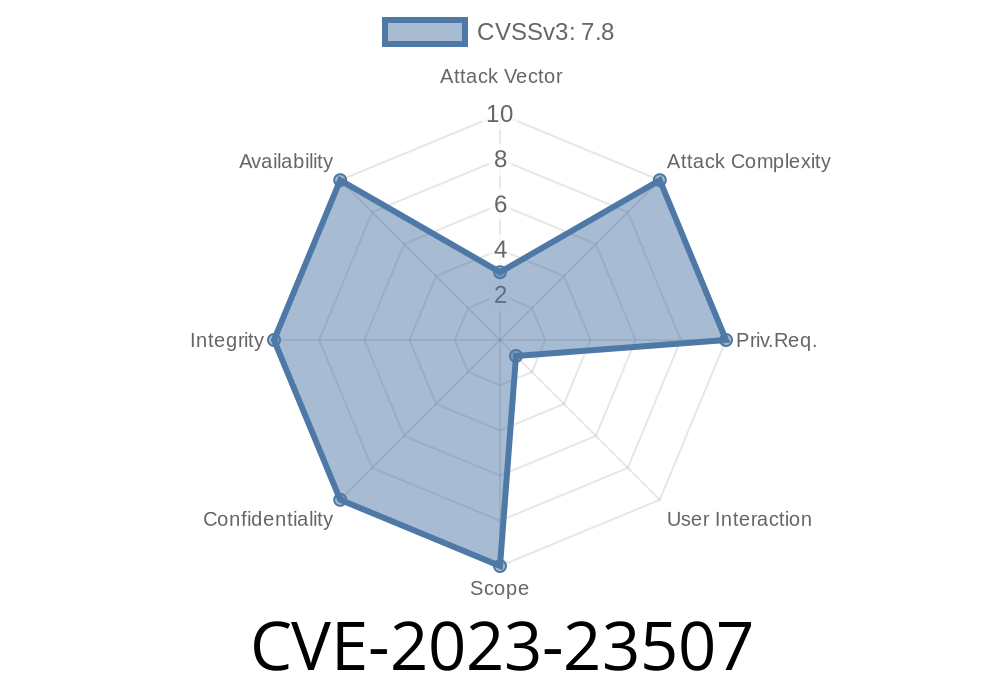
---
Introduction
In January 2023, Apple addressed a severe vulnerability tracked as CVE-2023-23507. This issue allowed malicious applications to execute arbitrary code with kernel privileges, potentially taking full control of affected macOS devices. The root cause? Insufficient bounds checking in one of the operating system’s kernel components. Although Apple patched the problem in Ventura 13.2 and Monterey 12.6.3, understanding its mechanics gives valuable insight into secure development and kernel exploitation on macOS.
This article walks through the vulnerability, explains its technical details, shows how an attacker could exploit it, and provides links to further sources.
What is CVE-2023-23507?
CVE-2023-23507 is a kernel vulnerability in Apple’s macOS operating system. According to Apple’s security notes, "An app may be able to execute arbitrary code with kernel privileges." The issue was caused by missing or incorrect bounds checks in the kernel’s memory handling, which could be abused by a specially crafted application.
Technical Details
The flaw lies in failing to check the size of user-supplied data before using it in kernel operations, commonly referred to as an "out-of-bounds write" or "buffer overflow." An attacker could supply an oversized input that would overwrite critical kernel memory, redirecting code execution.
Monterey before 12.6.3
The problem was fixed by adding stricter bounds checking on user-provided data.
Here’s a generic view of what such issues look like in code (not Apple’s actual source)
// Pseudocode illustrating faulty bounds check
void vulnerable_function(char *user_buffer, size_t user_len) {
    char kernel_buffer[256];
    // No validation if user_len is <= 256!
    memcpy(kernel_buffer, user_buffer, user_len);
}
If user_len is greater than 256, this code will overflow kernel_buffer, allowing arbitrary data to overwrite adjacent kernel memory. A correct implementation should check that user_len does not exceed kernel_buffer's size.
// Fixed version
if (user_len <= sizeof(kernel_buffer)) {
    memcpy(kernel_buffer, user_buffer, user_len);
} else {
    // Reject the input as invalid
}
In practice, attackers would
1. Craft a malicious app that interacts with the affected kernel routine using a large or specially crafted buffer.
Here’s a simple pseudocode exploit sketch
// [Pseudocode Example] Using a device call to trigger the bug
int fd = open("/dev/vulndrv", O_RDWR);
char evil_buffer[4096]; // much larger than expected
memset(evil_buffer, 'A', sizeof(evil_buffer)); // Fill the buffer
write(fd, evil_buffer, sizeof(evil_buffer)); // Send to vulnerable driver
A real exploit would overwrite specific data to hijack execution, eventually spawning a root shell or opening the system to further attacks.
Patching and Mitigations
Apple quickly fixed CVE-2023-23507 by improving bounds checks in the affected code. If your system runs Ventura 13.2, Monterey 12.6.3, or later, you are not vulnerable.
References
- Apple Security Update: HT213606
- NIST CVE-2023-23507 Entry
- Synacktiv macOS kernel exploitation primer (Blog)
Summary
CVE-2023-23507 is a critical macOS kernel bug that threatened all unpatched Macs. By abusing lax bounds checking, a malicious app could seize total kernel control. Apple’s patch makes exploitation impossible, but the underlying lesson—never trust unchecked input—remains vital for every developer and security pro.
Always keep your system up to date and be wary of untrusted apps!
*This post was written exclusively to demonstrate the risk and patch details of CVE-2023-23507. It is not intended to encourage illegal activities or exploitation of vulnerabilities.*
Timeline
Published on: 02/27/2023 20:15:00 UTC
Last modified on: 03/04/2023 02:04:00 UTC