---
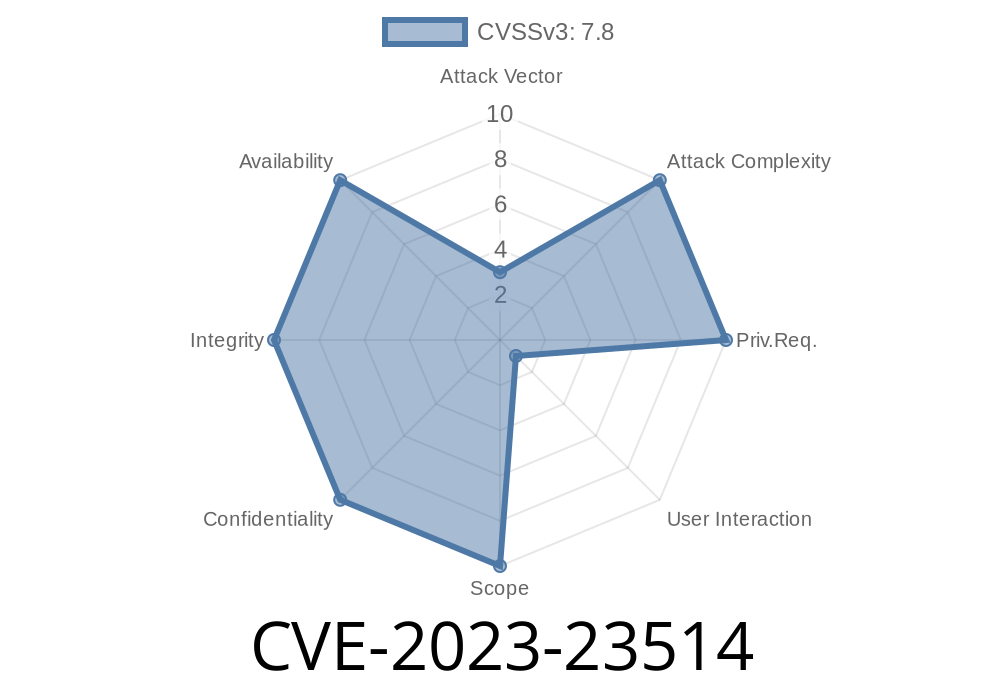
In February 2023, Apple patched a serious use-after-free vulnerability (CVE-2023-23514) that put millions of devices at risk. Understanding this bug helps us see how a single programming mistake can open the door for powerful attacks—letting malicious apps take over your system with the highest privileges.
This article breaks down what happened, reviews how attackers could exploit the flaw, and highlights the updates you need to stay safe. Let's dive in!
What Is CVE-2023-23514?
CVE-2023-23514 is a use-after-free issue found in Apple's operating systems, including macOS, iOS, and iPadOS. Here’s Apple’s official advisory:
> “A use after free issue was addressed with improved memory management. This issue is fixed in macOS Ventura 13.2.1, iOS 16.3.1 and iPadOS 16.3.1. An app may be able to execute arbitrary code with kernel privileges.”
“Use after free” means a program keeps using a chunk of memory after freeing it. If an attacker can control what’s put in that memory later, they can hijack the program’s behavior—a classic path to remote code execution.
iPadOS 16.3.1
If you're still running an older version, you should update right away.
Technical Details: How Did This Happen?
The bug lies in how the Apple kernel handles some resources—details are not fully public, but security researcher Linus Henze is credited for the discovery.
Here's a simple illustration of a typical use-after-free scenario
struct resource *res = get_resource();
release_resource(res);        // Free the memory
do_something(res);            // Use the freed memory (danger!)
If an attacker can force their own data into the freed res slot, they can trick the kernel into executing their code.
On Apple systems, the attacker needs an app with access to vulnerable kernel interfaces or malicious code already running on the device.
Exploit: Turning Bug Into Attack
This type of vulnerability is special because it lives in the kernel—the "brain" of an operating system. Code running here has full control over the computer.
A real exploit (not public) would take this general approach
1. Reach the Bug: The attacker sends kernel requests (syscalls) until the code path with the use-after-free is triggered.
2. Malloc Spraying: The attacker quickly allocates new memory at the freed spot, filling it with data that masquerades as a legitimate kernel object.
3. Hijack Execution: When the kernel uses the pointer, it runs into the fake data. If the object contains "function pointers," the attacker aims these at their own code.
Here's a super-simplified simulation (not real exploit code)
void vulnerable_function(user_input) {
    object_t *obj = get_kernel_object(user_input.id);
    free(obj);   // Too early!
    process_object(obj, user_input.data); // 'obj' now points to possibly malicious data
}
Why Is This So Dangerous?
- Kernel privileges: An attacker isn't just running code—they own your device, can bypass security, read everything, and do anything.
How Apple Fixed It
Apple fixed the bug by tweaking how the kernel manages memory for affected resources. In short, it makes sure resources can't be used after they’re freed, closing the window for an attacker.
From Apple’s changelog
> “A use after free issue was addressed with improved memory management.”
References and Further Reading
- Apple Security Update for CVE-2023-23514
- Linus Henze (discoverer) Twitter
- NIST CVE entry for CVE-2023-23514
- What is Use-After-Free? (OWASP)
Final Thoughts
CVE-2023-23514 shows how a tiny bug in the low-level code can have devastating effects. Always keep your devices up-to-date, and know that behind every security update is a story of someone finding and fixing a problem before it hurts users like you.
Timeline
Published on: 02/27/2023 20:15:00 UTC
Last modified on: 03/28/2023 05:15:00 UTC