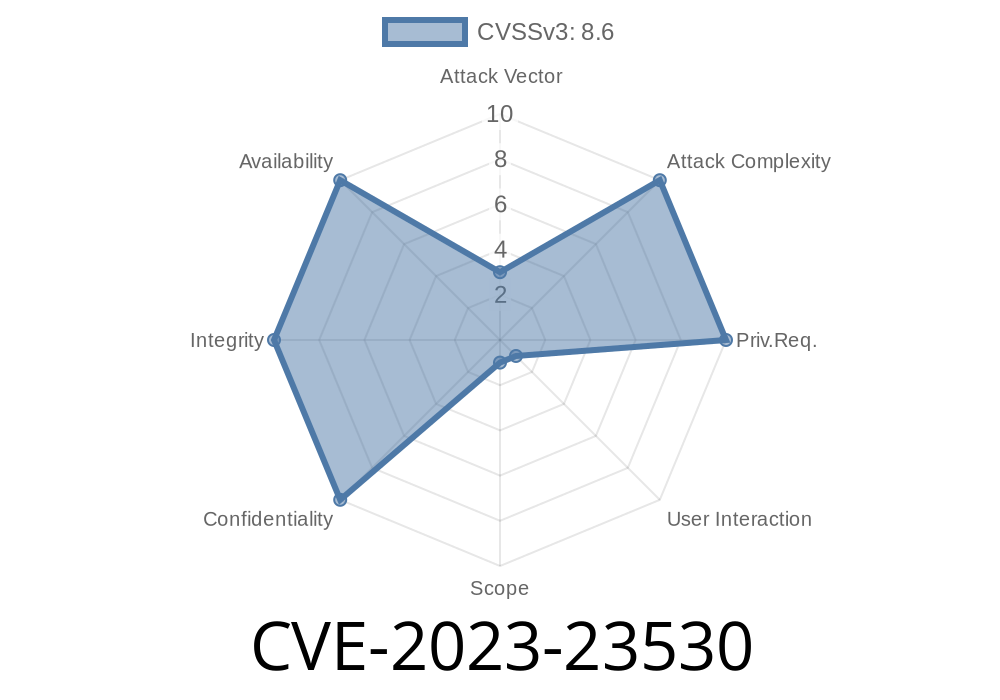
In early 2023, Apple patched a critical vulnerability—CVE-2023-23530—that put millions of users at risk. The flaw affected macOS Ventura, iOS, and iPadOS, and could let a malicious app break free from its sandbox. In simple terms: an app could run code on your device where it shouldn't, possibly even with special privileges. In this post, I’ll break down what happened, show you code snippets to help understand, and link to the official references.
What is CVE-2023-23530?
CVE-2023-23530 is a vulnerability caused by improper memory handling in Apple’s operating systems. Specifically, it meant an app could trick the system into running its code outside of the safe, restricted sandbox. This opens doors to malware, data theft, and all sorts of bad stuff.
Apple’s advisory said:
> “An app may be able to execute arbitrary code out of its sandbox or with certain elevated privileges. This issue was addressed with improved memory handling.”
> — Apple Security Updates
Where Was the Bug?
Apple didn't go into major detail (they rarely do), but security researchers revealed the flaw was in the Kernel, the core of the operating system. By abusing improper memory management, an attacker could overwrite memory in just the right way to get code execution.
iPadOS (before 16.3)
Fixed in:
Exploit Details: How Could an Attacker Use This?
Imagine you install an app from outside the App Store, or maybe a third-party profile lets a malicious app in. Thanks to CVE-2023-23530, that app could potentially:
Gain system or elevated privileges
Here’s a simplified version of how such an attack might look in code terms.
1. App allocates memory and writes out-of-bounds
The kernel misses a bounds-check.
char buffer[256];
// Vulnerable function in kernel (hypothetical)
void process_input(char *input) {
    strcpy(buffer, input);  // No length check!
}
// Attacker sends overly large input:
char evil_input[1024];
memset(evil_input, 'A', sizeof(evil_input));
process_input(evil_input); // Overwrites memory
Here, the attacker overflows buffer, possibly altering critical kernel data.
Suppose they overwrite function pointers or security flags
void (*func_ptr)() = safe_function;
// After overflow:
func_ptr = evil_function; // Attacker's function outside sandbox
func_ptr(); // Executes code with kernel privileges!
3. Result: Code Execution Out of Sandbox
The app isn’t limited anymore. It's running as if it's part of the system.
Why Is This Scary?
This isn’t just a crash or a minor bug. With code execution out of the app sandbox, an attacker could:
Real-World Example: A Similar Apple Exploit
While the full PoC (proof-of-concept) for CVE-2023-23530 is not public, Project Zero by Google describes similar Apple kernel attacks in this research. The key is always a memory error letting untrusted code slip past safety checks.
How Was It Fixed?
Apple says: “The issue was addressed with improved memory handling.”
Example improved code
void process_input(char *input) {
    strncpy(buffer, input, sizeof(buffer));
    buffer[sizeof(buffer) - 1] = '\'; // Always terminate
}
References
- Apple Security Update: macOS Ventura 13.2, iOS 16.3, iPadOS 16.3
- NIST CVE Entry: CVE-2023-23530
- Project Zero: iOS Kernel Attacks
In summary:
CVE-2023-23530 shows how a simple bug in memory management can threaten every Apple user. The best defense? Keep your devices up-to-date and stick to trusted sources for apps.
Timeline
Published on: 02/27/2023 20:15:00 UTC
Last modified on: 03/08/2023 16:56:00 UTC