---
In May 2023, Microsoft published a critical security advisory about CVE-2023-24953—a severe remote code execution (RCE) vulnerability lurking inside Microsoft Excel. If exploited, this flaw allowed attackers to run arbitrary code just by getting victims to open malicious Excel files. Here, we dive deep into how CVE-2023-24953 works, detail its exploit mechanics, and offer simple defensive steps, all in easy-to-follow language.
What Is CVE-2023-24953?
CVE-2023-24953 is a vulnerability discovered in the way Microsoft Excel handles certain objects in specially crafted XLS files. When Excel processes one of these booby-trapped files, it can be tricked into executing arbitrary code with the same privileges as the user.
The bug mainly affects these versions
- Microsoft Excel 2013 (x64/x86)
- Microsoft Excel 2016 (x64/x86)
Microsoft 365 Apps for Enterprise
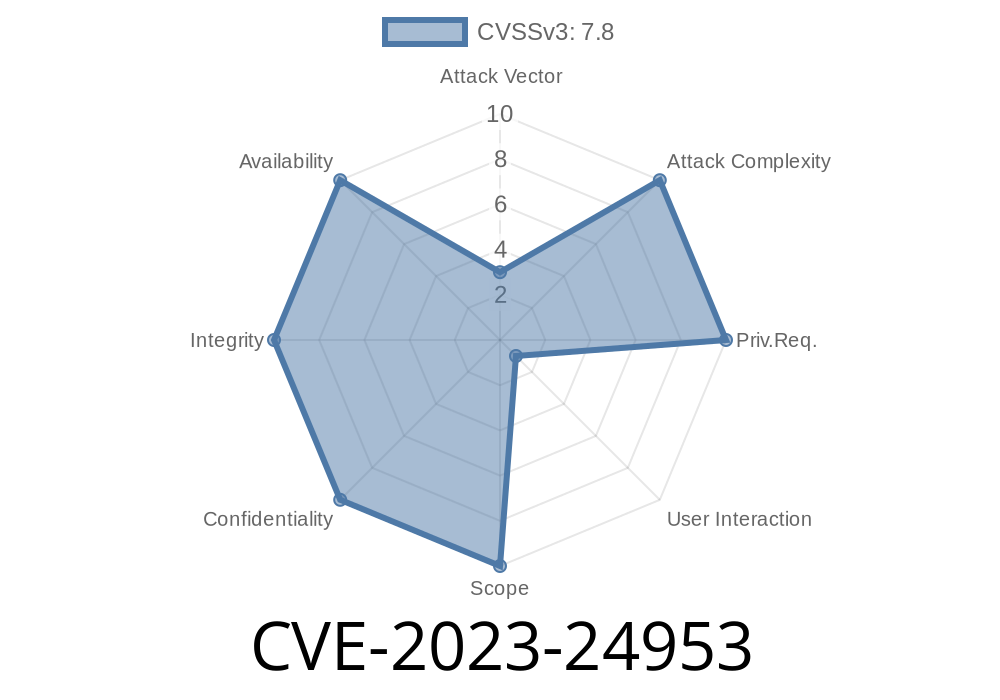
Microsoft itself assigned the vulnerability a CVSS score of 7.8 (High). You can read the official advisory here:
Microsoft Security Response Center (MSRC) CVE-2023-24953
How Does It Work?
The heart of the issue is how Excel parses certain object types or macro-enabled content within a file—often relating to how complex formulas, embedded macros, or even OLE (Object Linking and Embedding) objects get processed.
An attacker can create a specially crafted .xls or .xlsm file. Just opening this file in a vulnerable version of Excel is enough to trigger the exploit.
Craft a Malicious XLS File:
The attacker builds an Excel file containing malformed object references—perhaps embedded macros or bad OLE structures that hijack normal parsing.
Remote Code Gets Run:
The code now runs on the victim’s computer—capable of installing malware, stealing data, or acting as a backdoor.
Code Example: Crafting a Malicious XLS Macro
Below is a simple VBA macro that, when run, launches a calculator. When exploiting CVE-2023-24953, the attacker might try to trigger similar shell execution via a crafted macro payload:
Sub Auto_Open()
    Shell "calc.exe", vbNormalFocus
End Sub
> Note: In a real attack, this payload would be obfuscated or more sophisticated, but the above clearly demonstrates how an attacker can execute arbitrary code.
To weaponize the vulnerability, attackers can embed this macro in a custom, malformed XLS file—using additional malformed objects to bypass traditional Excel security prompts.
Build a Macro-Enabled XLSM File with the above VBA code.
2. Alter Embedded Object References using a binary file editor to create malformed references triggering the bug.
Original Microsoft Advisory:
https://msrc.microsoft.com/update-guide/vulnerability/CVE-2023-24953
NIST NVD Entry:
https://nvd.nist.gov/vuln/detail/CVE-2023-24953
Security Blog Example (for context):
https://www.tenable.com/cve/CVE-2023-24953
Conclusion
CVE-2023-24953 is a significant Excel bug that was actively exploited in real-world attacks. Always keep your software up to date, treat unexpected Excel files with suspicion, and monitor your network for malicious activity. For more technical details, always refer to the original advisories linked above.
Stay safe!
Excel is powerful, but with great power comes great responsibility... and risks.
Timeline
Published on: 05/09/2023 18:15:00 UTC
Last modified on: 05/16/2023 16:16:00 UTC