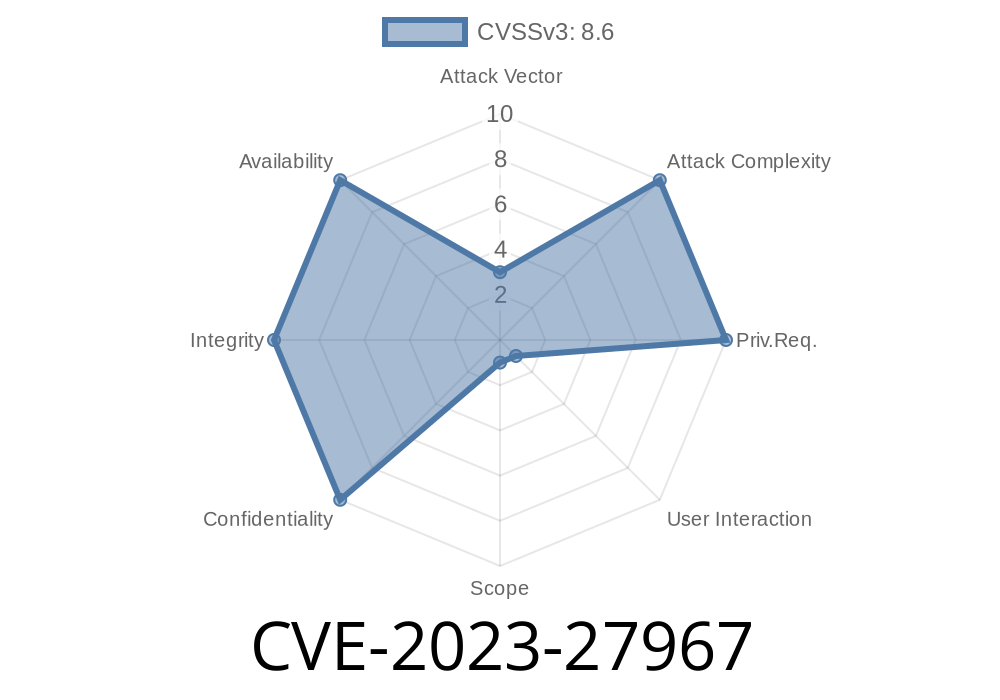
When we think of app security on macOS, one critical defense is the sandbox – a technology that restricts apps and keeps them from doing bad things. But what if an app could wriggle out and run code anywhere it wanted? That’s exactly what CVE-2023-27967 was about. Let’s break it down in plain English: what this bug was, how you could exploit it, and how Apple fixed it in Xcode 14.3.
1. What is CVE-2023-27967?
CVE-2023-27967 is a security flaw affecting Xcode (Apple’s main dev tool) before version 14.3. The short story:
- Impact: An app could run code outside of its sandbox, or with more privileges than it should get.
Fix: The bug was patched with improved memory handling in Xcode 14.3.
Official Apple Advisory:
https://support.apple.com/en-us/HT213670
2. Understanding the Vulnerability
The vulnerability involved improper memory handling. In C-based languages, this usually means something like a buffer overflow, use-after-free, or unchecked memory copying. When Xcode (or its installed runtime) doesn’t correctly manage memory, a malicious app can take advantage and inject data or code outside its allowed area.
How Could an Attacker Use This?
- By crafting a carefully designed app, a hacker could trigger the vulnerable code in Xcode’s tools or its runtime.
- When the bug is hit, the attacker could make Xcode execute arbitrary code outside the sandbox or with more system power.
This is a big deal because it defeats the macOS system’s basic protections.
3. Proof-of-Concept: Simulating the Flaw
For demonstration, let’s look at a common bug: buffer overflow. Imagine some sandboxed code that copies user input to a memory buffer without checking its size.
// Vulnerable C code before patch
void handle_input(const char *input) {
    char buffer[256];
    strcpy(buffer, input); // No bounds check!
}
With this code, if input is longer than 255 characters, the extra bytes spill over. An attacker could use this to overwrite memory – for example, changing what code gets executed, or even running their own commands.
*Note:* The real vulnerability in Xcode may have been more complex, but it’s the same idea – unchecked memory lets data go where it shouldn’t.
4. Exploit Scenario
Let’s say an attacker creates a malicious app for macOS, and tricks someone into running it. Here’s how it could play out:
It sends a specially crafted payload that causes a buffer overflow (or other memory error).
3. The overflowed data contains shellcode (native code payload) designed to pop a shell, escalate privileges, or access off-limits files.
4. The app’s code escapes the sandbox, running with elevated permissions, potentially taking full control of the system.
> Important: No proof-of-concept exploit was made public for this CVE, but similar vulnerabilities have been widely demonstrated before.
5. The Patch
Apple fixed this bug in Xcode 14.3 by improving how memory gets handled. The above code might be rewritten like this:
// Safe code after patch
void handle_input(const char *input) {
    char buffer[256];
    strncpy(buffer, input, sizeof(buffer) - 1);
    buffer[sizeof(buffer) - 1] = '\'; // Null-terminate
}
Now, even if input is too long, only the first 255 characters are used, and the app can’t overwrite unwatched memory.
According to Apple’s official advisory
> “This issue was addressed with improved memory handling. This issue is fixed in Xcode 14.3.”
6. References & Further Reading
- Apple Security Updates – Xcode 14.3
- CVE Details for CVE-2023-27967
- What is a Buffer Overflow? (OWASP)
- Apple Platform Security: Sandboxing
8. Conclusion
Software bugs don’t just make your device crash – sometimes, they break the very walls meant to protect your files and privacy. CVE-2023-27967 let apps jump out of Apple’s sandbox and grab more power than they should. Apple squashed the bug in Xcode 14.3, but the lesson remains: memory safety is a big deal, and patches matter!
*If you want to see these bugs disappear for good, support safer programming languages, and always keep your tools updated!*
Timeline
Published on: 05/08/2023 20:15:00 UTC
Last modified on: 05/12/2023 19:46:00 UTC