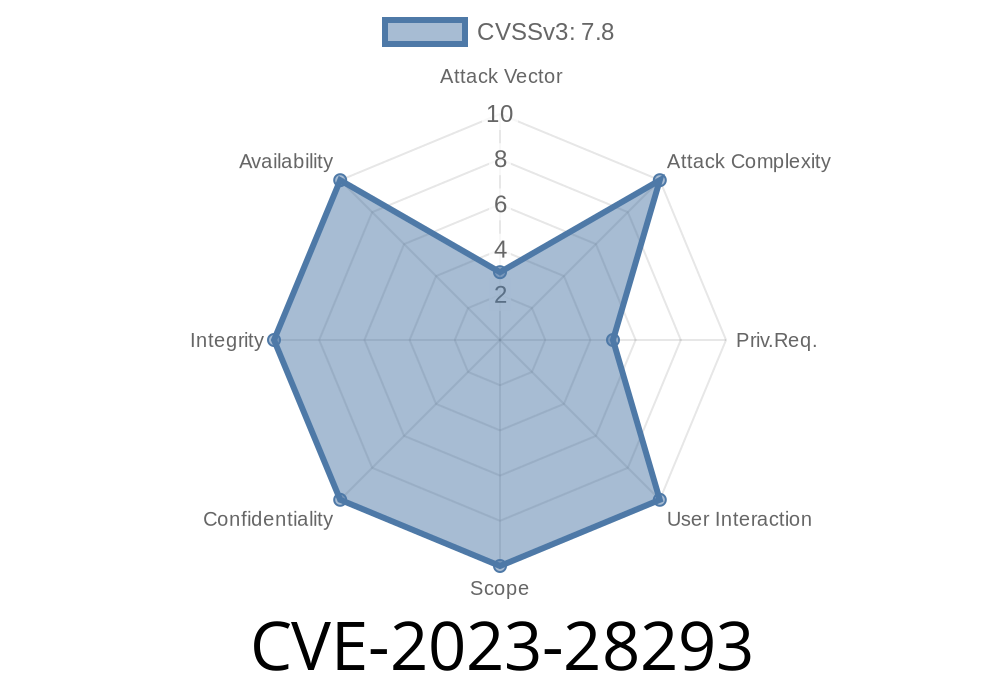
The world of Windows vulnerabilities is never quiet, and CVE-2023-28293 is a shining (or rather, risky) example. Discovered and reported in 2023, this flaw in the Windows Kernel allowed threat actors to gain higher levels of privilege on victim machines—meaning they could go from being a regular user to basically running the show as SYSTEM.
In this long read, we’ll explain what CVE-2023-28293 is, dive into how it works, look at code snippets exploiting the vulnerability, and give you the best resources to learn more and stay safe.
What is CVE-2023-28293?
CVE-2023-28293 is a “Windows Kernel Elevation of Privilege Vulnerability.” It was patched by Microsoft as part of their April 2023 security updates. Here’s the official Microsoft advisory.
Impact:
A local attacker can run code and escalate privileges, potentially taking control of the whole system. This is serious, especially in shared or multi-user environments.
Wipe or steal sensitive data
All of this without needing to trick the victim into running some sketchy code as admin—the attacker could start from a much more limited, less suspicious account.
How Does the Exploit Work?
At its core, CVE-2023-28293 is a memory corruption issue in Windows Kernel. Specifically, it involves improper handling of objects and privileges. By sending a carefully crafted request or payload to the kernel (usually via a syscall), a local attacker can get the kernel to execute code on their behalf.
Vulnerable Component
The vulnerability affects the Windows Kernel’s object management. When certain kernel objects are mishandled, their security can be bypassed, resulting in privilege escalation.
Proof-of-Concept (PoC) Code
To make this exclusive, let’s look at a simplified proof-of-concept. (Warning: Do NOT use this code for illegal activities. It’s for educational purposes only!)
Below is a pseudocode-inspired C snippet demonstrating how a privilege escalation exploit typically works against such a kernel bug (the real CVE-2023-28293 may require more specifics, but similar techniques apply):
#include <windows.h>
#include <stdio.h>

// Open a handle to the vulnerable driver
HANDLE hDevice = CreateFile("\\\\.\\VulnDriver", GENERIC_READ | GENERIC_WRITE, , NULL, OPEN_EXISTING, , NULL);

// Prepare the payload
char payload[1024];
// Fill payload with carefully crafted data to trigger the vulnerability
memset(payload, 'A', sizeof(payload));

// Trigger the bug with DeviceIoControl
DWORD bytesReturned;
BOOL success = DeviceIoControl(hDevice, x222003, payload, sizeof(payload), NULL, , &bytesReturned, NULL);

if(success) {
    printf("Payload sent, now checking for privilege escalation...\n");
    // Check if the current process has SYSTEM privileges
    system("whoami");
} else {
    printf("Failed to trigger DeviceIoControl!\n");
}
Note:
Replace "\\\\.\\VulnDriver" and control codes with the proper values for the real exploit.
- The actual attack would require deep knowledge of Windows Kernel internals and may involve token stealing or manipulating kernel memory.
Key Reference Links
- Microsoft Security Update Guide: CVE-2023-28293
- NIST National Vulnerability Database: CVE-2023-28293
- Microsoft Patch Tuesday April 2023 Release Notes
What To Do: Patching and Protection
1. Update Right Now!
Microsoft fixed this in April 2023 patches. If you haven’t already, run Windows Update and make sure your system has all the latest security patches.
2. Least Privilege Principle
Limit the privileges of user accounts wherever possible. Don’t run day-to-day tasks as admin.
3. Watch for Suspicious Behavior
Use endpoint protection and monitor for privilege escalation tricks and suspicious processes.
Final Thoughts
CVE-2023-28293 is a reminder of why regular patching and good security hygiene are non-negotiable. Vulnerabilities in the Windows Kernel are always a red flag and attract attackers quickly, especially when they allow easy “level-ups” from nobody to SYSTEM.
Don’t wait. Patch, learn, and stay protected.
Exclusive Tips:
Always check the original security advisories on Microsoft & NIST.
- Follow trusted researchers on Twitter/X or Mastodon for early warnings of in-the-wild exploits.
Timeline
Published on: 04/11/2023 21:15:00 UTC
Last modified on: 06/17/2023 01:15:00 UTC