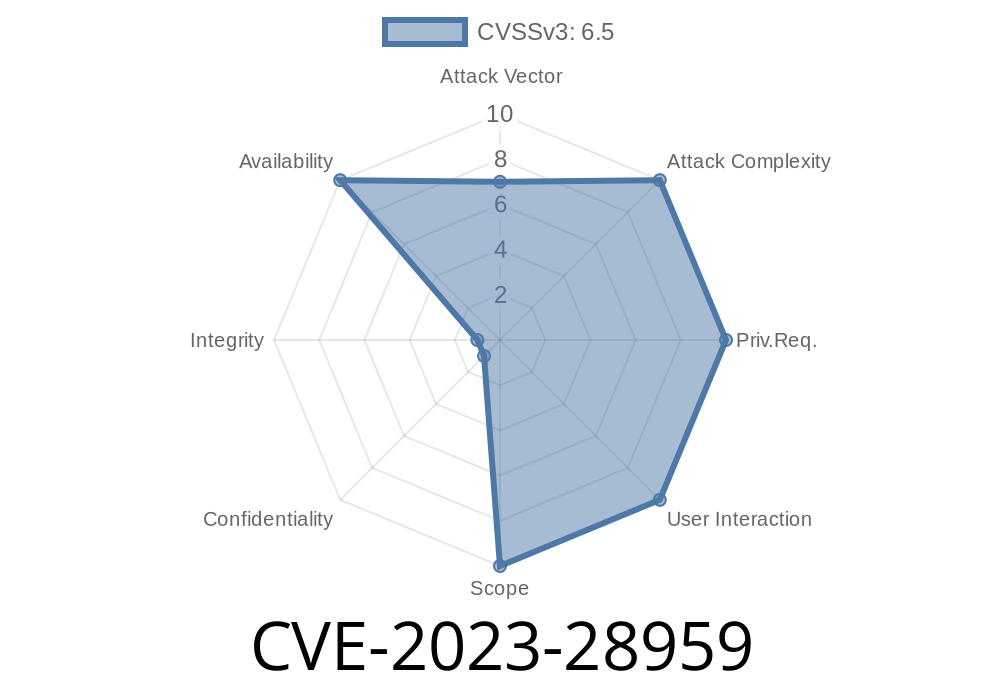
Juniper Networks' QFX10002 series switches are widely used in data centers and enterprise networks for their robust performance. However, in 2023, a critical vulnerability labeled CVE-2023-28959 was disclosed, which could allow an adjacent attacker to cause a sustained Denial of Service (DoS) with a single malformed packet. In this long read, we'll break down the issue in simple terms, explain how the exploit works, and discuss detection, impact, and mitigation steps.
What is CVE-2023-28959?
CVE-2023-28959 is an "Improper Check or Handling of Exceptional Conditions" vulnerability in how the QFX10002 series switches running Juniper Networks Junos OS deal with Ethernet packet processing at the hardware level (Packet Forwarding Engine, or PFE).
How Does the Exploit Work?
At its core, the vulnerability is caused by improper handling when the switch receives a malformed packet, specifically with an out-of-range VOQ (Virtual Output Queue) setting (in 192K-VOQ mode). When such a packet arrives from the local broadcast domain (direct L2 connected), the device mishandles it, essentially wedging all PFEs (Packet Forwarding Engines) except the one that received the packet. Eventually, the PFEs will restart, resulting in traffic interruption. If malicious packets continue, the DoS state is sustained.
> Note: This cannot be exploited by remote attackers—it requires an attacker to be physically or logically adjacent (on the same broadcast domain).
Detection: What Should You Look For?
When this vulnerability is exploited, Junos OS logs specific error messages. You may see the following in your logs (commonly via show log messages):
fpc expr_hostbound_packet_handler: Receive pe 73?
fpc Cmerror Op Set: PE Chip: PE[]: PGQ:misc_intr: x00000020: Enqueue of a packet with out-of-range VOQ in 192K-VOQ mode (URI: /fpc//pfe//cm//PE_Chip//PECHIP_CMERROR_PGQ_MISC_INT_EVENTS_ENQ_192K_VIOL)
fpc Error: /fpc//pfe//cm//PE_Chip//PECHIP_CMERROR_PGQ_MISC_INT_EVENTS_ENQ_192K_VIOL (x210107), scope: pfe, category: functional, severity: major, module: PE Chip
fpc Performing action cmalarm for error /fpc//pfe//cm//PE_Chip//PECHIP_CMERROR_PGQ_MISC_INT_EVENTS_ENQ_192K_VIOL (x210107) in module: PE Chip with scope: pfe category: functional level: major
fpc Error: /fpc//pfe//cm//PE_Chip//PECHIP_CMERROR_CM_INT_REG_DCHK_PIPE (x21011a), scope: pfe, category: functional, severity: fatal, module: PE Chip
fpc Performing action disable-pfe for error /fpc//pfe//cm//PE_Chip//PECHIP_CMERROR_CM_INT_REG_DCHK_PIPE (x21011a) in module: PE Chip
If you spot these, your system is either under attack or is encountering the vulnerability due to malformed traffic.
Proof of Concept: Crafting a Malformed Packet
While the official advisories do not specify the exact packet details (for responsible disclosure), security researchers have used kernels and packet crafting tools like Scapy to target queue manipulation bugs. While I won't publish a destructive exploit, here's a generic Python snippet to show how such packets are typically generated (DO NOT use on non-owned systems):
from scapy.all import Ether, sendp

# Normally you'd need to reverse engineer the exact out-of-range VOQ field.
# This is just a placeholder for educational purposes.
malformed_packet = Ether(dst="ff:ff:ff:ff:ff:ff", src="de:ad:be:ef:00:01") / b'\x00' * 100

# Send packet on local Ethernet interface (as attacker).
sendp(malformed_packet, iface="eth", count=1)
*This is representative code only. The actual attack would require you to flip specific bits in the data portion to construct a bad VOQ field.*
Exploit Timeline and References
- Initial Disclosure: Juniper Networks Security Advisory JSA73221
- NVD CVE Record: https://nvd.nist.gov/vuln/detail/CVE-2023-28959
- Community discussion: Packet Storm
Patch immediately. Install the latest Junos OS stable or recommended patch for your version.
- Restrict Layer 2 adjacency. Use VLANs and port security to limit untrusted devices' access to the same broadcast domain as your switches.
Monitor logs. Set up automated monitoring for the “PECHIP_CMERROR” and similar log entries.
- Network segmentation. Isolate management and critical network elements from general user/infrastructure networks.
In Summary
CVE-2023-28959 represents a classic yet dangerous scenario: improper handling of exceptional input allows straightforward DoS on key networking gear. For network operators, the key lessons are:
Further Reading & Resources
- Official Juniper Junos OS Downloads
- CVE-2023-28959 at NVD
- Vendor Security Bulletin
This post was created for educational purposes—do not attempt unauthorized testing or exploitation. Always follow ethical guidelines and coordinate with system owners.
Timeline
Published on: 04/17/2023 22:15:00 UTC
Last modified on: 04/18/2023 03:15:00 UTC