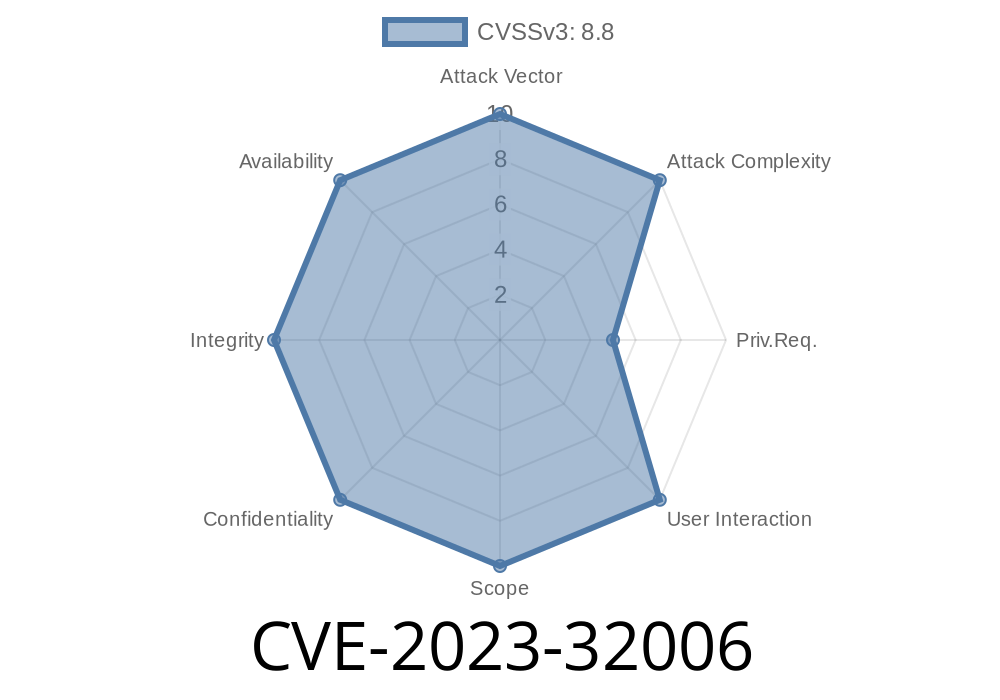
Node.js has long been praised for its broad feature set and active development. However, not every feature is rock-solid out of the box—some are marked as “experimental,” so they might include bugs or unexpected security issues. One such case is CVE-2023-32006. In this post, let's break down the vulnerability, show you a code snippet demonstrating the risk, and discuss what it really means for developers.
What is the Node.js Policy Mechanism?
Starting in Node.js 12, policy files allow administrators to control what code can be loaded at runtime, increasing security for production applications. Policies are managed using JSON files (like policy.json) and can restrict or allow modules and resources.
But here’s the catch: when something is “experimental,” it’s still a work in progress.
How it Works
CVE-2023-32006 arises because the internal Node.js method module.constructor.createRequire() can be used to import modules outside what’s allowed in your policy file (policy.json). This means a malicious or careless developer could use this method to sidestep your security settings without raising alarms.
Put Simply
If you’re relying on policy.json to block access to certain modules or files, this method can bypass those restrictions entirely.
20.x
If your app isn’t using the policy feature, you’re safe from this particular bug.
> Note: At the time this CVE was published, policies are still in experimental mode, so ideally you shouldn’t be using them in production.
Code Example: How is this Exploitable?
Suppose you have a policy.json that explicitly denies loading the fs (file system) module. Yet, code like this can import fs from anywhere:
// Normally blocked in policy.json
const { createRequire } = module.constructor;
const requireOutsidePolicy = createRequire('/'); // Root path

// This will still load 'fs', even if policy.json blocks it
const fs = requireOutsidePolicy('fs');

// Now you can read or write files
fs.writeFileSync('bypassed.txt', 'Policy bypassed!');
`json
{
"resources": {
"./main.js": {
"dependencies": ["./allowed.js"] // No 'fs' allowed!
}
}
Try using require('fs') in your main code: It fails as expected.
3. Now try the code snippet above: The createRequire trick works, and fs gets loaded. The policy is bypassed.
Real World Impact
In production, this vulnerability means any Node.js application dependent on policy files for security isn’t as safe as you think. A plugin, dependency, or even malicious user code could reach out for modules that policies should block—risking your system's integrity.
Mitigation & Fixes
- Update Node.js: As soon as a patched version is available for your version line, update! See the official CVE post.
- Avoid experimental features in production: Until Node.js policy gets out of “experimental,” avoid using it as a main line of defense.
References & Credits
- Node.js Official Security Advisory for CVE-2023-32006
- Issue Discussion on Node.js GitHub
- Node.js Policy Docs
Final Thoughts
CVE-2023-32006 is a good reminder that “experimental” features can carry real risk—sometimes, core security promises can be sidestepped with just a few lines of code. Always read release notes, watch for CVEs, and use features marked as “experimental” with caution, especially in production environments.
Stay safe, keep your Node.js up to date, and don’t rely solely on incomplete, under-documented features for your security!
Timeline
Published on: 08/15/2023 16:15:00 UTC
Last modified on: 08/22/2023 17:41:00 UTC