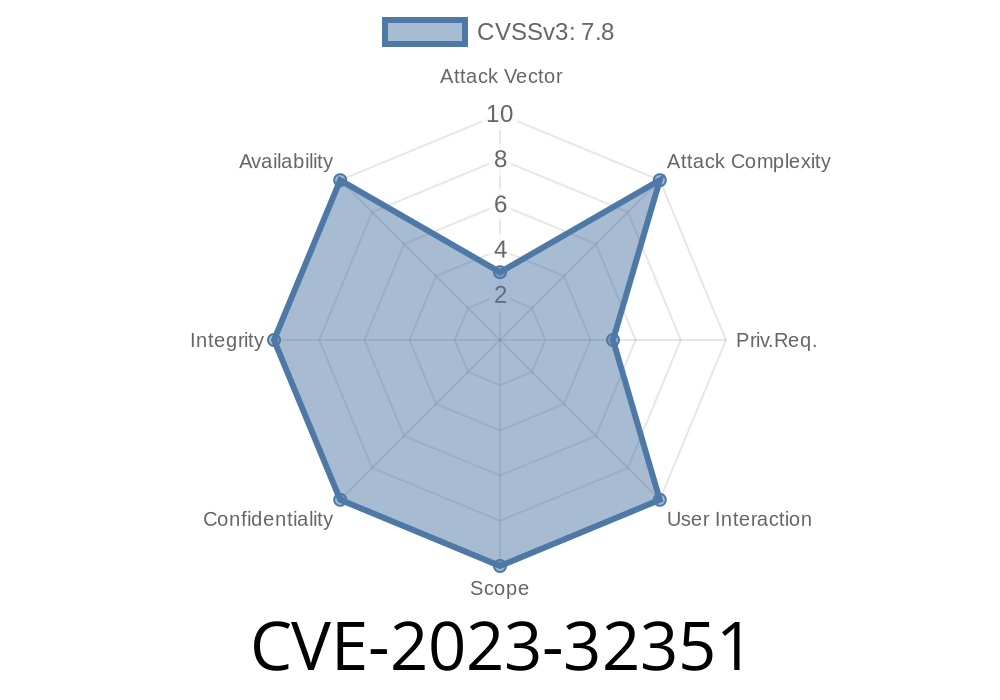
In May 2023, Apple quietly patched a serious security flaw—CVE-2023-32351—in iTunes 12.12.9 for Windows. This bug could've let a malicious app gain elevated permissions, effectively breaking out of its normal restrictions. While Apple’s note on the vulnerability was brief—"A logic issue was addressed with improved checks"—let’s break down what we know, why it mattered, and how such a flaw could be exploited in the wild.
What is CVE-2023-32351?
In short, CVE-2023-32351 is a privilege escalation vulnerability. Unprivileged (or low privilege) Windows programs could trick iTunes into running code with administrative rights. This isn’t a remote exploit—you’d already need to have some way of running code on the target system. But once in, the ability to jump to higher privilege opens the door to system-wide compromise.
Original Advisory:
Apple Security Update (May 23, 2023)
National Vulnerability Database Entry:
The official blurb
> "A logic issue was addressed with improved checks. This issue is fixed in iTunes 12.12.9 for Windows. An app may be able to gain elevated privileges."
Understanding the Logic Flaw
While Apple doesn't provide in-depth details, it’s common for these kinds of bugs to happen during tasks like service installation, update processes, or when handling temporary files. In the Windows ecosystem, it’s not uncommon for software running as a local service (with SYSTEM or Administrator privileges) to be tricked into executing user-supplied code or manipulating permission settings.
Let’s hypothesize what might be going on under the hood.
Example Scenario: Insecure Permission on a Service
Suppose iTunes creates or modifies a service during installation or updating, but forgets to explicitly set the permissions on that service. A non-privileged user may be able to replace or modify the service binary or configuration, making it possible to get that binary launched as SYSTEM on the next service start.
Here’s a simplified version to illustrate the idea
REM Hypothetical batch commands to exploit a permissive service
sc stop iTunesHelperService
copy malicious.exe "C:\Program Files\iTunes\iTunesHelper.exe"
sc start iTunesHelperService
If the service binary isn’t protected, a local attacker replaces the real iTunesHelper.exe with their own payload. When the service is started by Windows, the attacker's code runs as SYSTEM.
Of course, this is a simplified example. In the real world, there are more protections—but bugs in install/update logic often lead to these situations.
## Exploit Concept (for Research/Education)
Suppose iTunes for Windows launches an updater executable on login or during its operation, but fails to properly validate which user can write or replace the updater file:
When iTunes is triggered (by user or system), their code is executed as the privileged user.
Such privilege escalation bugs are very powerful because they provide an easy path to system compromise, even if the initial entry is through a low-privileged user account.
Recommended Mitigations
If you're still running iTunes on Windows, make sure to update immediately to 12.12.9 or later. Legacy versions, particularly on systems where users have access to C:\Program Files, are at risk.
- Get latest iTunes: Apple iTunes Download
If you manage endpoints, consider monitoring for strange activity from iTunes processes, especially if they’re being started by unexpected users.
References
- Apple Security Updates – May 2023
- Apple iTunes 12.12.9 Release Notes
- NVD - CVE-2023-32351
- Common Privilege Escalation Techniques on Windows
Final Thoughts
CVE-2023-32351 is a strong reminder that even mature, widely used software like iTunes can hide logic errors with serious consequences on Windows. Privilege escalation vulnerabilities are valuable for attackers and real headaches for defenders. Applying updates, especially for software running under Administrator/SYSTEM, is non-negotiable.
Happy (and safe) listening! 🚀
*This post is for educational purposes only. Always follow responsible disclosure and update your software promptly.*
Timeline
Published on: 06/23/2023 18:15:00 UTC
Last modified on: 07/27/2023 01:15:00 UTC