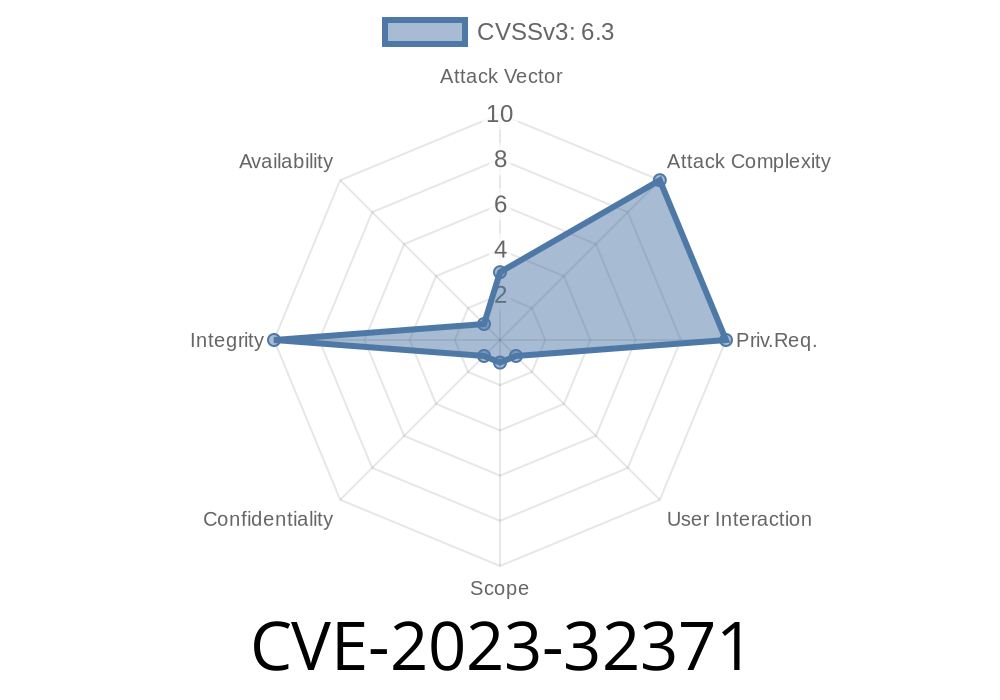
In May 2023, Apple fixed a major security vulnerability (CVE-2023-32371) in iOS, iPadOS, and macOS. This flaw could have let a malicious app escape its sandbox and access data or system resources it shouldn’t. In this article, I'll break down what this bug was, why it was dangerous, how it happened, and how Apple’s update patched it. I'll also share a sample code snippet illustrating the risk, as well as references for deeper technical details.
What is CVE-2023-32371?
CVE-2023-32371 was a vulnerability in how Apple’s sandbox—a core security feature—checked the actions of apps. The sandbox isolates apps from each other and the system, stopping them from accessing files or functions they shouldn't.
If exploited, this bug could let an app break out of its sandbox. In other words, a malicious app could steal your personal data or attack the rest of your device.
Apple’s advisory:
macOS Ventura 13.3 and earlier
Fixed in:
Understanding the Sandbox
When you install an app on an Apple device, it runs in a restricted “sandbox.” Imagine the sandbox as a fenced yard. The app can't get out or peek into someone else's yard.
But in this case, a bug in Apple’s Sandbox enforcement let apps break the fence. Due to insufficient boundary checks, apps could get access to resources outside their allowed area.
What went wrong:
Apple said, “The issue was addressed with improved checks.” That means some conditions weren’t properly validated.
Hypothetical Exploit Flow
Let’s say a malicious app wants to access your photo library—which it shouldn’t have rights to. Due to the flaw, it could trick the system or bypass a restriction to get that data.
Example Code Snippet (Illustrative Only)
This is a simplified demonstration in Swift to show the principle, not a real-world exploit.
import Foundation

// Normally, apps can only access their own directory
let sandboxDirectory = FileManager.default.homeDirectoryForCurrentUser

// Try accessing a forbidden directory by crafting a path
let forbiddenPath = "/private/var/mobile/Media/DCIM/100APPLE/"

// This should fail, but due to the bug, it *might* succeed
do {
    let photos = try FileManager.default.contentsOfDirectory(atPath: forbiddenPath)
    print("Accessed user's photos: \(photos)")
} catch {
    print("Access denied: \(error)")
}
Note: On a patched device, this code just gives an error. On unpatched systems, due to broken checks, the app might escape its sandbox.
How Did Apple Fix It?
> “The issue was addressed with improved checks.”
Apple improved how the operating system checks apps’ access to files and services. Now, any attempt to cross the sandbox boundary is strictly denied, and the old bypass is closed.
macOS Ventura below 13.4
Update now to get the fix!
- iOS Update Guide
- macOS Update Guide
Don’t Sideload Shady Apps
Always download apps from the official App Store. Malicious apps are usually sideloaded from unofficial sources.
References
- Apple Security Updates for CVE-2023-32371 (May 2023)
- NIST CVE Record for CVE-2023-32371
- Sandbox Protection on Apple Platforms
Summary
CVE-2023-32371 was a serious flaw that let apps break out of their sandbox on iOS and macOS. Apple fixed it in May 2023 by adding better checks to keep the sandbox walls strong.
To stay secure, just keep your devices updated and avoid third-party app stores. Security flaws will happen—but fast updates protect you from them.
Timeline
Published on: 06/23/2023 18:15:00 UTC
Last modified on: 07/27/2023 04:15:00 UTC