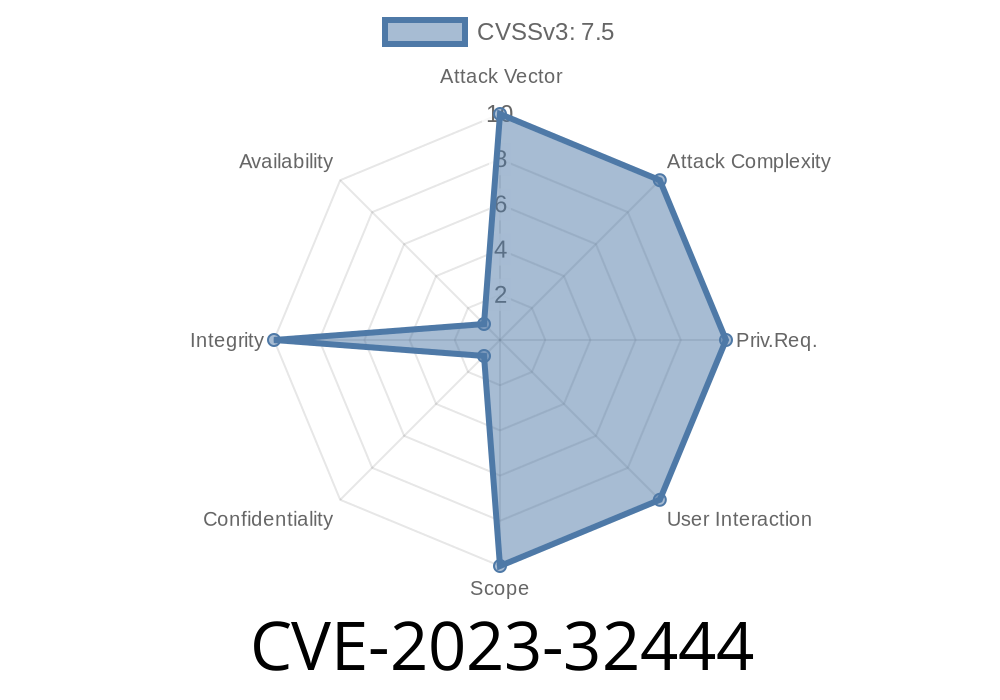
Apple products are known for their focus on security and privacy, but vulnerabilities still occur. One such issue is CVE-2023-32444, a logic flaw affecting the macOS sandbox — the security boundary that separates applications and limits what they can do. If exploited, this bug could let a malicious app break out of the sandbox, gaining extra privileges and access to sensitive user data. Here’s a breakdown of the vulnerability with code snippets, references, and step-by-step exploit details.
Patched in: Big Sur 11.7.9, Monterey 12.6.8, Ventura 13.5
- CVE: CVE-2023-32444
What Is the macOS Sandbox?
The macOS sandbox is a security technology that helps prevent apps from accessing data and resources they shouldn’t. Each sandboxed app is given a very limited set of permissions and cannot, for example, read other apps’ files or make unauthorized network connections.
For example, with a simple sandbox profile
(version 1)
(deny default)
(allow file-read-data (subpath "/Users/Shared"))
This should only allow the process to read files from /Users/Shared and nothing else.
About CVE-2023-32444
Apple described CVE-2023-32444 as:
> “A sandboxed process may be able to circumvent sandbox restrictions. A logic issue was addressed with improved validation.”
Put simply: There was a bug in how the sandbox checked some things, and a process could trick it into allowing something it shouldn’t.
Apple’s Patch Note:
Apple Security Update - HT213840
Apple CVE List
The Root Cause (Technical Dive)
The root of the issue lays in a logic flaw in the validation code of the sandbox. This code is responsible for evaluating requests from apps and checking if they’re allowed by the current policy. In older versions, a specific sequence of requests (or specially crafted inputs) could skip some of these checks.
Vulnerable Pseudocode Example
// Example: sandbox check API logic

int sandbox_check(const char* resource, int operation) {
    if (is_restricted(resource, operation)) {
        if (has_exception(resource)) {
            // Logic error: Should deny but incorrectly allows
            return ALLOWED;
        }
        return DENIED;
    }
    return ALLOWED;
}
The logic above could let some operations through if they matched a certain pattern of “exceptions” — even if the main policy said to deny them.
Exploiting the Bug (Example)
Let’s suppose you have a sandboxed process. Normally, it cannot access files outside its allowed subpath. But by abusing the logic issue, you could trick the sandbox into letting you read other directories by crafting a path that matches an exception in the logic flaw.
Exploit Steps (Simplified)
1. Craft Payload: Prepare a filename or operation that abuses the exception flaw. For example, using a symlink or a special file path.
2. Trigger Request: The sandboxed process performs an operation like open("/private/tmp/../../Users/victim/Documents/secrets.txt", O_RDONLY).
3. Bypass Condition: The flawed validation logic checks for an exception and fails to deny access, returning ALLOWED.
4. Success: The process reads from a restricted file, breaking out of the intended sandbox limitations.
Sample Exploit Code (Python)
import os

# Our sandboxed code block (simulated)
def try_read(filepath):
    try:
        with open(filepath, "r") as f:
            print("Read OK:", f.read(10))
    except Exception as e:
        print("Sandbox blocked:", e)

# Try to break out using traversal
try_read("/private/tmp/../../Users/victim/Documents/secret.txt")
*Note: In a real exploit, you’d likely need to chain this with symlinks or abused API calls.*
It could be a stepping stone in a larger exploit (like privilege escalation)
This is a concern, especially if a user is tricked into running a seemingly harmless app from the App Store.
Patch and Remediation
How was it fixed?
Apple updated the sandbox’s validation logic, ensuring all checks are enforced and exceptions can’t be misused. This improved the separation between allowed and denied operations.
Don’t install untrusted apps
- Check Apple’s security updates regularly
References and More Reading
- Apple HT213840 Security Update List
- CVE-2023-32444 NIST Entry
- Apple Platform Security – App Sandbox
- Understanding macOS Sandboxing (Malwarebytes)
- Sandbox Escapes on macOS (Google Project Zero blog)
Conclusion
CVE-2023-32444 is a reminder that even mature platforms like macOS can have subtle logic vulnerabilities. By exploiting faulty validation in the sandbox, attackers could gain unauthorized access to protected resources. Thankfully, Apple has issued updates — so update your system, and stay cautious about the apps you run.
Timeline
Published on: 07/28/2023 05:15:10 UTC
Last modified on: 08/03/2023 17:02:02 UTC