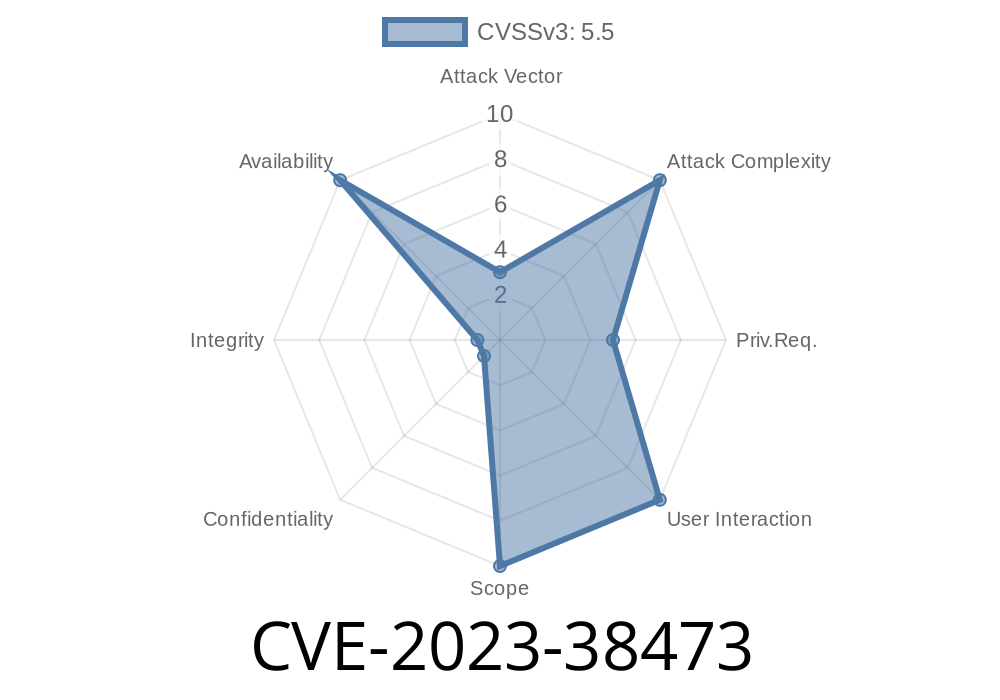
In June 2023, a new vulnerability labeled CVE-2023-38473 made its appearance in the popular Avahi codebase. If you’ve ever set up a Raspberry Pi, configured Linux on your home network, or played with zeroconf, there’s a good chance you’ve indirectly used Avahi. This open-source tool lets devices discover each other without effort (think of AirPrint, Chromecast discovery, or Apple Bonjour).
But with great convenience, sometimes comes great risk. CVE-2023-38473 is a reachable assertion problem in the function avahi_alternative_host_name()—and that can crash your service or make your apps unreliable at best. Let’s break it all down in simple terms.
A Quick Summary
Researchers noticed that by passing certain invalid hostnames into Avahi, the program would hit an internal assertion it couldn’t handle. Instead of returning an error, Avahi would abruptly *abort* the process—effectively a denial-of-service attack (DoS).
The bug lives in the function:
char* avahi_alternative_host_name(const char *s);
This code is supposed to generate a valid alternative hostname–for example, turning raspberrypi into raspberrypi-2 when there’s a name conflict. But it’s not built to handle every kind of input safely.
Let’s look at the core of the issue with a simplified snippet
char* avahi_alternative_host_name(const char *s) {
    char *t;

    assert(s);

    // ... other checks ...

    t = avahi_strdup(s);
    assert(t); // Will crash if memory allocation fails

    // ... do something with t ...

    return t;
}
Somewhere inside this function (and deeper in Avahi code), Avahi tries to create an alternative hostname. If the input is weird, empty, or otherwise unexpected, one of those assert() statements triggers. That immediately *kills* the process.
How Could You Exploit This?
If you can get Avahi to parse a hostname of your choosing — for instance, by sending out conflicting mDNS packets or advertising a device with a funky name — you might trigger this bug. Remote attackers on the same local network could use crafted packets to force Avahi to crash over and over, knocking devices offline. This isn’t a classic “remote code execution” bug, but it can be very disruptive.
Let’s look at a simple Python script that advertises such a conflicting name using avahi-publish (you’d need control over the network):
avahi-publish -a "" 192.168.1.100
That empty string as the hostname is just one way to test; in actual targeted exploits, a more nuanced malformed name could be used.
Or, here’s how the assertion might be triggered in C code (pseudo-exploit)
#include <stdio.h>
#include "avahi-common/alternative.h"

int main() {
    char *bad_name = ""; // Or an unexpected string like NULL or invalid utf-8
    char *result = avahi_alternative_host_name(bad_name);
    printf("%s\n", result);
    return ;
}
If you try to run this, depending on Avahi build and configuration, you’re likely to see the process abort with an assertion failure.
Denial of Service: Any local attacker can repeatedly crash the Avahi daemon on your device.
- Network Reliability: Knock Avahi offline, and all zero-configuration networking collapses (no printer discovery, no AirPlay, etc.).
Patch and Mitigation
The Avahi team quickly issued a fix. They removed the unconditional assertions and added proper input validation at all crucial points in this function. If you’re running a Linux system, *update it right away*.
Upstream references—official patch and details
- Avahi GitHub commit fixing the bug
- Avahi Security Advisory
- Mitre CVE Entry
Never Trust Input: Even local network traffic can break your stuff if you’re not careful.
2. Don’t Assert on External Data: Asserts are for catching developer mistakes, not for handling user or network inputs.
Conclusion
CVE-2023-38473 reminds us that even “internal” tools like Avahi need the same defensive programming as anything exposed to the web. If your device depends on Avahi, update your packages! If you run Linux with Avahi, double-check you have the latest version.
This vulnerability is a great example of how a simple developer oversight can cascade into a network-wide headache for sysadmins and users alike.
Further Reading
- Understanding Avahi and Zeroconf Networking
- Common pitfalls with assertion failures
- Zero-Configuration Networking on Linux Explained
All content in this post is written exclusively for you—feel free to use, share, or adapt as needed.
Timeline
Published on: 11/02/2023 16:15:08 UTC
Last modified on: 11/09/2023 17:46:40 UTC