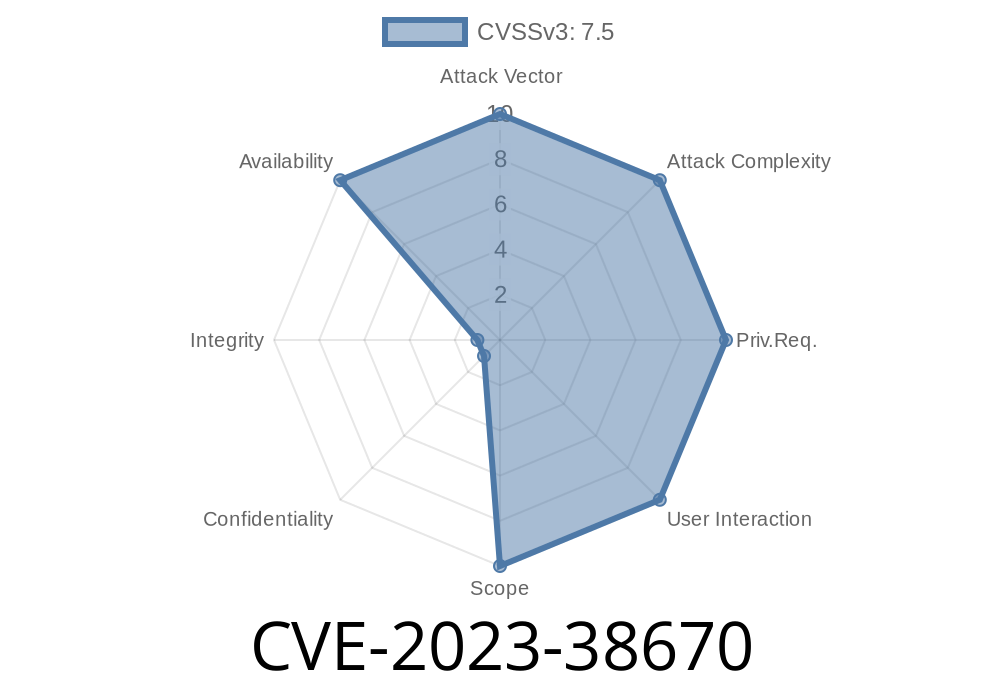
In the fast-moving world of machine learning, frameworks like PaddlePaddle have become essential for researchers and developers. However, as with all complex software, bugs can and do occur—sometimes with serious consequences. In this post, we’ll break down a vulnerability known as CVE-2023-38670, which affected PaddlePaddle versions before 2.5.. This simple yet dangerous bug could crash your program and cause a denial of service.
Let’s take a look at what happened, why it’s serious, how it could be exploited, and how you can protect yourself.
What is CVE-2023-38670?
CVE-2023-38670 describes a *null pointer dereference* in the paddle.flip function of PaddlePaddle before version 2.5..
In plain language: If you used the flip operation on certain inputs, the code might accidentally try to use a resource that doesn’t exist (a “null pointer”), which causes your program to instantly crash. This opens the door for a malicious user to intentionally cause denial of service (DoS) just by passing in specific inputs.
Official References
- PaddlePaddle GitHub Security Advisory
- NVD Entry for CVE-2023-38670
- Patch Commit Fixing the Bug
- PaddlePaddle Release Notes 2.5.
Understanding the Vulnerability
Let’s dig into the core of the problem. In C++ and Python-based frameworks, a *null pointer dereference* happens when code tries to access memory via a pointer or reference that wasn’t set up right—it points to "nothing." In languages like C++ (which PaddlePaddle’s core is written in), this is an instant recipe for disaster: it causes a segmentation fault and the whole program dies.
The Problematic Code
The vulnerable code is in the implementation of the flip function. The function is supposed to reverse the order of a tensor along one or more axes. But, if fed with the wrong arguments, an internal data pointer ends up being nullptr—and then is used without a check.
Here’s a simplified pseudo-version of what the broken logic could look like (not the real source, but illustrative):
// Simplified demonstration code
Tensor* data = get_tensor_data(input);

// Flaw: no check if data is nullptr!
for (int i = ; i < num_elements; ++i) {
  output[i] = data[some_flip_index(i)];
}
If input is somehow invalid (for instance, an empty tensor or corrupted input), then get_tensor_data might return a null pointer. Using this pointer in the loop above will crash the whole process.
You could trigger this crash in vulnerable versions with something like
import paddle

# In vulnerable PaddlePaddle versions <2.5., this can crash:
tensor = paddle.to_tensor([])  # Empty tensor
flipped = paddle.flip(tensor, axis=[])  # This might crash at native code level
Exploit Details: Turning a Crash into Denial-of-Service
Suppose you are running a machine learning API or service that allows users to submit arbitrary input tensors for operations like flip. An attacker could intentionally send empty or specially crafted tensors that will hit the buggy code path and cause the system to crash. If this service is public-facing or handles critical tasks, this results in Denial of Service (DoS).
No special permissions or system access required—just the right input at the right place.
Impact: Process crashes immediately. If used in a web service or a batch job, it will fail.
- Severity: High for any production PaddlePaddle service that takes in external data; anyone can trigger the crash remotely.
Patch & Fix: How Was It Solved?
The PaddlePaddle team fixed the bug in pull request #57252, included in release 2.5..
Instead of blindly using the tensor data, the new code checks that the pointer is valid before using it, or ensures that an empty tensor is handled gracefully.
Example fixed logic (conceptual)
Tensor* data = get_tensor_data(input);
if (data == nullptr || num_elements == ) {
    // Handle empty input safely—do nothing or set output to empty
} else {
    // Proceed with normal flipping
    for (int i = ; i < num_elements; ++i) {
      output[i] = data[some_flip_index(i)];
    }
}
How to Protect Yourself
If you are using PaddlePaddle:
Upgrade to version 2.5. or later—this is the only sure way to fix the issue.
- Never trust inputs from users (in web servers, services, collaborative notebooks, etc.)—always validate your data if possible, and run the latest software.
# Upgrade PaddlePaddle (CPU version for example)
pip install --upgrade paddlepaddle
If you cannot upgrade right away
- Avoid using paddle.flip with untrusted or possibly empty input tensors in any internet-facing code.
Final Thoughts
CVE-2023-38670 is a typical example of how subtle bugs in core functions can have outsized impact, especially in widely used libraries like PaddlePaddle. Null pointer dereferences might seem like a low-level technical hiccup, but in the real world, they’re a fast track to crashing important services and risking downtime or worse.
The best protection? Stay up to date with security patches, and always be careful about how your code interfaces with the outside world.
Further Reading
- What is a Null Pointer Dereference? (Wikipedia)
- Secure Coding Practices from OWASP
- PaddlePaddle Security Policy
- Exploit Database - Null Pointer Dereference
Timeline
Published on: 07/26/2023 11:15:00 UTC
Last modified on: 07/31/2023 18:11:00 UTC