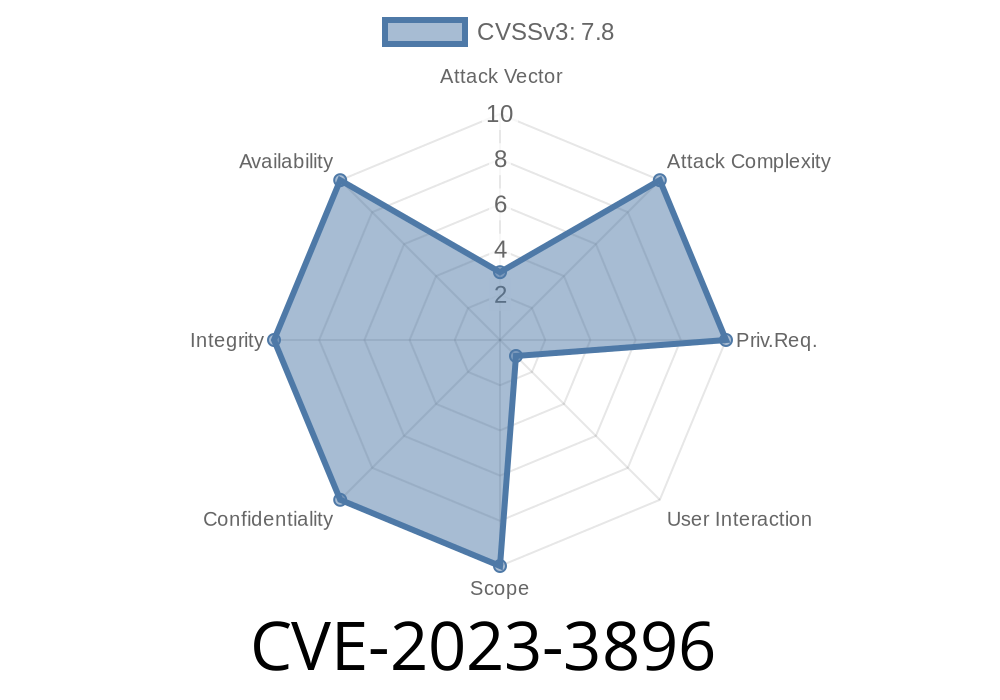
Vim is one of the most popular and powerful text editors in the world, widely used by programmers and system administrators. But even such a battle-tested tool can have dangerous bugs. In this long-read post, we’ll break down CVE-2023-3896, a divide-by-zero vulnerability discovered in Vim versions 9..1367-1 to 9..1367-3. This article will explain what happened, show relevant code snippets, and discuss how attackers can exploit this issue and how to protect yourself.
What is CVE-2023-3896?
CVE-2023-3896 is a critical bug that can cause Vim to crash if it processes certain specially crafted text files. Specifically, it’s a divide by zero error—a situation where the program tries to divide a number by zero, causing unexpected behavior, program crashes, or even opening doors for exploits.
References
- NIST National Vulnerability Database
- Vim GitHub Issue
- Vim Patch 9..1368
The Vulnerable Code
The vulnerability lies in Vim’s handling of multi-byte and multi-column text when processing autocommands and “virtualedit.” The function responsible—ml_get_len—could end up dividing by zero if passed malicious input.
A simplified version of the vulnerable code looks like this
int ml_get_len(line) {
    int col = ;
    int width = get_line_width(line);  // Can return  for some input
    int pos = ;
    while (pos < width) {
        pos += get_char_width(line, col);
        col++;
    }
    int result = some_value / width;   // Vulnerable: width can be zero!
    return result;
}
What happens if get_line_width() returns zero? When the code later tries some_value / width, it ends up dividing by zero. This triggers a fatal error, crashing the Vim process.
How Does Exploitation Work?
Attackers can deliberately craft a Vim buffer—or a file loaded into Vim—with specific content that tricks the code into entering this divide-by-zero condition. Since Vim often loads many different kinds of files (even remotely fetched ones, in some workflows), a specially crafted file can crash Vim just by being opened.
Here’s a minimal proof-of-concept file (“exploit.txt”) that could crash vulnerable Vim
:set virtualedit=onemore
:call append(, "X")
:normal! ggvGg_
:call feedkeys("\<C-g>")
A user opens this file, and Vim processes it automatically. When the vulnerable code path is triggered, Vim will attempt a division by zero and crash.
Why is this a Problem?
Vim is usually not run with root privileges, but a crash can lead to denial of service—especially in shared systems or in scripts that rely on Vim. Even without privilege escalation, an attacker could disrupt workflows or abuse the crash for more advanced exploitation (like information leaks or RCE, if chained with other vulnerabilities).
Patch and Protection
The issue was patched in Vim Patch 9..1368, which adds checks to prevent zero divisions:
// Fixed version
if (width > ) {
    result = some_value / width;
} else {
    result = ;
}
If you cannot update, do not open untrusted files in Vim, especially from email or the web
- Use file type detection with care, and disable automatic execution of scripts from files where possible
Conclusion
The discovery and quick patching of CVE-2023-3896 shows how even legacy software can run into dangerous bugs. The best defense is to keep your software up to date and avoid opening suspicious files in critical tools like Vim. If you maintain Vim on servers or in shared environments, make sure you've upgraded past the vulnerable versions.
Original References
- CVE-2023-3896 – NIST NVD
- GitHub Vim Security Advisory
- Vim Patch 9..1368 Commit
*If you use Vim, always keep an eye on security patches. One bug is all it takes!*
Timeline
Published on: 08/07/2023 13:15:00 UTC
Last modified on: 08/31/2023 19:15:00 UTC