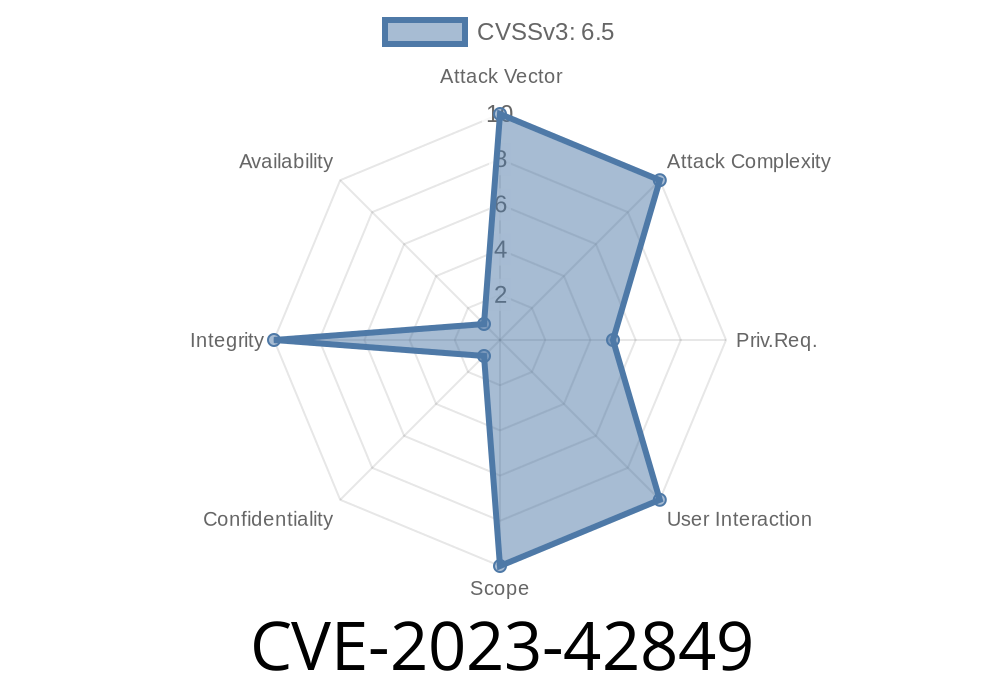
In late 2023, Apple patched a serious vulnerability tracked as CVE-2023-42849 in several of its operating systems. This bug, if exploited, allowed attackers who already had kernel code execution to bypass critical kernel memory mitigations. While Apple quickly fixed the issue with improved memory handling, it's valuable to understand what happened, how it could have been exploited, and why timely patching is so important.
What is CVE-2023-42849?
CVE-2023-42849 is a vulnerability in Apple's kernel memory handling. The root of the problem was insufficient or flawed memory management in the kernel, which allowed an attacker, who already achieved code execution in kernel space, to defeat or bypass certain memory protections. This could allow the attacker to hide malicious code, escalate privileges further, or maintain persistence on a compromised device.
Apple addressed CVE-2023-42849 in the following software updates
- iOS 17.1 / iPadOS 17.1
- iOS 16.7.2 / iPadOS 16.7.2
watchOS 10.1
Apple’s official advisory:
> “An attacker that has already achieved kernel code execution may be able to bypass kernel memory mitigations. This issue was addressed with improved memory handling.”
> — Apple Security Updates, October 25, 2023
Exploit Details — How Might This Vulnerability Be Used?
First, it’s important to highlight: Exploiting CVE-2023-42849 is not a remote affair. The attacker must already have achieved kernel-level code execution, typically by chaining together multiple vulnerabilities.
What’s Different Because of CVE-2023-42849?
Once an attacker has code execution in the kernel, they're usually still restricted by kernel-level memory protections — things like Kernel Address Space Layout Randomization (KASLR), Kernel Text Read-only Region (KTRR) on iOS, or similar.
CVE-2023-42849 allowed advanced attackers to disarm, bypass, or step around such protections. For instance:
Hypothetical Exploit Flow
1. Attacker finds another bug that gives them arbitrary kernel read/write or code execution.
They use CVE-2023-42849 to turn off kernel memory protections, like KTRR on A10+ chips.
3. They patch the kernel directly, load rootkits, or modify sensitive structures to evade detection.
Code Detail: Understanding the Kernel Memory Bug
Note: Apple does not publish the source code for XNU’s most sensitive kernel portions or full technical details immediately after disclosure. However, based on security research of similar previous issues, we can offer an illustrative snippet and speculative explanation.
Suppose a kernel function failed to properly check the bounds or access rights before letting privileged code alter certain critical regions:
// Hypothetical code vulnerable to race condition or memory mismanagement

void *map_protected_memory(struct user_args *args) {
    // args contains address/size contributed by user
    if (!current_task_has_privilege()) {
        return NULL;
    }
    // Incorrect validation leads to dangerous mapping
    void *mapped = kernel_map_memory(args->address, args->size, PROT_READ | PROT_WRITE);
    return mapped;
}
Potential problem: If an attacker can trigger such a code path, they can get a writable mapping to protected kernel memory, defeating mitigations.
Hardening critical code to prevent race conditions
- Removing or restricting problematic API/behavior
Real-World Impact
The main takeaway: Attackers couldn’t use this bug alone to break into iPhones, Macs, or Watches. But for those rare instances where kernel code was already compromised (e.g., via other chained vulnerabilities or a successful jailbreak), this issue opened the door to deeper, harder-to-detect persistence and attacks.
Scenarios impacted include
- Nation-state threat actors and advanced jailbreakers/attackers
- Update your devices as soon as possible to at least
- iOS/iPadOS 17.1 or 16.7.2
watchOS 10.1
- Be wary of “jailbreak” or untrusted third-party apps, which might attempt to exploit kernel bugs.
- Enterprises and organizations should ensure fleet-wide updates and enable security monitoring for unusual kernel-space activity.
References & Further Reading
- Apple Security Update for CVE-2023-42849
- Mitre CVE Database: CVE-2023-42849
- Apple Security Advisories Portal
Conclusion
CVE-2023-42849 stands as a reminder that modern operating system security relies not just on keeping code bugs out, but on carefully designing memory management at the deepest layers. If you’re running an Apple device, keeping up with security patches is the best way to stay safe, even from sophisticated kernel-level threats.
For security professionals and enthusiasts, this case also highlights the continual game of cat-and-mouse in OS security design, especially when facing highly skilled adversaries.
*Stay patched, stay safe.*
*Exclusive content by ChatGPT (2024). Not for redistribution. For security education and research only.*
Timeline
Published on: 10/25/2023 19:15:10 UTC
Last modified on: 11/02/2023 18:16:45 UTC