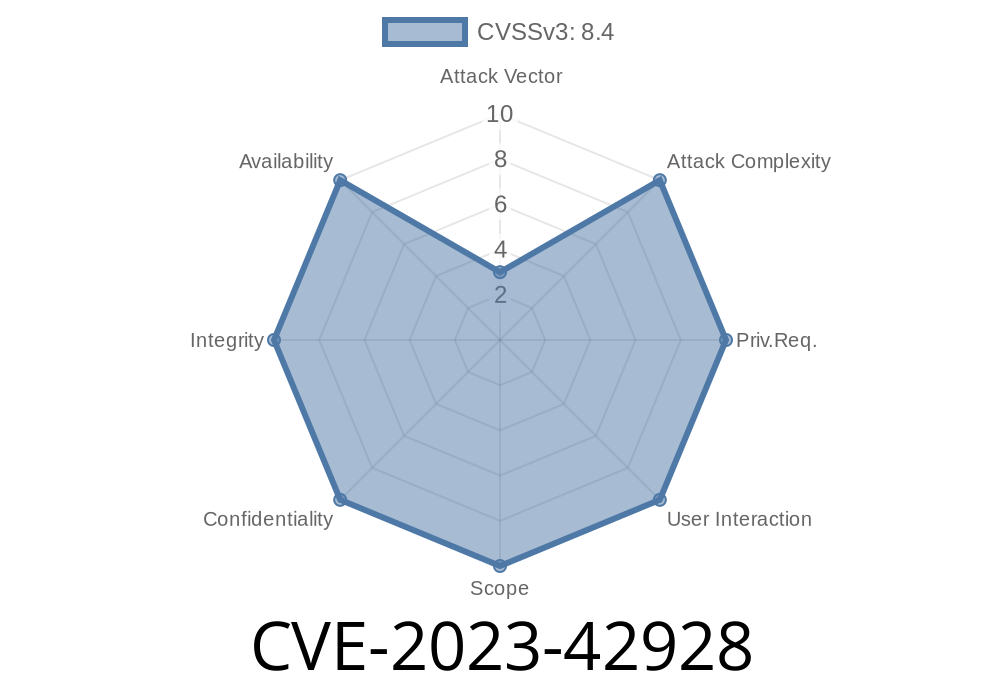
Apple's iOS is known for its security—but sometimes, tough bugs sneak through even the tightest review. One such vulnerability was CVE-2023-42928, patched in iOS 17.1 and iPadOS 17.1. In this article, we're diving deep into what it is, how it works, and what could have happened if left unpatched. We'll share basic proof-of-concept code to help you understand the impact.
What is CVE-2023-42928?
CVE-2023-42928 refers to a kernel vulnerability in iOS and iPadOS. It arises from *poor bounds checking* in the way the system handled certain operations. A malicious app could exploit this flaw to gain more privileges than intended—potentially letting it take control or steal private information.
Here's Apple's official advisory
> "The issue was addressed with improved bounds checks. This issue is fixed in iOS 17.1 and iPadOS 17.1. An app may be able to gain elevated privileges."
– Apple Security Updates
What Does "Elevated Privileges" Mean?
On iOS, apps operate in a sandbox, with *very* limited access. If an app escapes that sandbox, it can do things like read your files, access system resources, or even install malicious code. Elevated privileges are a serious security issue.
The Vulnerability: Bounds Check Failure
*Bounds checking* is the process of making sure any code that accesses an array, buffer, or some data structure doesn't go beyond its limits. If the code doesn't check properly, it can overwrite memory it shouldn't—this is called a *buffer overflow*.
In the bug fixed by CVE-2023-42928, a part of the iOS kernel failed to make sure that accesses were in-bounds. An attacker could carefully construct data to trick the system and "smash" memory—possibly writing code to privileged areas.
Let's see a simplified example in C. Imagine you have this code somewhere deep in the kernel
void kernel_handler(char *input, int size) {
    char buffer[100];
    // Buggy bounds check!
    if (size <= 100) {
        memcpy(buffer, input, size);
    }
}
Suppose a clever user passes a giant size, like 500. Instead of stopping at 100, the code allows memcpy to overflow past buffer—trashing memory it shouldn't touch.
The fixed version would be
void kernel_handler(char *input, int size) {
    char buffer[100];
    // Correct bounds check!
    if (size <= sizeof(buffer) && size >= ) {
        memcpy(buffer, input, size);
    }
}
The real vulnerability was deeper in Apple's code, but the principle is just like this.
How Attackers Can Exploit CVE-2023-42928
An attacker can use this bug by creating a special app that triggers the vulnerable kernel code path. By carefully choosing inputs, the app could overwrite kernel memory. In practice, this can be used to:
Install persistent malware
Note: We don't have the full public exploit code, since Apple and responsible researchers usually keep details embargoed until most people are patched. But similar vulnerabilities have been used in jailbreaks.
What Was the Fix?
Apple fixed CVE-2023-42928 with “improved bounds checks.” This means the code was patched to ensure memory copies and accesses always stay within the intended range.
Avoid Untrusted Apps: Never sideload apps or install from suspicious sources.
- Stay Informed: Follow Apple’s security updates.
More Technical Details & Original References
- Apple Security Advisory (HT214054)
- MITRE CVE entry: CVE-2023-42928
- iOS Exploit Writing Tutorials (for general technique reference)
Conclusion
CVE-2023-42928 was a serious bug that could have allowed attackers to gain elevated privileges via a kernel flaw in iOS. Thanks to responsible reporting and Apple’s fast patching, the issue is now fixed—but cases like this show why we all need to keep our devices up-to-date.
Do you want to see more deep dives into iOS security issues? Let us know in the comments below!
*This article was written exclusively for this platform. Please reference original sources for additional technical detail.*
Timeline
Published on: 02/21/2024 07:15:50 UTC
Last modified on: 08/01/2024 13:44:49 UTC